Showing posts with label Ukraine. Show all posts

Saturday, April 26, 2025

CRIMEA: LET’S LOOK AT THE FACTS

When Donald Trump came to office last January, it was with the promise that he would have the war in Ukraine over with in twenty-four hours. Like much of what Donald Trump says and promises, this statement too was empty, hyperbolic and always undoable.

Since then, however, he and what I call his non-negotiators—principally Secretary of State Marco Rubio, Vice-President JD Vance and Special Envoy Steve Witkoff—have sought to quickly end the conflict by scandalously siding with Russia’s Vladimir Putin and vilifying Ukrainian leader Volodymyr Zelensky. This approach ignores completely the fact that the Ukraine War is a war of aggression perpetrated by Russia’s totalitarian leader against a sovereign nation. It also disregards the direct challenge Russia’s aggression poses to NATO, and to the sovereignty of the nations of both Eastern and Western Europe.

The Trump administration’s stance further ignores the fact that Russia is a natural enemy of the US and of the West as a whole, engaged ever since World War II in an ideological and geopolitical struggle for worldwide influence and power that is opposed to the West’s own world leadership goals. There has only been one brief period of rapprochement following the fall of the Berlin Wall. But since the start in 1999 of the reign of Vladimir Putin, alternating between the offices of prime minister and president, the focus of the Kremlin has been on reviving Russian imperialism and on the reestablishment of a bipolar world.

Incredibly, considering this environment, the officials handling Trump’s virtual capitulation to Putin’s whims are now quoting a Russian talking point as the basis for their “negotiations”. Namely, that the war is not Russia’s fault at all, but Ukraine’s for seeking a place as a Western ally within the framework of NATO. Here, my friends, is where we should be seeing a huge flashing sign reading: What’s wrong with this picture?

What I mean by that, in case you’ve let yourself get confused about who Putin is and who the US is supposed to be, is that Ukraine’s wanting a closer relationship with the West is now, and should always have been, a good thing, not a fault. Ukraine is a key piece in the geopolitical puzzle, the very terrain which stands between Russia and renewed domination of Eastern Europe. In case you’re getting lost on the map, if Ukraine’s wanting to be in NATO sparked Russia’s war of aggression, letting Russia have Ukraine is the same as opening a gaping hole in Western defense against a repeat of Russian post-war imperialism, and of the czarist imperialism that preceded it.

In the manner of Herod making a reluctant gift to Salome of John the Baptist’s head, Trump administration officials conducting these non-negotiations are starting from a position of abject weakness by kneeling before Putin with Crimea on a platter. Their sorely uneducated notion is that Crimea has always pretty much been Russian anyway, and besides, Putin grabbed it a decade ago, so, hey, finders keepers.

But is that really the case? The answer is, no.

The fact is that prior to Russia’s original imperialist advances, Crimea was inhabited by various ethnic groups, but principally the Crimean Tatars. They were a Turkic people who established the Crimean Khanate in the fifteenth century. Indeed, the name Crimea is derived from the Turkish root word Qirim. Crimea was a vassal khanate of the Ottoman Empire from 1478 to 1774. The Ukrainian region was, then, part of the Ottoman Empire’s broader sphere of influence, not that of the Russian Empire.

It was only through conquest, not by legal or consensual means, that the Russian Empire annexed Crimea in 1783, following the Russo-Turkish War (1768–1774).  At the end of that war, the Ottoman Empire had granted Crimea independence through the Treaty of Küçük Kaynarca (1774). So the Russian annexation nine years later was the first instance of Russia’s simply grabbing sovereign Crimea for its own strategic purposes. It was that annexation that marked the start of a Russian presence on the peninsula, but contrary to Putin’s narrative, that presence wasn’t based on any inherent or historic Russian claim to Crimea.

Crimean Tatars
The Putin myth echoed by Trump officials that ethnic Russians have always formed the population of Crimea is also spurious.  While it is true that Cossacks traditionally formed part of the Crimean population, along with the native Turkic Crimean Tatars, and while it is also true that Cossacks took part in Russian military campaigns throughout history, the Cossacks cannot be counted as Russians. They were a diverse group of predominantly East Slavic people. A mix of peasants, escaped serfs, and some nobility, they emerged as a nomadic society in the fifteenth century, banding together for mutual protection. They were a quasi-military and semi-nomadic society that primarily inhabited the Ukrainian steppes, venturing as well into Southern Russia. While the Cossacks still exist, with various levels of organization and activity, their communities have been reconstituted and adapted to modern society. 

Highly independent and of autonomous spirit, while not strictly mercenaries, the armies of the Cossacks often fought for a variety of regional powers, including Russia, in exchange for self-governance and a free lifestyle. They played a significant role in the history of the region, including participation in conflicts with various states in resistance against foreign invaders. But they formed part of no other nation.

Cossacks - quasi-military, semi-nomadic people

Nor is the term "Cossack" Russian. It is derived from the Turkic word kazak, which, literally translated, means adventurer or free man. Furthermore, East Slavs, the ethnicity to which the Cossacks pertain, were once part of a federation of principalities known as Kyivan Rus', a medieval state that existed from the late ninth to the mid-thirteenth century. It emerged as a powerful confederation with the city-state of Kyiv (today the capital of Ukraine) as its capital, and its territory encompassed much of what are today Ukraine, Belarus, and parts of Russia. 

That said, the Cossacks weren’t indigenous to Crimea. Having taken  part in Russian military campaigns in the area, some of their number eventually settled on or near the Crimean Peninsula, but their presence does not give Russia a legitimate claim. Especially since some of the campaigns the Cossacks took part in where Russian efforts to subjugate and/or displace the native Crimean Tatars.

As for the Tatars, they were the dominant ethnic and political group in Crimea for centuries, and still formed the majority of the population until 1944, when Soviet strongman Joseph Stalin engineered their mass deportation. It was, then, through an act of what is today known as ethnic cleansing, rather than through any legitimate transfer of sovereignty, that the Crimean region’s demographic balance was tipped toward a predominantly ethnic Russian population.

Stalin's deportation of the Tatars
From a strictly legal standpoint, ten years after Stalin’s annexation of Crimea in 1944, the Presidium of the Supreme Soviet (governing body of the USSR) transferred the peninsula back to Ukraine in 1954. Basically, the Supreme Soviet removed Crimea from the Russian Soviet Federative Socialist Republic (RSFSR) and placed it once more under the original control of Ukraine (at the time, the Ukrainian Soviet Socialist Republic). Ukraine’s claim to Crimea was never questioned after that, until Putin’s decade-long challenge to Ukrainian sovereignty—not by the Russian Federation after the fall of the USSR in 1991, nor by any international body.  

What is more, International law recognizes Crimea as part of Ukraine. Following the collapse of the Soviet Union in 1991, Ukraine inherited Crimea as part of its internationally recognized borders. Russia itself recognized these borders in multiple treaties, including the 1994 Budapest Memorandum, in which Russia agreed to respect Ukraine’s sovereignty in exchange for Ukraine giving up its nuclear arsenal.

Bearing all of this in mind, Russia’s 2014 annexation of Crimea and its armed invasion of other parts of Ukraine’s sovereign territory, using devastating military force, are violations of international law, and have sparked the largest major ground war in Europe since World War II—one involving a world-class nuclear power. Russia’s war of aggression on a sovereign country has drawn widespread condemnation in the international community. The United Nations has passed a resolution (R68/262) reaffirming Ukraine’s territorial integrity and declaring invalid a referendum held by Russia in Crimea to try and justify its annexation.

Crimean Tatar children in traditional dress
In short, Russia’s claim to Crimea and all other areas of Ukraine that it has usurped by military force since 2014 is historically, ethnically, legally and morally illegitimate, and the Trump administration’s attempts to justify Russia’s actions based on some “might makes right” theory that forms part of Trump’s authoritarian view of the world, fly in the face of international law, of respect for the sovereignty of free nations, and of America’s traditional role as the erstwhile leader of the Western world.

Worst of all, Donald Trump admires authoritarians. It’s a schoolyard philosophy, a bully’s attitude of joining other bullies in ganging up on the weaker kids in order not to have to stand up to the other bullies himself.  It’s a stance that not only makes the US Russia’s vassal, but which is also tantamount to appeasing a dangerous, megalomaniacal imperialist.

It is easy enough to understand if we stop pretending this is business as usual and start realizing that Trump identifies with Putin because Trump has megalomaniacal expansionist delusions of his own when it comes to our neighbors. There is all too obviously no difference between Trump’s feverish, openly-stated ambition of taking over Canada and making it a state, and Putin’s realized dream of invading Russia’s sovereign neighbors and making them part of his empire.

Appeasing bullies has never worked. There is no better example to quote than that of another megalomaniacal expansionist who invaded his neighbors prior to World War II. The US and Europe alike appeased Germany’s Adolf Hitler when he took over Austria. They turned a blind eye as well when he went on to invade Czechoslovakia, apparently hoping if they let him violate the sovereignty of a couple of nations, he would somehow get it out of his system. It was a fatal mistake, one with the most catastrophic consequences the world has even known.

Western Europe needs to stop appeasing not only Vladimir Putin, but also Donald Trump, if the US itself continues to fail to rein in its rogue leader. European leaders must stop hoping against hope that Trump will have some sort of epiphany and suddenly begin exercising the kind of pro-Western leadership the US consistently produced before the Era of Trump. For as long as Trump is leading it, the US is no longer a reliable ally, and does not have the best interests of the free world in mind. If anyone is to save Europe from the new wave of Russian imperialism—which, make no mistake, will not end in Ukraine if Ukraine is abandoned to its fate—it will have to be Western Europe itself, and the time to step up, sideline Trump, and draw a line in Ukraine is now.  


Thursday, February 20, 2025

THE VIEW FROM TRUMPWORLD


For many educated Americans with even a passing knowledge of US foreign relations, President Donald Trump’s latest machinations on the world  stage are very likely baffling.  If we are baffled, however, it is because we are failing to understand that Trump doesn’t see the world from the point of view of a world-class leader, but rather, from that of a mobster.

A lot of us were shocked and infuriated during his first term when he dissed our Western allies, while embracing every murderous dictator he had ever longed to meet. It was clear that these were “his people”, and that it mattered little to him what the people of the United States had sacrificed in the past to help democracy and freedom ring throughout every Western nation, following the worst war in the history of the world.

We watched him disrespect the memories of men and women sacrificed from our fathers’ and grandfathers’ generations, and belittle the pain, hardship and suffering endured by those like my father (and yours), who put their lives on hold to fight fascism and the expansive imperialism of a madman in Europe, and survived. He belittled that cause and our elders, calling them “losers and suckers” and asking rhetorically “what was in it for them.” Those brave people, the ones who understood the value of defending the free world, and who continued to support that cause, when the Soviet Union crushed the freedom of Eastern Europeans following World War II, back when US presidents understood that Russian tyrants were our enemies.

We witnessed too, his denigration of the noble institution of NATO, which he dismissed as being over and of no importance to the US—that great alliance which has been the mortar holding together Western peace and democracy for the past seventy-five years. An all-for-one-and-one-for-all pact in which the US earned its leading role with the blood we spilled on European soil in two world wars. A role which has been almost totally responsible for launching the US to world leadership status on the global stage.

Trump shocked patriotic and democratic Americans in those first four years by speaking in disparaging and arrogant terms to those previously highly respected Western allies, while at the same time referring in the most glowing of terms to murdering despots like Vladimir Putin and Kim Jong Un (with whom he said he had “fallen in love”), and like China’s Chairman Xi (whom he admired for becoming leader for life and suggested perhaps the US should follow suit with him). He preferred Russian talking points to US intelligence, revealed things to Putin that the Kremlin never should have known, and mishandled a treasure trove of classified documents putting American lives in danger.

And then he threw the country into chaos by, for the first time in history, refusing to participate in the peaceful transfer of power, after losing an election, and created further chaos by inciting an insurrection designed to halt certification of the election he had lost, apparently bent on remaining in office as an ad hoc authoritarian ruler.

The majority of Americans breathed a sigh of relief when he was finally gone, and talked about how our democracy had dodged a bullet. It had been a close call but democracy was intact and we could all sleep easy.

But then, something utterly insane happened. Slightly more than half of voters who actually voted in the 2024 election put this despot back into office, not caring that he was a convicted felon, a court certified rapist, a man indicted on charges of election tampering, inciting an insurrection, and gross mishandling of America’s secrets. None of that mattered because people were worried about eggs being more expensive than when he was in office, and about whether they would be able to keep affording fuel for their gas-guzzling SUVs and giant pick-up trucks.

Trump ran on that. But anyone who was even half-awake during his first term was at least vaguely cognizant of the fact that, if Trump’s lips are moving, he’s lying. That is, except when he talks about using the power of State to destroy his personal enemies, or when he talks of dismantling any part of American democracy that keeps him from doing exactly what he pleases with no consequences. Those are promises—vendettas—that he is serious about keeping.

How all of that is affecting democracy at home is becoming more shockingly evident by the day. Adding insult to injury for every small-d democrat in the nation,  Trump is already, after only a month in office, describing himself in monarchic terms on Truth Social, where, referring to himself,  he wrote LONG LIVE THE KING!  That message was repeated under the White House’s official X handle captioning a Time-style fake cover with an illustration of Trump wearing a crown. In the same flurry of narcissistic, self-congratulatory messages, Trump also quoted—without saying he was quoting him—Napoleon Bonaparte saying,   “He who saves his Country does not violate any Law.” Napoleon was, of course, also a narcissist, an emperor and a despot.

The consequences of Trump’s dictatorial actions on the home front will even shortly begin to become evident to his most fanatical followers when they start to understand that what he does will negatively affect them as well where the rubber meets the road. Especially when the high prices they were so worried about and that were a decisive factor in his re-election, are not going down. On the contrary, thanks to the president’s reduction in taxes on the rich and soaring tariffs on international trade, prices can only be expected to rise.

But they’ll also start to feel the pain of their decision to return him to office when their Social Security and health care benefits are affected, when the cost of their medication rises, when their farming subsidies are cut, when their flights are canceled because of a hamstrung Federal Aviation Agency, and when every government office they must deal with is rendered totally ineffective because it has been stripped to its bare bones.

Returning to the foreign relations front, just because common everyday people have no idea of the importance of America’s status on the global stage doesn’t mean that it is unimportant, since our leadership in that arena is what defines US power and its ability to continue to shape democracies abroad and to influence the world through its allies. Trump clearly doesn’t care about that. He thinks of the US as a big business to be run as ruthlessly as he and Elon Musk have always run their own. His attempt to turn US relations with Ukraine into a protection racket in which he conditions aid—already earmarked by Congress—on President Zelensky’s signing over half of the country’s wealth of natural resources to him, should make every American feel ashamed. Every American but him, of course, because if there’s something we can be assured of, it’s that Donald Trump has no shame. And it’s not a first by any means because he already sought to blackmail Zelensky during the earlier Trump administration, by withholding vital defense aid unless the Ukrainian president dug up dirt on the son of his political rival, Joe Biden.

Worse still, he is now blaming the victim for causing the crime. (If you’ve been paying attention to his take on sexual assaults and molestations he and his cronies are accused of, you’ll understand that this stance is nothing new for him). Let’s be clear: The reality, the unvarnished facts, are that Russia, an imperialist power, run by a dictator, and a natural enemy of the United States, invaded Ukraine, a sovereign, democratic nation, unprovoked, and based on the sole self-justification that Ukraine was seeking closer ties to the West, and that it had cast off a puppet government put in place by the Kremlin. Any other interpretation is political spin and an out-and-out lie.

Yet, Trump now insists that Ukraine “never should have started” the war of Russian aggression against it. And that, instead of fighting tooth and nail against that invasion, it should have rolled over and “made the deal” that Putin offered. Which for any sovereign nation, was no deal at all, but rather capitulation to Russian dominance.

Ukraine is not, of course, the only place where the US stands to lose ground in the world due to the ham-handed fashion in which the new US thugocracy is mishandling international relations. Eastern European leaders are already on alert, since, with the US (actually Donald Trump, not the US as such) taking the side of Vladimir Putin and accepting Russian propaganda talking points as truth, if Ukraine falls, there is no way an emboldened Putin will stop there, or until all of Eastern Europe is once again under Russian dominance.

Meanwhile, Western European leaders have been left scrambling and are holding emergency meetings to decide how to approach this new reality. After reestablishing firm US-European and NATO ties during the four years that Joe Biden sought to pick up the pieces of American diplomacy shattered under Trump’s earlier four years, they find themselves back at square one after the unthinkable happened and Americans brought a convicted felon back to office again. Clearly, they have to be thinking that, no matter what happens next, the US is no longer a reliable ally. As such, they are now discussing ways in which Europe can disengage from US dominance and start fending for itself in the face of new threats of Russian expansionism.

But I am concentrating on the Ukraine situation because it is a case in point for how Donald Trump views the world. And as I said at the beginning of this essay, his viewpoint is not that of a world leader, but of a mobster.

Let me explain: Trump sees the world not as the sophisticated strategic game that it is, in which strong alliances are vital to the mutual defense of democratic nations. First of all, Trump is not a believer in democracy—not that he is above using the democratic process to gain access to power. It’s just that once in power, he no longer plays by democratic rules. So for Trump, organizations like NATO, the UN, the Organization of American States, and any agency within the government he heads designed to halt corruption or to place checks and balances on the powers that be, are meaningless.

On the contrary, Trump is incapable of complex thinking. Things for him are quite simple. As simple as they are for any mob boss—it’s no coincidence that Trump has more than once expressed his admiration for 20th-century bootleg mob boss Al Capone (clearly and conveniently ignoring the fact that “Scarface” died in prison on a federal rap). Capone embodied everything Trump admires: raw power backed by violence, accumulation of a vast fortune through any means necessary, lawlessness, and accountability to no one but himself.

Trump, then, doesn’t identify with his predecessors. He doesn’t see himself as the elected leader of a free and democratic nation, guided by an ironclad Constitution and controlled in his actions by the checks and balances of a carefully created three-branch system. He sees himself simply as the head of the greatest military power on earth, and as such, as the Boss, the capo dei capi, the Boss of all bosses.

It follows, then, that he has little or no respect for any of the “minor bosses”—the European leaders, for instance, who, throughout post-war history, have been our friends and allies. If he is the Boss, then they are beholden to him, and, in his simple mind, are worthy only of his contempt and his vengeance if they fail to toe his line.

That means that he sees the world as being divided, much like the mob, into “families”, each with its own turf and its capo dei capi, and it is only for the other Bosses that he reserves his respect. For Trump, there are three “families”. America, Russia and China. Their bosses, Putin and Xi, are, if not his friends, then at least his colleagues, his equals, and he respects their “businesses”, like they respect his, even if, as in the case of China, he exacts certain payments for allowing their businesses to overlap. Business, after all, is business. But they keep their territories clearly marked and try their best to keep out of each other’s way, at the expense of the minor bosses, whom they see as their underlings. Because a turf war between the three families would be “bad for business”.

This is why I’m using Ukraine as my example. Because in Trumpworld, Ukraine doesn’t count. And the only sovereignty it has is because the Boss on its turf allows it to have it. And it can only have it if the Boss is happy with its performance. For Trump, Ukraine, and, very likely, all of Eastern Europe, belongs to the Russia Boss. Asia belongs to the China Boss. And the West belongs to the US Boss. The Middle East is something of a no-man’s-land, but the three are careful not to step on each other’s toes there either—hence Trump’s abandoning of Syria to its Russian regime oppressors during his first term. The fact that it all backfired under Biden is Putin’s problem, but it wasn’t the America Boss standing in the Russia Boss’s way, and the people of Syria be damned. Same goes for the Ukrainians in the simple black and white rules of mobster ethics.

You might say, then, that Trump, a mobster dolt looking to set up a thugocracy, with nobody really doing much to stop him, thinks he’s playing checkers on the world game board. Xi and Putin, meanwhile are playing chess, and Putin has just put Trump in a check move that leaves America’s king in danger of capture.


Friday, December 23, 2022

(AD)DRESS CODE

I cannot believe how many jerks in Congress and on TV were worried about how Zelensky was dressed when he appeared before Congress.

Really???

That morning the guy was on the front lines handing out medals to true heroes while all of these sleazes were taking up wasted oxygen instead of worrying about how to support Ukraine and help its brave people stop Putin in his tracks.

Zelensky is one of the truest examples of a modern-day hero, a David who has taken on Goliath. My only irate question is, who gives a flying fuck what he wore to Congress? As if scores of senators and representatives haven't already violated and spat on any pretended decorum, integrity and sanctity that that body ever might have presumed.

Saturday, March 12, 2022

APPEASEMENT - HISTORY REPEATS ITSELF IN UKRAINE


The tragedy that is unfolding in Ukraine at the moment is the consequence of the kind of ruthless, murderous, criminal behavior that the world—shocked though everyone seems to be—should by now have come to expect from Russian dictator Vladimir Putin. It is a repetition of the kind of unprovoked invasion and scorched earth tactics that he has commanded during his twenty-two-year reign in places like Chechnya and Syria. And it mirrors the same lack of concern over geopolitical consequences and humanitarian considerations that Putin demonstrated nearly a decade and a half ago in Georgia, where he launched the first European war of the twenty-first century.

But leaving aside the similarities between the ruthlessness that Putin has exhibited in Ukraine and those he has employed in earlier armed interventions, there are also historical similarities between how the world is reacting to this latest naked aggression in Europe by the Putin regime, and the earlier policy of appeasement that permitted unfettered expansion by the armies of the most undisputedly emblematic dictator of the modern era.

Since the two world wars fought in the twentieth century, “appeasement” has become a technical term for any diplomatic policy that is based on making concessions to an aggressive power in order to avoid armed conflict. The term’s most iconic historical application has been as a means of describing the diplomatic policies of the then all-powerful British Empire in dealing with the rapid rise of fascism in Germany and Italy and the brutal expansionist doctrines instituted by both nations—but particularly by Nazi Germany—in the run-up to World War II.

The scapegoat for the appeasement shown toward German dictator Adolf Hitler and his Nazi regime has traditionally been British Prime Minister Neville Chamberlain, who was heading the British government when Nazi Germany’s aggression in Europe could no longer be ignored and spilled over into the start of World War II. But truth be told, previous British prime ministers, including Ramsay McDonald and Stanley Baldwin, had preceded Chamberlain in their hands-off approach to the brutal rise and aggression of both European dictators, embracing appeasement even as both Hitler and Mussolini consolidated their power in Europe in the period between World War I and World War II.

In all fairness, those were different times, the nineteen-twenties and thirties, when the world didn’t yet have the historical context of World War II to look back on. World War I was still being thought of as the “war to end all wars” and as “the Great War”, and most people at that time couldn’t have imagined that Germany’s European aggression would once again spark a worldwide conflict that would prove far more deadly and horrific than the first one. Appeasement, at that time, was not seen as “backing down” in the face of naked aggression, but rather as a policy aimed at preserving the peace that had cost all of Europe such tremendous sacrifice during the First World War.

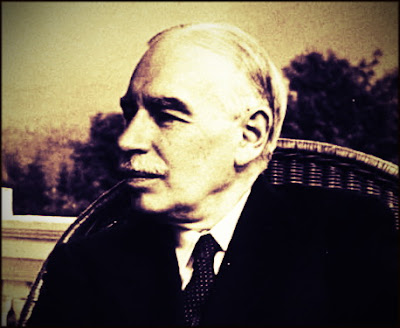
Appeasement was also seen as the price Europe was paying for the exaggerated and highly vindictive sanctions and contemptuous treatment to which the Allies had subjected Germany following the Great War. There was no more outspoken critic of those sanctions than renowned British economist John Maynard Keynes,

John Maynard Keynes
whose book, The Economic Consequences of Peace, published in 1919, was to become a worldwide bestseller. In that book and at the 1919 Paris Peace Conference, where he was the British Treasury delegate, Keynes argued that applying a “Carthaginian peace” with the purpose of further crushing an already defeated Germany would lead to new consequences for European peace in the future. He advocated not imposing crippling reparation payments that would impoverish the German people and lay waste to the country’s economy, or at least limiting those reparations to no more than two billion pounds.

Keynes’ advice fell on deaf ears among the Allies in their drafting of the Treaty of Versailles and other associated treaties. And the terrific hardships that the people of Germany suffered in the post-World War I years are historically cited as the main social and humanitarian catalyst that permitted Hitler to become the most powerful man in Germany and the country’s undisputed Fuhrer.

As Great Britain and the US began, during the late nineteen-twenties, to visualize the consequences of the Treaty of Versailles, appeasement commenced to be viewed as the most desirable way to avoid escalating new hostilities between Germany—allied with fascist Italy—and the rest of Europe. Appeasement garnered powerful support among the British upper classes, including the House of Lords, British royalty, and big business, at the time headquartered in the City of London. Conservative media, such as the BBC and The London Times, were also supportive of appeasement as a tool of peace.

The left and the lower and middle-class public at large were, however, far less convinced of the wisdom of permitting Nazi Germany to aggressively expand without drawing a line in the sand. As Hitler advanced beyond German borders, much of the liberal press and popular public opinion decried the former Allied powers’ increasing failure to contain Hitler and drive Nazi Germany back, Prime Minister Chamberlain could think of nothing better to do than to impose censorship on the liberal press, meet with Hitler in Munich and then declare himself the architect of “peace in our time”.

Much in the way that Putin is today seeing the desire of the West to maintain world peace and not get into a shooting war with him as acquiescence that he can take advantage of in order to prosecute his expansionist policies, Hitler seized the opportunity provided by appeasement to annex Austria, parts of Czechoslovakia, Bohemia and Moravia, before invading Poland, which finally became a bridge too far, and sparked the start of World War II.

Historians remain divided on the issue of appeasement, however, with one school of thought positing that the policy of appeasement was precisely what permitted Nazi Germany to become so powerful and to gain such a European foothold while the other school of thought is that in the run-up to the war, Hitler’s Germany was already so powerful that early engagement might have permitted him to win the conflict, while appeasement gave Europe time to better prepare for what was, in the end, an unavoidable conflagration.

Like Hitler in Germany following the Treaty of Versailles, Putin built his popular strength as a dictator on the rubble of the fallen Soviet Union. As a ranking intelligence officer in the former KGB, Putin worked closely with former head of state Boris Yeltsin, Russia’s first freely elected president following the fall of the Berlin Wall, and managed to become Yeltsin’s protégé. His reputation as a strongman and eminence gris behind Yeltsin placed him first in the line of succession when Yeltsin, in ill-health and highly unpopular after a crippling recession in Russia that some economists have compared to the Great Depression in the US and Europe, resigned from office in 1999. In exchange, one of Putin’s first acts was to provide immunity from prosecution to Yeltsin, who was facing possible charges of corruption and dereliction of duty.

If Yeltsin had tried unsuccessfully to convert Russia from a seventy-five-year-old communist regime to a free market economy overnight, Putin took a more pragmatic approach, taking advantage of the more open market to position himself at the forefront of a highly lucrative oligarchy that helped him consolidate his power and made him, as well as his cronies, a very wealthy man into the bargain. Although Yeltsin had considered the Soviet era over and done with, if anyone was paying attention, it was easy to see that, despite his taste for capitalism, Putin was nostalgic for the enormous power that the Soviet Union had wielded on the world stage, and which had waned to only a shadow of its former self under the post-Berlin Wall Russian Federation. In this regard, cavalierly relegating the two world wars to a position of secondary importance, Putin once said that the fall of the Soviet Union had been, “the greatest geopolitical catastrophe of the century.”

He also took clever advantage of the so-called “glasnost” policy first introduced by his predecessors Mikhail Gorbachev and Boris Yeltsin, which actively sought ever-closer ties with the West. He established strong trade ties with Western Europe and the US and succeeded in making some of the most powerful countries in Western Europe—most notably Germany—largely dependent on Russian oil and gas, the Federation’s main export.

He was at first seen in the West, then, as the new face of Russian democracy and capitalism and gained “most favored nation” trade status with Western nations including the United States—a status that, incredibly, even as he lays waste to Western ally Ukraine, he continues to enjoy, and it is only now that the US and Western Europe are reluctantly considering revoking it. It wasn’t until he was certain that he was in the best position possible to ensure that any Western moves against him would not come without injury to Western economies that he began to reveal who he really was—a ruthless, anti-democratic dictator with an agenda aimed at rebuilding the Russian Federation to the level of power once wielded by the Soviets, but without the all-pervading communist Politburo to hamper him.

Establishing a political partnership with Dmitry Medvedev in which they basically passed the offices of prime minister and president back and forth between them for nearly two decades—a “tandemocracy” as international journalists dubbed it—Putin was clearly always the strong man and Medvedev his shill. Two years ago, Putin decided that he had consolidated sufficient autocratic power to dispense with this farse and pushed Medvedev, who has since been demoted to deputy chairman of the Russian Security Council, to resign. Medvedev did so, saying that he was leaving office to permit Putin to introduce constitutional changes—obviously designed to further entrench him in power permanently.

"Strategic target" - a Ukrainian kindergarten
Putin’s invasion of Ukraine is utterly unprovoked and brutal. His main goal in doing so is to prevent Ukraine, as an independent sovereign nation, from seeking membership in NATO and the European Union and thus from becoming a basically Western country. A large country of more than forty million people with valuable resources, Ukraine was one of the many Eastern European nations dominated by the Soviet Union from World War II until the end of the cold war, when, like other former satellites of the USSR, Ukraine declared its independence from Moscow.

As of the start of his reign in 1999, however, Putin set to the task of re-introducing Russian domination by infiltrating Ukrainian politics and eventually installing a puppet government in Kyiv that was loyal to Moscow and beholden to Putin. In 2013, mass protests erupted in Kyiv and other Ukrainian cities, the main purpose of which was to seek closer ties with the West, and particularly with the European Union. Although opposed by the ethnic-Russian minority—mostly centered in Eastern Ukraine and Crimea—this movement became a full-fledged civil uprising known as the Revolution of Dignity, in which at least ninety-eight people were killed, a hundred went missing and some fifteen thousand were injured. In 2014, the protests boiled over into what was essentially a popular coup d’état, as a result of which Putin’s surrogate Viktor Fedorovych Yanukovych was removed from power and fled to Moscow.

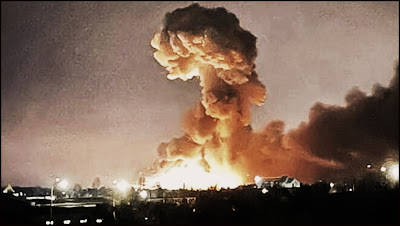
Putin is using thermobaric bombs that crush the 
lungs of anyone within their killing range.

New—this time free—elections were called, and Petro Poroshenko won by more than fifty percent of the votes, running on a pro-European Union platform. Since then, Putin has actively and violently moved to retake Ukraine by force, first through the direct annexation of Crimea and by providing material and military support to pro-Russian insurgencies in Eastern Ukraine, and now, with the strengthening of pro-Western overtures under the government of President Volodymyr Zelenskyy, by means of the full-scale invasion and destruction of the country as a whole.

The excuse of NATO for not doing more to militarily help the Ukrainians—among other things, at least establishing a no-fly zone so that cities in that country don’t have to contend with Russian air support for its bloody invasion—is that Ukraine isn’t a NATO country. But it’s not for lack of trying on the part of Kyiv. Since once and for all declaring its independence from Moscow, the main thrust of Ukraine’s foreign policy has been to be accepted into the West.

A Ukrainian school hit by Russian cluster bombs.
Clearly, Ukraine would be a positive addition to the West. It is the second-largest country in Europe by area (after Russia). Its population has free access to excellent education. Full secondary school is compulsory, and the country has a literacy rate of about ninety-nine percent, compared to the US with only an eighty-eight percent literacy level. Higher education is free with admissions being provided on a competitive basis. The country’s Lviv University was established in 1616, and the rest of Ukraine’s major cities also host centuries-old institutions of higher learning—a total of nearly one hundred fifty, with a student population of eight hundred fifty thousand.

The country boasts significant natural resources, including lithium, natural gas, kaolin, timber, and an abundance of arable land with a temperate climate that permits a long growing season—even if in certain regions it is vulnerable to environmental issues such as inadequate potable water, air and water pollution, and radioactive contamination in the northeast due to the Chernobyl atomic reactor disaster that took place in 1986, while Ukraine was still dominated by the USSR.

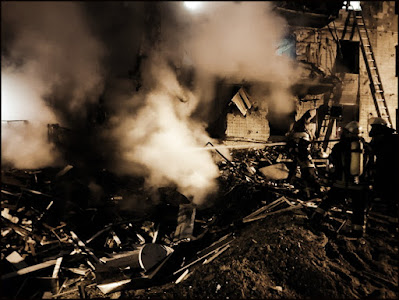
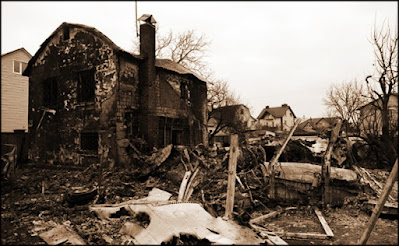
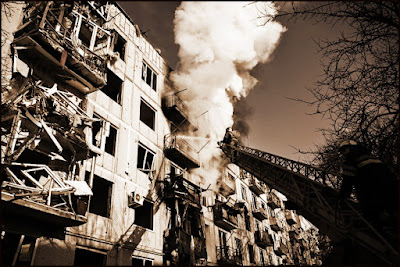
A bombed out apartment building
Ukraine has a score of major industries including power-generation, fuel, ferrous and non-ferrous mining, chemical and petrochemical production, natural gas, machine-building, metallurgy, forestry, woodworking, wood pulp and paper production, construction materials, and food production, among others. The country also has a massive high-tech industrial base in such areas as electronics, arms production and aerospace. 

Unfortunately, its economic performance fails to reflect its very real potential since it has always been subject to the vicissitudes of the Russian economy or has been punished by Russia for seeking its independence, a problem that Western Europe and the US have failed to systematically offset. Add to this the fact that, in just three weeks, Russia is estimated to have destroyed a hundred billion dollars in Ukrainian economic assets—or a little less than two-thirds of the GDP—and Ukraine is currently the poorest nation in Europe.

So why hasn’t the EU done more to embrace Ukraine and make it a progressive Western emerging economy, since the country is not only willing but eager to do just that? Again, the answer is appeasement. It is the West caving to Putin’s refusal to allow a sovereign nation to exercise self-determination. Had the West moved in 2014 to bring Ukraine into the European Union, and more importantly, into NATO, it would have taken a much bigger Russian commitment to war than the one it is now making by ruthlessly invading Ukrainian territory.

While it may be a laudable goal to try and avoid Western armed conflict with one of the world’s two most advanced nuclear powers—especially considering that it is someone as ruthless and brutal as Putin who currently has his hand on the Russian nuclear trigger—as happened with Hitler before World War II, appeasement very likely will prove to be a policy of postponement rather than of avoidance in facing down the Russian dictator. Seeing Putin’s performance to date, it is very hard to imagine that following NATO appeasement in Ukraine, he will not want to test the Western alliance’s resolve in acting on its all-for-one-and-one-for all Western defense policy.

Russia with a defeated Ukraine would pose an immediate threat to Moldova, Estonia, Latvia, and, thanks to its alliance with Belarus, Lithuania. Poland would also be immediately vulnerable, as Putin sought to make good on his dream of returning to the past glory of the powerful Soviet Union.

The choices are clear: How NATO in general and the US in particular react to further Russian expansion will almost certainly either lead to a NATO-Russian shooting war, or it will lead to the nullification of NATO as a viable body for the protection of Western security and to the severe erosion of world security as a whole.

Meanwhile, Ukraine remains the sacrificial lamb in a still cold war between East and West. Putin is determined to use unadulterated state-terrorist tactics to bring Ukraine to its knees, while the West appears to be content to stand by with its arms folded in the hope that Putin will shoot himself out in that country and perhaps not then push on to attack others. 

The price of both opposing strategies is tragic. Ukraine, in just three weeks, has suffered indiscriminate bombing in sixteen of its twenty-five regions. As in Syria and Chechnya in the past, Putin’s war isn’t nearly as much on the Ukrainian military as it is on the Ukrainian people. His bombs have repeatedly destroyed apartment blocks, food and water supplies, heating facilities, stores and shops, markets, schools, churches, and, at last count, at least twenty-four hospitals. His attack on that country is the largest in any European country since World War II, already generating two and a half million refugees, predominately the elderly, women and children. In some locations, like the city of Mariupol, it has given rise to unprecedented humanitarian crises. Also in Mariupol, in just three days of Putin’s siege, at least one thousand three hundred civilians were slaughtered, and Ukrainian officials were forced to start creating mass graves to handle the war dead.

In short, the valiant people of Ukraine—who only sought to live in peace and democracy—and their courageous president are being sacrificed as pawns in the latest East-West power struggle, constituting the most heart-breaking human tragedy in Europe since the end of World War II.  


Tuesday, March 8, 2022

A SOMBER WOMEN’S DAY AND AN INTERNATIONAL OUTRAGE


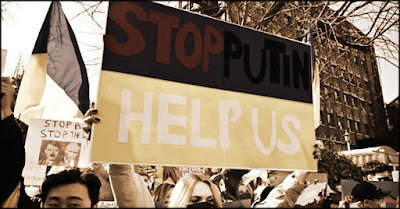
How very sad on International Women's Day to see millions of refugees, mostly women and children, as their men stay behind to defend their homeland, fleeing the unprovoked wrath of yet another madman dictator who is placing the security of people everywhere in imminent danger.

Tuesday, March 1, 2022

TRUMP AND PUTIN FOREVER


Former US President Donald Trump's half-hearted condemnation of Russia's crime against humanity in Ukraine shows once again where his loyalties lie: basically, with Trump (uber alles).

Trump, as a would-be autocrat, has consistently placed his loyalty to other authoritarians over American allegiance to the nation’s traditional allies. Throughout his disastrous presidency, he systematically undermined strategic American foreign policy, attacked America’s allies in Europe, blackmailed and belittled the country’s friends in NATO, withdrew American support for major international accords—such as the Paris Climate Accords and the US-sponsored Iran Nuclear Agreement—and publicly proclaimed his belief of Vladimir Putin over America’s own intelligence community, which he continually accused of being his enemy.

In his latest tirade, Trump only tangentially mentioned the tragic aggression being waged by Putin against the sovereign nation of Ukraine as an excuse to once again rail against the US Congress and to score new points with the Russian dictator. At a time when the rest of world leaders and former world leaders are, practically to a man and woman, condemning Putin as a war criminal and a threat to the integrity of Europe and to world security, Trump chose the occasion to characterize American Congress members as "the biggest lying scum" on earth, and "truly evil people"—singling out House Majority Leader Adam Schiff as the worst of all—while describing Putin as "smart" and "savvy", even though pronouncing himself against Russia's invasion of Ukraine.

Actions speak louder than words, of course—especially when it comes to Trump’s actions and words. You might recall that when Ukraine President Volodymyr Zelensky sought US aid from the Trump regime to help him prepare the country for an already looming Russian threat of invasion, Trump could think of nothing better to do than to try and extort Ukraine by withholding that military aid as a means of twisting Zelensky's arm into digging up dirt on Joe Biden's businessman son. In other words, Trump used US foreign policy and American taxpayers’ money as leverage to get Ukraine’s leader to give him a hand with his dirty political campaign in the run-up to his bid for a second term.

If there is one major take away from Donald Trump’s political campaigns and presidency, it is that, in his world, advantages and disadvantages are all personal and nothing he has ever done was for the good of the US or its allies. On the contrary, the failed, twice-impeached, insurrectionist former president severely damaged America’s reputation worldwide and left in his wake a divided US in which democracy remains at imminent risk.

In Trump's world, the Ukraine invasion is the fault of the US and its allies for being "soft on Russia"—if Washington is being “soft” on Russia, then Trump’s relationship with Vladimir Putin can only be viewed as “carnal”— and for showing weakness in the Afghanistan pullout. Yet it was Trump who wanted to bring all Americans home from the Middle East and leave the region to its own devices, in an immediate pullout that his aides eventually convinced him would be disastrous. And it was Trump who abruptly withdrew the US from Syria and left America's Kurdish allies, who were instrumental in fighting ISIS, to their fate at the hands of Turkish dictator Erdogan (another Trump hero). And it was Trump too who never had a harsh word for Putin throughout his presidency and who preferred to believe the Russian dictator over six of America's own intelligence-gathering agencies regarding Russian intelligence interference in American domestic affairs—obviously because that interference was to his distinct advantage in his first election campaign.

Although no longer in office, and self-exiled in the banana republic of Mar-a-Lago, the ex-president continues to issue pronouncements that show clearly that he has never had a thought that wasn’t self-serving, vitriolic, provocative and wrong-minded, In short, Trump just can't seem to help continuing to demonstrate why he was never fit to be president in the first place, and why he certainly never again should be permitted to run for any public office.