Showing posts with label Buenos Aires Herald. Show all posts

Tuesday, March 24, 2026

GOLDEN ANNIVERSARY OF A RECURRENT NIGHTMARE


First Junta of the National Reorganization Process (left to right) Massera, Videla, Agosti

Today marks the fiftieth anniversary of the coup d’etat that preceded a nearly eight-year nightmare known as “El Proceso” (National Reorganization Process) in Argentina. This date, March 24th, 1976, is an important one for me since I, along with my superiors and colleagues at the Buenos Aires Herald lived those times first-hand, and up close and personal.

I’m commemorating this historic anniversary in the best way possible. I’m in Buenos Aires, and attended a special ceremony of the Argentine branch of PEN Club international—an esteemed organization of writers and journalists worldwide—to honor my friend, mentor and former boss, Robert J. Cox. Although none of us at the Herald back in those times would have bet a plug nickel on our chances for getting far into middle age, let alone entertaining any chance of seeing old age, incredibly, Bob is now a very lucid and active ninety-two-year-old, and I’ve reached the ripe old age of seventy-six. No one is more pleasantly surprised than the two of us.

Cox speaking at PEN Buenos Aires
The honor bestowed on Bob Cox at the PEN was for “defense of free expression and human rights.” It is well-deserved. And it wasn’t the first international award that he has received for his courage and professionalism in those dark days. Few newspaper editors in history have risked as much as Bob and the Herald did during that bloody military regime.

Recalling that first day of the new regime in particular, my memories are vivid. We had been expecting  a military uprising for several days before it happened. In fact, given Argentina’s history, which for  nearly half a century by that time, had been characterized by pendulum swings between shaky democracies and spontaneous coups, we found it rather amazing that it hadn’t happened sooner, since the country had, quite literally, descended into chaos.

Already for two years by then—coincidentally, my first two years as a newsman at the Herald—the left and right of Peronism, following the death of the movement’s iconic leader, General Juan Domingo Perón, had been busy trying to kill each other off.  Perón had sought to model his last wife, Isabel Martínez, after his late wife, Eva Duarte de Perón—who had been just as iconic as Perón himself and, depending on which side of the political spectrum you came from, was both the most revered and most hated woman in Argentine history. It didn’t take, of course. Isabel was no Eva. Evita was unique and an incredible if short-lived populist firebrand.

José "El Brujo" López Rega
Isabel was utterly incompetent, and even before Perón returned from nearly eighteen years of exile in Spain to once again become the constitutional president of the Argentine Republic, she had fallen under the spell of Perón’s private secretary, José López Rega, a Rasputin-like character known as “El Brujo” (the Sorcerer), who had convinced Isabel that he could imbue her with the living spirit of Eva Perón.

Instead, he merely manipulated Isabel, who had succeeded Perón as president, and, through her, ran the country. This is a totally subjective description, however, since from  an objective viewpoint, Isabel Perón was completely incapable of governing the country, and  what López Rega “ran”, was Argentina into the ground. By the time of the coup, hyperinflation had reached seven hundred percent a year. Prices literally changed by the hour. And seeing the writing on the wall, López Rega had already fled the country eight months before the coup took place.

He would manage to live in hiding abroad for a decade, until his arrest in the United States in 1986 and his extradition to Argentina which, by then, was living under a stable democracy. He would die in prison in Argentina, awaiting trial for his many crimes.

López Rega’s shadow-government was basically a criminal association. He headed up a clandestine paramilitary organization known as the Argentine Anti-Communist alliance, or Triple-A. A retired Federal Police corporal—who would promote himself to police commissioner-general —López Rega had no tools for governing and, instead, surrounded himself (and Isabel) with people who were just as lawless, ineffective and bloodthirsty as he was. The Peronist left and mafia-style Peronist labor unions were vying with him for control of power, as the country was descending into economic and political chaos.  With, as I say, prices changing by the hour, the government of Isabel Perón was constantly signing compulsory monopoly-money-style pay hikes, decreed under Peronist union pressure by both Congress and the Casa Rosada (government house) in a futile attempt to help workers keep pace with rampant inflation. It was, in a word, utter pandemonium.

Meanwhile, it was López Rega’s Triple-A that would initiate what, under the military, would later on be known as Argentina’s Dirty War. By the time that bloodbath was over nearly a decade later, thirty thousand people in Argentina would be “missing” and/or murdered. But López Rega’s brief but ruthless chapter in this history would account for more than six hundred of those disappearances and deaths.

The only reason the last truly Peronist government tottered on for as long as it did was thanks to a political maneuver in which Senate President Italo Luder bundled Isabel off to the country in Córdoba Province “for health reasons,” took temporary control of the government and, in one of his first acts, declared a “state of siege”, a modified form of martial law in which, under the terms of Luder’s proclamation, the country’s military was given a free hand to “annihilate subversion.” It was actually a carte blanche to kill or jail everybody the far-right had ever felt like getting rid of.

There’s a problem—I mean other than the obvious one—of giving the military free rein to do as it pleases, beyond the bounds of the Constitution and the rule of law. And that is that in a situation in which an administration rules by force rather than by law, it is the military that outguns everyone else. Inevitably, then, there came a time when the Armed Forces decided to cut out the middleman (or woman, as it were) and take over government themselves. That’s precisely what happened on March 24th, 1976.

There was word before the coup took place of unusual activity on the military bases surrounding Buenos Aires and near other major cities. Hours before the coup took place, we knew that armored vehicles were rolling toward the Capital.

Cox at the Herald, circa 1976

Funny story. Bob, as editor, had inherited a Government House correspondent who was more of a bureaucrat than a journalist. It didn’t cost much to keep him there and it saved having to send somebody to pick up daily government press releases, which were of little use anyway, except to get the “official story”. The guy’s name was Goyena. He was a descendant of Pedro Goyena, a 19th-century legal expert, journalist and politician. 

Goyena would come in at the end of his day, say hello to everyone in the newsroom, go to Bob’s office, wish him a good evening and drop off the government handouts. Then he would bid us all goodnight and leave. He was the bearer of the official story and was otherwise clueless about and completely uninterested in what was actually going on in the country.

So, on the night of the coup, Goyena breezes in, looking dapper as always in his three-piece suit. We are all hard at work gathering information, reading cables, talking to contacts, etc. A real hive of frenzied activity as the coup approached.

Just as Goyen is reaching Bob, who is standing in the doorway of his office reading a wire service cable, I ask him to tell me what’s going on at Government House. He turns and answers, “Nothing, chief. Not even a fly is stirring.”

Bob and I both stared at him in disbelief, our mouths hanging open, wondering how a man could sit in the press room at the center of government all day and not have a clue what was going on.

Oblivious, Goyena hands Bob the press releases as usual, smiles, bids us all good night, and is gone. Bob and I just stood there looking at each other and shaking our heads. Right after that, I sent a sixty-point banner headline to the shop that read: TANKS ROLL TOWARD BUENOS AIRES.

March 24, 1976, Buenos Aires, Casa Rosada
But I mention this because Goyena’s reaction to the impending coup wasn’t all that atypical. Quite a large segment of the population was content to bury their heads in the sand, and act like nothing was wrong, that it was just business as usual, and no business of theirs. Years later, Cox would write in an editorial that perhaps the hardest job of a good journalist was attempting to tell readers things they didn’t want to hear about subjects they preferred to ignore. It was a brilliant analysis of reality under martial law in Argentina.  And I think it’s an apt analysis of what’s happening in far too large a segment of the population today in my native United States, where authoritarianism is alive and well once more.

When I left the paper well after midnight the night of the coup—I didn’t have a car yet then—there was no public transport and the streets downtown were full of Army trucks  and swarming with armed troops. I had to walk many blocks to find a renegade cab, trying my best to dodge the checkpoints that had been set up. I saw soldiers standing guard over long rows of mostly men who were face-first up against walls, legs back and spread, being patted down and their IDs checked by NCOs and platoon officers. Some of them were unceremoniously loaded up on trucks and driven away. Most of the troops armed with FAL assault rifles were conscripts—nervous, frightened young guys, barely more than boys. It was a dangerous climate, I finally caught a cab with a nervous, suspicious driver, about twenty blocks from the Herald and was able to safely reach my midtown apartment in the wee hours of the morning.  I took an immediately dim view of where this was heading.

This scene and many more from those times have been replaying vividly in my head recently as I’ve watched news footage of federal agents and paramilitary thugs acting with impunity and outside of the law in major opposition cities throughout the US. It is chilling to think that the horror I experienced and reported on in Argentina fifty years ago is today taking place in real time in a country once considered the greatest democracy on earth—my country.

The Herald’s response in the beginning was the same as that of most of the rest of the country, except for the far-left fringe. The lawlessness and bedlam of the Isabel Perón/López Rega regime had been so all-pervasive that having the patriarchal power of the Armed Forces step in and “make things right” seemed like the only quick solution.

Still, Bob Cox in his editorials, and we in the news coverage at the Herald were very careful not to praise the military. We took the attitude that the National Reorganization Process should be just that. That is should basically “take out the trash” and start over with a clean and pluralistic democratic society. We wanted to believe that it was a caretaker regime that would reestablish constitutional order. This would quickly be proven an erroneous assessment.

But I recall that, in one very early editorial—I think the first one after the military arrested members of the Peronist regime and took over—Bob talked about the former government’s having died of its own accord and that now all that was left to do was to remove the corpse. It was a powerful analogy that underscored the very real gravity of the situation.

Bob and Dan, 2026, fifty years after.
I think perhaps because of his thinking of Economy Minister and “Chicago boy” José Alfredo Martínez de Hoz (Dr. Joe in Herald lexicon) as a serious and internationally respected economist, and of his own friend and attorney Walter Klein, who seconded the minister, as an honest and decent human being, Bob was at first willing to give the regime the benefit of the doubt. He wanted to trust that their intentions were honorable.


However, it didn’t take long for Bob to realize that while the head of the Junta, General Jorge Rafael Videla, was disseminating the message that the last thing the military wanted was to rule indefinitely—that they were just there to reestablish constitutional order and make the country safe for democracy again—the new regime was, in fact, simply doubling down on the brutal tactics of the former one. And they were doing so with much greater military efficiency and non-partisan ruthlessness. The Triple A hadn’t disappeared. It had merely been absorbed, placed under “new management”, as well as being vastly expanded under the military regime.

Bob very soon started employing a tactic (almost a ruse) to keep the Herald on a tightrope above the fray. On the one hand, he praised the new regime’s economic initiatives under Minister Martínez de Hoz and Walter Klein as Economic Coordination Secretary. On the other he was sharply critical of continuing clandestine paramilitary activity including an ever-mounting tally of disappearances and murders.

I recall when he first met Videla, only shortly after the coup. I asked Bob what impression he’d had. They were already calling Videla “The Pink Panther” behind his back because of his striking resemblance to the cartoon character. Bob said he reminded him more of a rabbit with its ears laid back so you might want to pet its head. That perception was short-lived, however.

At first Videla tried to get Bob to believe that disappearances, murders and torture being reported to us were simply a big mistake. Videla’s consistent message was, “We give specific orders, but can’t always control how they are carried out.” But no one who had ever been in the military, which both Bob and I had—I in the US Army, and he in the British Navy—could be very easily convinced by that argument.

After the same horrific things not only kept happening but also increased by leaps and bounds, the next time Bob was in a meeting with the general, and Videla reiterated the lies about not being able to control the plainclothes paramilitary’s action, Bob caught the president off guard by responding that in the beginning he was willing to accept that excuse, but that since then, the government had done nothing to rein that sort of behavior in, and, on the contrary, state violence was expanding exponentially. Videla’s excuses, Bob insisted, were no longer valid or believable.

As a result, there began to be a much frostier relationship between the paper and the regime, and Bob’s editorials reflected that. This was true not just of the Army, which was the dominant force, but also of the Navy. I recall once, after Bob wrote an editorial about the increasing role of the Navy in repression, he was summoned to the office of Junta member Admiral Emilio Massera. Bob arrived promptly for the appointment in the early evening, his busiest time of day at the paper. Massera kept him cooling his heels there for more than an hour. When Bob asked the Admiral’s aide to remind Massera that he was waiting, Bob was told to be patient, that the admiral knew he was there.

Eventually, Bob made it clear that if the Admiral wasn’t going to see him soon, he would have to leave because he had work to do. After a brief consultation, the aide said the Admiral would see him now. When Bob was ushered into the enormous inner office, Massera was seated at a table with a number of other men, who seemed annoyed at the interruption. With little or no prelude, Massera turned to Bob and said, “I don’t want to appear in your newspaper anymore, Cox. I don’t want you to even mention my name.”

Bob started to protest that since Massera was one of the three most powerful men in the country, that request would be impossible to fulfil. Massera repeated, “not even a mention, Cox.” And Bob was ushered out. Of course, Bob being Bob and the Herald being the Herald, he came back to the paper and immediately wrote an editorial about Massera.

News editor Andrew Graham-Yooll announced he was leaving shortly after the coup. I have a feeling that the disappearance of his friend, novelist Haroldo Conti, was a factor. It was shortly after Conti was snatched—and subsequently murdered—that Andrew got word that he was on a list for execution. Very likely the same task list Conti had been on. He had long been receiving telephone threats and finally decided to take them seriously, packing up his family and moving to London. Andrew would later write that when he told Cox he was leaving, Bob had said, “You can’t! I need you.” But then apologized for having been insensitive to Graham-Yooll’s plight.

Andrew would continue and even intensify his campaign against the regime from Fleet Street. But he would no longer be at the Herald for the duration of the dictatorship. Bob, almost immediately after that, promoted me to a news editor post and had me overseeing both the International Desk (known at the Herald as the “the Night Desk”) and the City Desk, but brought in a Herald alumnus, Andrew McLeod, who had been living in Brazil, to actually run the Night Desk post that I’d been filling since 1974, and take the day-to-day pressure of that job off of me to free me up for local news coverage, where Andrew’s absence had left a gaping hole. It was during this period, from 1976 until Bob’s forced exile toward the end of 1979, that our friendly boss-employee status was transformed into an intensive working relationship and a clearcut friendship.

It was self-affirming that Bob was putting his trust in me. Although, in reality, he had little choice. That became clear to me when he one day said, “Since Andrew is gone, The Telegraph is looking for someone to be their Buenos Aires stringer. I thought of you.”

I accepted, and it was from that point on that I took an ever-increasing role in reporting what was happening in Argentina to the world. And every new free-lance contact I made as a  correspondent was thanks to Bob. Former Herald reporter David Hume, who was leaving Argentina after receiving credible death threats, handed his ABC Radio News string over to me, as well as The London Daily Express for which he had been free-lancing. When McGraw-Hill World News moved their Buenos Aires full-time correspondent Ernie McCrary to Río, Bob and I took over that Buenos Aires string together as well, until Bob found he didn’t have the time for it and left it to me entirely. McGraw-Hill had fifty specialized publications (including Business Week), and I found myself writing regularly for four or five of them that were interested in certain aspects of the regime.

Bob wrote for several very major international publications, and once left me on call for them while he was on vacation in Europe. That was how I ended up covering an important international story for Newsweek, when an Army task unit sought to arrest People’s Revolutionary Army chief Mario Santucho, a move that ended up in a gunbattle in which both the leader of the Army unit and Santucho died. Suddenly, without realizing how it was happening, I’d become the international free-lance correspondent I’d always dreamed of  being, and I had Bob to thank for it. That made me work all the harder to be a good writer and reporter, because I was grateful and didn’t want to let Bob down. He was, in a very real sense, my mentor. And remains so to this day.

Meanwhile, my job at the Herald was ever more demanding, and I found myself leading the same kind of fast-pace life that I’d always observed in Bob and Andrew, playing international correspondent during the day and working at the paper all night, catching a few hours of sleep whenever I could. Despite the tragedy of those dangerous times, it ended up being the most exhilarating chapter of my life, and I’ve never found anything to match it since, in terms of self-fulfillment. We were actually accomplishing something. We were writing a piece of history, day by day, on which no one else was reporting as thoroughly as we were.

Far too many others weren’t lucky enough to make it through that entire period unscathed.  At least a hundred journalists would perish. Many other journalists, academics, actors, writers, artists and intellectuals in general would go missing. And by the end of the first year of the Proceso, Videla’s interior minister, General Albano Harguindeguy, was making it clear that the Proceso was there to stay. The ballot boxes, he said, were well stored, and that’s how they would remain until the military decided it was time to get them out again.

That turned out to be nearly eight years after the coup. And the only the only thing that accelerated the regime’s demise—despite growing popular dissent—was the military’s attempt to remain in power by carrying out the military occupation of the Falkland Islands, known in Argentina as La Malvinas. There had been a diplomatic dispute between Argentina and Britain for a century and a half over those South Atlantic islands, and the Proceso reasoned that taking them over militarily would cause Argentines to rally round the flag and give the faltering regime a new lease on life. What they never counted on, oddly enough, was a British military response that would lead to a bloody and tragic ten-week war.

In other words, the Falklands/Malvinas were where the military regime went to die. In a very real sense, the tragedy of that war nevertheless led to a true celebration of democracy following some of the darkest years in Argentina’s history.

Neither dead nor alive...'disappeared'
Throughout the long, dark years of the Proceso,  foreign correspondents, prompted by Cox and the Herald, would ask Videla repeatedly, “What about the missing?” But it would be in answer to a renowned local journalist, José Ignacio “Nacho” López,  that General Videla would, in 1979, finally provide a response to that question that was as cynical as it was chilling, and as definitive as “disappearance” itself. Videla would tell López, “They are an unknown, they have no entity, they are neither alive nor dead. They are ‘disappeared’.”

 The golden anniversary we mark today should be a tribute to the thirty thousand missing and dead. It should be in remembrance of brave human rights activists who struggled and died, of intellectuals murdered because the regime felt ideas posed a threat to its existence, of third world priests, seminarians and nuns executed for the “crime” of serving the poor and destitute. And it should be a tribute as well to my friend and mentor Robert Cox for ensuring that the Herald reported in English what other local media were silencing in Spanish. And a tribute to him as well for inspiring those of us who stayed and carried on the fight for truth for the next three years after he himself was forced into exile. 

In the end, however, this fiftieth anniversary of the Proceso should be a time of reflection for Americans like me, because the similarities to what happened back then are striking within the context of what is happening in the US today, where a two-and-a-half-century democracy, once considered the greatest democracy on earth, is fast-descending into despotism and chaos.

I can truly say that I’ve seen this movie before, and I know how it ends. No day better than today to renew my commitment to telling people my experience, telling them what I have been part of, and what I have lived through, in the hope that they wake up before having to see that same nightmare through to the bitter end. 


Thursday, January 9, 2025

WHAT JIMMY CARTER MEANS TO ME


Today we said farewell to Jimmy Carter, perhaps the most underrated president, statesman and diplomat in the history of the United States. The former president died on December 29th, at the age of one hundred, prior to which, he was the oldest living president in US history. His state funeral services were held today in Washington, although his mortal remains will now be returned to his hometown of Plains, Georgia, for burial there.

Even in dying, President Carter demonstrated his stubborn will and resilience. Lucid to the last, he had said he would live long enough to vote for Kamala Harris for president, and did. I can’t help but wonder if , given Vice President Harris’s loss, he didn’t also promise himself to give up the ghost before Donald Trump took office again. 

No matter how anyone views the thirty-ninth president’s single term in office, no one, even more or less in his or her right mind, can be dismissive of the superior moral, ethical and humanitarian standards that marked President Carter’s long and accomplished life and service. Not even President-elect Trump, who always seems ready and able to say something derogatory about some of America’s most admirable people. In the case of Jimmy Carter, Trump surprisingly wrote: “Those of us who have been fortunate to have served as President understand this is a very exclusive club, and only we can relate to the enormous responsibility of leading the Greatest Nation in History… The challenges Jimmy faced as President came at a pivotal time for our country and he did everything in his power to improve the lives of all Americans. For that, we all owe him a debt of gratitude.”

Of course, that hasn’t kept the president-elect from expressing his fury that, thanks to the timing of President Carter’s death, the flag will be at half-staff during the Trump inauguration on January 20th. (I’m imagining Jimmy’s genuine, toothy grin and a cosmic onery wink to his most ardent fans as I write this). Perhaps that was something that crossed Trump’s mind when he decided, after ranting insanely about annexing Canada, buying Greenland and renaming the Gulf of Mexico, to also include “taking back the Panama Canal”, and not ruling out using military force to do so. It’s worth recalling that a major achievement of the Carter Administration was to sign accords with Panama to end US imperialism in the country’s Canal Zone, and to thus return full and effective sovereignty to that Central American nation, while ensuring unrestricted international use of that vital sea link between the Atlantic and the Pacific.

While historic, however, that was not the highest achievement of his brief presidency.  The greatest of his presidential accomplishments was his astute and persistent brokering of peace between Israel and Egypt, leading to the signing of the so-called Camp David Accords of September 1978. Prior to that time, the two countries had fought each other in four wars—the Arab-Israeli War of 1948-49, following which the State of Israel was founded, the Suez crisis of 1956, the Six-Day War of 1967, and the Yom Kippur War of 1973—while, in the meantime, barely maintaining a fragile suspension of hostilities.

An ever-stubbornly determined Carter’s peace efforts culminated in a summit between the Egyptian president, Field Marshall Anwar Sadat, and Israeli Prime Minister Menachem Begin at the Camp David Presidential Retreat. President Carter’s relentless diplomacy and vocation for peace led all three men to remain at Camp David for nearly two weeks straight until an agreement acceptable to both parties in dispute could be hammered out and signed. The agreement ended more than three decades of hostility between the two nations, with Carter negotiating a major commitment from Begin for the return to Egyptian control over territory that Israel had illegally seized on the Sinai Peninsula.

The peace treaty that resulted from the Camp David talks and accords remains in effect and without violation to this day, nearly a half-century later, maintaining a sound peace between those two Middle East neighbors. This, despite the fact that Sadat literally gave his life for that peace. On October 6, 1981, he was assassinated by extremist members of the Egyptian Islamic Jihad, who had long opposed the bilateral peace pact. But his murder appears only to have fortified the resolve of both countries to keep the agreement for which President Carter had served as peacemaker.

The following year, President Carter sat down in Vienna with Soviet Premier Leonid Brezhnev to negotiate a Strategic Arms Limitation Treaty, better known as SALT II. Despite Brezhnev’s reputation as a hardliner, and largely thanks to President Carter’s diplomacy and understanding of positive compromise, an agreement was reached and an accord signed by the two men.

It was as that major agreement was being delivered to the US Senate for ratification, however, that the  Soviet Union invaded Afghanistan. True to his staunch commitment to world peace and non-aggression, Carter withdrew the treaty from congressional consideration. But despite that ethical stance against Soviet expansionism, President Carter kept the lines of communication open between the White House and the Kremlin, and managed to broker an informal commitment for the superpowers to abide by the terms of SALT II.

In later life, Carter would express frustration that he had not had a second term in which to continue his work toward a lasting Middle East peace, by seeking a similar agreement to the Camp David Accords—in the form of a two-state solution—between Israel and Gaza-West Bank Palestinians. In this regard, in 2006, he authored a controversial book entitled Palestine: Peace Not Apartheid, in which he argued that Israel's continued control over and building of settlements on land rightfully belonging to the Palestinians have created the primary obstacles to a comprehensive Middle East peace agreement.

Based on what he posits in that book, the late president has been quoted as saying: “The book has nothing to do with what's going on inside Israel, which is a wonderful democracy, you know, where everyone has guaranteed equal rights and where, under the law, Arabs and Jews who are Israelis have the same privileges… That's been most of the controversy (about his book) because people assume it's about Israel. It's not.”

President Carter apparently saw Gaza the way many other clear-minded observers have. That is, basically, as an open-air prison, not unlike the so-called “townships” of South Africa before the dismantling of Apartheid, which was a repressive means of maintaining segregation between Native Africans and their European rulers.

He made it clear, however, that in the case of the Israeli-Palestinian conflict, the separation policy isn’t about race, but about territory. In Carter’s own words: “I've never alleged that the framework of apartheid existed within Israel at all, (but) that what does exist in the West Bank is based on trying to take Palestinian land, and not on racism. So it was a very clear distinction.”

He went on to clarify, “When Israel does occupy this territory deep within the West Bank, and connects the two hundred-or-so settlements with each other, with a road, and then prohibits the Palestinians from using that road, or in many cases even crossing the road, this perpetrates even worse instances of apartness, or apartheid, than we witnessed even in South Africa.”

A series of international developments largely beyond his control had consequences at home that whittled away at the initial popularity of the Carter Administration. Adversaries were quick to claim that Presidency Carter’s “weakness” as a leader was solely to blame and managed to so undermine his popularity that he lost his bid for a second term to Republican Ronald Reagan in 1980 and left office in January of 1981. Far from considering that the end of his career serving his country, however, many of his truly greatest diplomatic and humanitarian achievements were yet to come.

Less than a year after he left office, President Carter, along with his wife Rosalynn, partnered with Emory University to found the Carter Center, located just minutes from downtown Atlanta. The NGO’s mission statement is to “advance human rights and alleviate human suffering” worldwide. The center, whose board is made up of  business leaders, educators, former government officials, and philanthropists, is currently managing projects in eighty countries, and its activities include election-monitoring, democratic institution-building, conflict mediation, and human rights advocacy. The Carter Center has also taken the lead in projects to treat long-neglected tropical diseases including onchocerciasis (a parasitic illness sometimes called “river blindness”) trachoma (a granular conjunctivitis that causes blindness), lymphatic filariasis (better known as elephantiasis), malaria, and dracunculiasis (parasitic Guinea worm disease).

The Carter Center’s work on such a wide variety of humanitarian endeavors has been so effective that Jimmy Carter was awarded the 2002 Nobel Peace Prize. The Nobel Committee granted President Carter the award for working through the Carter Center  “to find peaceful solutions to international conflicts, to advance democracy and human rights, and to promote economic and social development.”

But in closing this tribute to a truly great American patriot, humanitarian and world statesman, I’ll take a moment to express what Jimmy Carter means to me personally.

I had the privilege of working with award-winning international journalist Robert Cox at the Buenos Aires Herald during the dark days of the military dictatorship commonly known as “el Proceso”, that ruled Argentina with an iron fist from 1976 to 1983. In fact, it was Bob Cox who provided me with my first opportunity to work as a professional journalist, and he too who was not only my boss and friend, but also my mentor in those crucial early years.

Although others of us would follow in his footsteps—after the Proceso drove him and his family into  US exile in 1979—by continuing to bear the standard of democracy and human rights that he had raised, it was clearly Bob Cox, and Bob alone, who established our paper’s reputation as a bulwark of freedom and rule of law, and as a small but courageous voice against the gross abuse and state terror perpetrated by the regime.

That said, I can’t help but wonder what would have happened to us in that little English-language paper had Ronald Reagan preceded Jimmy Carter as US president instead of the other way around. We’ll never know, of course, but I suspect that, had that been the case, the Herald might well not have survived the regime—and perhaps neither Cox nor James Neilson and I,  as the main editorialists who succeeded him, would today be celebrating a brand new year at ages ninety-one, eighty-four and seventy-five, respectively.

Indeed, those were dangerous times. Some one hundred journalists and writers who dared investigate, who dared dissent, were murdered or “disappeared”, along with tens of thousands of other people caught in the gnashing teeth of the Proceso, never to be heard from again. While it is true that the Herald was, for all intents and purposes, a lone voice in the local press, recording and reporting what was going on in real time, it is also true that, during the worst years of the regime, we had a friend in Jimmy Carter.

After decades of US policy that took a hands-off approach to “friendly dictators”, President Carter imposed a foreign policy whose key tenet was the protection of human rights through diplomacy. The dichotomy of US foreign policy up to then had always been that while Washington preached democracy, rule of law and the Bill of Rights as basic inalienable human and civil rights at home, it applied a double standard elsewhere. It was tantamount to saying that Americans were just a little more human than the people who had to live under the heels of dictators’ boots in rightwing regimes that posed as front men for the US in its war on communism.

Never, in modern times, had a US president emphasized as much as Jimmy Carter did the idea that US foreign policy should reflect the highest human ideals of the United States and Western democracy. And to make sure that his policies actually were implemented at a consular level, Carter’s State Department instituted what was basically a human rights section at the American Embassy in Buenos Aires, capably headed up by career diplomat Franklyn Allen “Tex” Harris.

Tex and Cox worked closely together during Tex’s tenure (1977-1979). It was a job Harris took seriously and one in which he went above and beyond the call of duty to fulfil. The regime was not only uncooperative, but often also obstructive. Still, Tex managed to save lives, using the power and contacts with which  his post provided him to track many of the same cases of “disappearance” as the Herald, and, as often as possible, trying to find out where victims were being held without charge and pressuring for their release. As such, he had a major influence on the Carter Administration’s foreign policy in Argentina.

But Jimmy Carter’s human rights measures didn’t end there. He also named staunch human rights activist Patricia Murphy Derian to be his Assistant Secretary of State for Human Rights and Humanitarian Affairs. As such,  she immediately took on the authoritarian regimes in places like Chile, Paraguay and Argentina, as well as in apartheid-era South Africa and elsewhere. President Carter’s focus in those years on cleaning up the human rights situation in Latin America and putting these countries on the road to democracy was clearly a question of starting in his own backyard and turning the Americas into a showcase for basic, traditional American ideals.

Assistant Secretary Derian proved a tenacious defender of that policy and of human rights in general. In the case of Argentina, she openly accused the regime of crimes against humanity and became instrumental in setting up an inspection mission that the Inter-American Human Rights Commission (IHRC) carried out in Argentina under authority from the Organization of American States (OAS) in 1979. It was also in September of that year that she helped secure the release of Jacobo Timerman, former owner and publisher of the center-left newspaper, La Opinión, who had been imprisoned and tortured after being falsely accused of helping launder left-wing terrorist extortion money.

Through Cox’s numerous editorials and articles published in the news sections of the newspaper, the Herald had already mounted a two-and-a-half-year local and international campaign for Timerman’s release. But Patricia Derian’s  campaign for  Timerman’s freedom helped catapult his case to the forefront of international interest and put such intense pressure on the Argentine military that they finally had to let him go. Assistant Secretary Derian’s actions so infuriated the Argentine military that they internally declared her their Public Enemy Number One and are even reported to have entertained plans to have her killed. (Not surprising, since this was how they had been handling the opposition of every color up to then, and they were obviously arrogant enough to think they could get away with it).

With Ms. Derian leading the action, President Carter slapped sanctions on Argentina for failing to heed his demands that human rights be respected, alienating the leaders of the Proceso, but at the same time drawing ever-increasing international media attention to what was going on, and making it impossible for the military to operate with the same blanket impunity that they had early on after the coup. Suddenly, the Proceso was high-profile and its image was abysmal.

In Argentina, Assistant Secretary Derian would have to wait nearly three decades to receive the recognition she deserved for hobbling the dictatorship and very likely saving thousands more lives that would otherwise have been taken, but finally, in 2006, she was awarded the Order of the Liberator General San Martín, with the rank of Officer–the highest decoration granted by the Argentine government to foreign officials.

Following Ronald Reagan’s election win over President Carter, things turned dangerous again. Reagan’s old-time “anti-red” approach to foreign policy prompted him to almost immediately send his foreign policy architect, Jeane Kirkpatrick, to let the Proceso leaders know that the Jimmy Carter era was stone cold dead, and that from now on they would no longer have to fret about pesky human rights investigators out of Washington.

Dr. Kirkpatrick was a fervent anti-communist and the author of what came to be known as the “Kirkpatrick Doctrine”, one of the main principles of which was the exact opposite of the Carter policy of pinning US support to democratic government and, above all, respect for human rights.

The Kirkpatrick policy advocated Washington’s support for just about any kind of government, including harsh far-right dictatorships, with the only prerequisite for membership in the Reagan Administration’s group of ‘friends’ being hardline opposition to all things leftist. The Proceso was, obviously, a shoo-in. It had been so tough on reds that it had wiped out every opponent that ever even dared to blush. And the Proceso was more than willing to lend support to Reagan’s far-right Contra guerrillas in Central America.

My own theory about how the Falklands War between Argentina and Britain in 1982 took shape lays ample blame at the door of the Reagan Administration for coddling the Proceso,  prompting its leaders, erroneously, to believe that Washington would back Argentina’s long-standing claim to the Falkland-Malvinas Islands over that of Britain.  Had Jimmy Carter won a second term, I couldn’t be more sure that it was a war that would have been avoided, and that the regime would have fallen even earlier.

As such, President Carter will always hold a special place in my heart and mind. He represented everything that the United States should be, everything that the US should promote and defend.

May he rest in peace.


Monday, May 3, 2010

Iron Mothers

This past week, the Mothers of Plaza de Mayo celebrated the 33rd anniversary of the first time they defied the Argentine dictatorship known as the National Reorganization Process by gathering in Plaza de Mayo, the main square in the City of Buenos Aires, to protest against the disappearance of their children at the hands of the former military regime.


Caption: The Mothers' white head scarves have become a human rights symbol. Here it is painted on the tiles of Plaza de Mayo - tiles worn by the Mothers' 33 years of resistance marches.

The importance of this group in drawing local and international attention to gross human rights violations and crimes against humanity under the “Process” cannot be overstated. It has clearly and consistently been the most high-profile and active of social institutions in defense of human rights in the country and even to this day, its leaders have refused to relegate to the forgotten past the issue of what happened to the thousands who “disappeared” during nearly eight years of military rule. Nor have they abandoned their struggle to see the perpetrators of that massacre brought to justice, despite legislation like the “full stop” and the “due obedience” laws passed under successive democratic administrations in attempts to assuage the military rebellions that marked the early years of democracy following the fall of the Armed Forces regime.

The Mothers are known worldwide and their cause has been immortalized in books, songs, photographs, documentaries, biographies and feature films. Their emblematic white head scarves bearing the embroidered names of their missing children have become an internationally recognized symbol of persistent resistance to tyranny and of the unflinching bravery of women in defending their families.


Caption: A poster from a documentary film about the Mothers by Lourdes Portillo and Susana Muñoz.

Admittedly, as often happens with grassroots protest movements, aims can become denatured and skewed as these loosely formed groups start to become “established institutions”. And the Mothers, at least in part, have been no strangers to this phenomenon. In fact, this was precisely what would eventually lead to an inevitable schism, which took place in 1986, three years after the country’s return to democracy.

By and large, this controversial politicizing of the Mothers of Plaza de Mayo has been taken out of context. The most vocal and radical of the two separate lines within the movement, the Mothers of Plaza de Mayo Association, has come to be considered, among many people at a local level, the “true face” of the Mothers and has thus served to discredit the movement as a whole. At an international level, most people have no idea that there are two separate lines within the movement, and therefore, she who shouts the loudest is seen as the face and voice of the Mothers. That would be Hebe Bonafini, head of the radicalized, extreme leftist Association, and a woman who has become such a caricature of far-left revolutionary ideals that she has lost all credibility as a serious defender of human rights and of peaceful protest. Although often profiled as a simple woman with an eighth-grade education, Bonafini has shown herself to be a canny developer of contacts and positioning, a skill that, combined with her often incendiary comments, has helped her to maintain a position of predominance, in the eyes of the public, in detriment to the traditional Founding Line of the Mothers of Plaza de Mayo. This second group advocates peace and non-violence, rule of law and respect for human rights and, paradoxically, it is probably because of the very decency of their endeavors that theirs is the lesser known of the two factions.

The Mothers emerged in April of 1977, a year after the coup that brought the Armed Forces ‘Process’ to power, and in the midst of the bloodbath that followed. At the time, it was not, by any means, a formal organization. It sprang, rather, from the decision of a tiny group of women to band together, in order to draw strength from one another and to find creative ways to draw attention to their plight. All of them were seeking information on the whereabouts of members of their families who had been abducted by paramilitary hit squads for having alleged ties to leftwing terrorism, subsequently falling through the intentional cracks in the “justice” system and simply “disappearing”.

The dozen women who took part in the first quiet protest in Plaza de Mayo were: Azucena Villaflor de Vicenti, Berta Braverman, Haydée García Buelas, Delicia González, Pepa Noia, Mirta Baravalle, Kety Neuhaus, Raquel Arcushin de Caimi and four sisters – María Adela Gard de Antokoletz, Julia Gard, María Mercedes Gard and Cándida Gard. Their original organizer was Azucena Villaflor. In her rounds of different government offices, where no one wanted to talk to her, she started bumping into other women who were also looking for missing family members. She convinced them that they were never going to get anywhere on their own. She said that they needed to band together if anyone were ever to take any notice of them.

They had no real plan for that first protest other than drawing attention to themselves and their call for information about their missing children. So where better to do it than under the noses of the Junta, in Plaza de Mayo, in front of Government House, and across from the Metropolitan Cathedral, headquarters of a Church hierarchy that had thrown in its lot with the military government? Azucena Villaflor’s idea was that if they could get enough women to gather each week in the Plaza, there would come a time when the government could no longer ignore them. That was the strategy, pure and simple. And her immediate goal was to get a meeting with the head of the Junta, Lieutenant General Jorge Rafael Videla.

Nor was that first protest meant to be a “march”. But when Federal policemen standing guard in the square saw the women gathering, they warned the Mothers that they would either have to “circulate” or leave, because under the dictatorial decrees of the military regime the right to public assembly was revoked and they could be arrested for holding a public gathering. And so they started circling the central pyramid in the Plaza, the revered symbol of Argentina’s May 1810 Revolution.

And the next week, they were back again. By simple word of mouth their number had grown and one of the Mothers who was at that second meeting was Hebe de Bonafini from the provincial capital, La Plata, who was to eventually become the firebrand leader of the group. Before long, it had become widely known that the Mothers met every Thursday afternoon from 3:30 until 4:00 in Plaza de Mayo and walked around the May Revolution Pyramid.

The first person to make sure that this was widely known was my boss at the time, British-born newsman Robert J. Cox, editor of the English-language daily, the Buenos Aires Herald. Bob not only wrote about the Mothers (who, in the trans-Atlantic jargon of our paper became known as ‘The Mums’), but also started going as often as he could to the Plaza, to lend his moral support to the women. He encouraged those of us who worked with him to do the same. It was easy enough to do, since it was mostly a matter of just being there. At the time, the women’s gatherings were a great deal like the way migratory birds start flocking together in the autumn. At around 3:30 each Thursday they would enter the Plaza one at a time until a handful of them got together and started walking around the May Revolution monument, and then the others would join in. Most of us younger Herald staffers went from time to time. Some occasionally interviewed the Mothers, or even became friendly with them. Others, like myself, simply went to add strength in numbers to their cause and sat on park benches nearby, watching the movement grow in importance and effect, week after week, and seeing how we could work them into the stories we wrote for the foreign publications we were ‘stringers’ for.

Each week there would be new mothers and wives and brothers and sisters of missing people and each week there would also be new supporters who showed up to look on or to join in the march. Eventually, someone in the movement came up with the idea of the headscarves, first just white, then later with the names of the missing embroidered on them. Some of the Mothers also carried pictures of their missing children or wore images pinned to their blouses or wraps. This set the Mothers apart from the rest of the passers-by in the Plaza, and wherever those easily distinguishable scarves were, a handful of other people also gathered and risked being photographed by government agents that passed themselves off as reporters.

And there were indeed reporters. As the movement grew, so did coverage. And as he had done from the outset with the plight of the ‘disappeared’, Cox sought every opportunity to get the Mothers into the international media. His theory was that the more people around the world who knew about what was going on, the harder it would become for the ‘Process’ to keep grinding lives up in the cogs of its counterterror machine. So whenever international correspondents would pay a courtesy call to him at the Herald, he would ask if they had heard about the Mothers of Plaza de Mayo and encourage them to visit the Plaza on Thursday.

By late 1977, the Mothers had managed to draw enough attention to themselves as to have the Junta take notice of them. But not the attention they were clamoring for. On December 10th (International Human Rights Day) the group published an ad listing the names of all of their missing children. That same night, a paramilitary death squad snatched Villaflor from her home in Villa Domínico (Avellaneda). Two other founding Mothers, Esther Careaga and María Eugenia Bianco, were also abducted. The military denied knowledge of their whereabouts. Like their children before them, they had joined the ranks of the ‘disappeared’ – the growing thousands of missing people that a sinister and cynical General Videla would describe by saying: “The missing are just that, missing. Neither alive nor dead. They’re not here. And if they’re not here, they don’t exist.”


Caption: On International Human Rights Day, December 10, 1977, Villaflor and two other Mothers joined the ranks of the 'disappeared'.

That, of course, was a lie. They did indeed exist, in over 300 concentration camps and safe houses around the country. And if they weren’t there, they were dead. But alive or dead, they still existed, every Thursday afternoon in Plaza de Mayo, when the Mothers and their supporters turned out to ensure that the public knew of their existence and to be a reminder to everyone that the same thing could happen to them or to their loved ones, that the greatest threat to the citizens of the country was their very own government. You didn’t have to be an armed terrorist to ‘disappear’. You only had to incur the wrath of the military or any of its powerful friends. Sometimes you didn’t even have to do that. Your name on the lips of a torture victim, your street and telephone numbers in the address book of a detainee were enough to earn you a blindfold and a ride in a government-issue Ford Falcon with no license plates.

Unlike many of the missing, who vanished without a trace, Azucena Villaflor’s fate, and that of the other two mothers who ‘disappeared’ with her, was found out. In 2005, the famed Argentine Anthropology Team (best known for having discovered the long lost body of Marxist revolutionary Ernesto “Che” Guevara in Bolivia, where he was summarily executed in 1967, thirty years before), on a search mission to find the bodies of Argentina’s ‘disappeared’, discovered three corpses, which they were later able to identify as those of Villaflor, Careaga and Bianco. All three presented the kind of bone fractures consistent with death by falling from a great height. Further investigation has led to the conclusion that they were probably detained at a clandestine torture and holding facility that operated at the Navy Mechanics School on posh Avenida Libertador in Buenos Aires, before then being placed on one of the regime’s so-called “death flights” in which prisoners were drugged, stripped and heaved out of aircraft into the ocean. Early on in the ‘Process’ bodies were also disposed of in the wide River Plate Estuary that separates Argentina from Uruguay, but prevailing currents meant that the corpses kept washing up on the Uruguayan shore and some less scandalous way had to be found to get rid of the mounting number of cadavers. The death flights over the Atlantic were one such solution, as was nocturnal incineration in the city crematorium at the sprawling Chacarita Cemetery.

That same year, at the Mothers’ 25th Annual Resistance March, Azucena Villaflor’s ashes were interred at the foot of the May Pyramid in Plaza de Mayo on her daughter Cecilia’s orders. Cecilia said: “Here is where my mother was born into public life and here is where she must stay forever. She must stay here for everyone.”

In looking back and commemorating the 33rd anniversary of the founding of the Mothers of Plaza de Mayo, I feel this is the point I want to make: that the founding idea of Azucena Villaflor and the women that joined her on that first march and the idea of the Founding Line of the Mothers never was one of specific political ideologies, of vengeance or of militancy under the flag of any political color. Their cause, and the one that made the Mother’s famous worldwide was that of decency, human rights and rule of law. Each woman to form part of the movement surely has had her own convictions and political bent. Only women of a strong and vibrant nature could have stood up to the years of abuse, arrests, threats and persecution that they had to endure to make their cause known. But just as surely, most of them have adapted or put aside the individual political axes they may have had to grind in order to be of undying service to their greater cause.

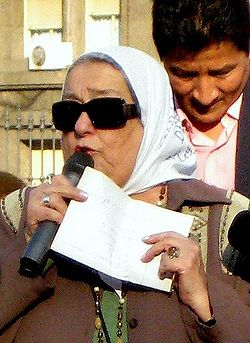
Caption: Hebe Bonafini

This has unfortunately not been the case of Hebe Bonafini. While no one can justly question the fearlessness, motivation, energy and strength she has shown in her three decades as a leader in the movement, she can indeed be almost solely blamed for the criticism of which the Mothers as a whole have become the target in the years following the end of the dictatorship. She has consistently alienated even many of those who championed the Mothers previously by being the first to believe in her own bigger-than-life status and believing that it gives her the right to state her own personal beliefs as if they applied to the Mothers as a whole. She has sought to align the Mothers with autocratic leaders like Hugo Chavez and Fidel Castro, merely because they peddle ‘Marxist’ rhetoric while repressing their own people in much the same ways that the ‘Process’ did while supposedly “defending Western and Christian ideals”. She has distanced herself from the movement’s original humanity by publicly stating her satisfaction at hearing about the nine-eleven attack that destroyed the World Trade Center in New York killing thousands of innocent people, implying that it was a just act considering the thousands of civilians killed in successive US incursions into the Middle East. And so, through her, the discourse of the Mothers would appear to the general public to call for an eye for an eye, rather than rule of law and respect for human rights.

She has further created an almost ‘carnal’ union between the governments of Néstor and Cristina Kirchner and the Mothers Association, thus aiding and abetting the almost flagrantly autocratic Kirchners in waving the flag of human rights in the face of the world at large, while, at home, using gang tactics and boss rule to try and muzzle freedom of expression and distract attention from the rampant corruption that has been the hallmark of their reign.

The saddest part of this is not that Bonafini has discredited herself as a true defender of human rights, but that, in the process, she has sullied the reputation of one of the noblest institutions to emerge in Argentina’s recent history.