Showing posts with label Putin. Show all posts

Thursday, March 6, 2025

A VERITABLE ONE-MAN SHOW…PT BARNUM WOULD BE PROUD (REAGAN NOT SO MUCH)

 I don’t know if anybody has  noticed, but Donald “The Don” Trump is dilapidating eighty years of US leadership history in a matter of days.

I’ll get to the mobster-style ambush Vice President JD Vance laid with Trump for Ukrainian leader Volodymyr Zelensky in a minute, but first, let’s talk about the right-wing propagandist who got himself a coveted White House press pass and used it, in his role as a fake-news promoter, to ask perhaps the most inane yet incendiary question ever formulated at a summit meeting venue. I’m talking about the idiot (there’s just no other word if we’re giving him the benefit of the doubt, and if we aren’t, then it makes that question malicious, and him a provocateur—although, perhaps, the adjective “useful” before “idiot” would be appropriate here) who, in the midst of a major discussion between two heads of state, broke in to ask President Zelensky why he didn’t wear a suit.

Such a moronic, taunting, disrespectful and mal-intentioned query could only have come from the quarters in which it originated: the so-called Right Side Broadcasting Network, best known for adoring live-stream coverage of Trump’s rallies, town halls, and public events. With the new rise of Trump to the presidency, the network, which relies heavily on YouTube and Rumble for its audience, currently has nearly two million largely MAGA subscribers. In other words, the “reporter” was a MAGA-fake-news plant.

Trump with MAGA minion Brian Glenn
As for the name of the moron who asked the question, it was none other than Brian Glenn, there for a far-right propaganda outfit called Real America’s Voice. That might not mean much to a lot of my readers, many of whom tend to seek out fact-based news outlets for their information. But if you’re one of many Americans who, unfortunately,  subscribe to wild conspiracy theories and Trumpian prevarication, then Glenn may be something of a minor god in your world (where Trump is the big-dog god) since he is a champion conspiracy-theory disseminator.

Oh, did I mention that, among other achievements, Glenn is also the high-flying MAGA celebrity-climber who has scaled Mount Marjorie? That’s right, Brian and Marjorie (Taylor Greene, a.k.a. “Moscow Marjorie”) have been going steady for some time now. So he clearly has direct access to a fecund source of conspiracy gossip and MAGA dogma. 

Brian and Margie, going steady
The question could not have been more crucially timed if it had been planned in advance—or was it? It served as the lit fuse that touched off the fiery shouting match between the Vance-Trump tag-team and the Ukrainian president. It seemed specifically aimed at infuriating President Zelensky, when he was already being badgered by Vance, who seemed thoroughly amused at that sort of question’s being put to a foreign dignitary. It was the sort of question that, had it been asked of Trump by—oh, I don’t know, say, The Associated Press—would have gotten that news medium banished from the White House press core. (Oh wait! The AP was banned for less, simply for refusing to add the fictitious name, Gulf of America, to its stylebook).

Suffice it to say that Glenn’s network  was selected to fill a “secondary TV” role in the White House press pool—CNN has been relegated to that same category, which didn’t exist before last week. Indeed, the White House granted that press pass to Glenn, even as Trump continued to block reporters from The AP, one of America’s most major sources of objective news coverage, from attending. This policy began last week, with the White House handpicking the reporters it permits to attend  presidential meetings held in reduced settings, such as the Oval Office.

Glenn’s query could not have been more impertinent or captious: “Why don’t you wear a suit?” asked Glenn. “You’re at the highest level in this country’s office, and you refuse to wear a suit.” And then, insultingly, he doubled down, asking, “Just want to see if—do you own a suit? A lot of Americans have problems with you not respecting the office.”

President Zelensky, a wartime leader
President Zelensky sought to keep his cool, answering eloquently in his second language, “I will wear costume after this war will finish." The word for “suit” translates into Ukrainian as  kostyum. But whether intentional or not, the word “costume” in English couldn’t have been more accurate, since the only participant in that room not masquerading as a gentleman, when they were far from it, was the Ukrainian head of state. He was the only one who dressed honestly for the occasion, wearing the combat fatigues of a leader defending his nation and Europe against a war of aggression perpetrated against it by Russia, a dictatorial imperialist power. A power that, until six weeks ago, US leadership still recognized as what it is, one of America’s two most threatening rivals, and, currently the number one  most imminent threat to international peace and security.

As if to lighten the shocking and uncomfortable moment Glenn had created, President Zelensky then quipped, “Maybe something like yours, yes. Maybe something better, I don't know,” sparking laughter in the room. Then he added,  “Maybe something cheaper.”

The Ukrainian leader’s skill as a former comedian could have defused a tense moment. But that wasn’t the game plan. Vice President J.D. Vance—an Ohioan, I’m ashamed to say, like myself—wasn’t going to let this opportunity slip through his fingers. He seized on Glenn’s “disrespect” comment to say, “For four years, the United States of America, we had a president who stood up at press conferences and talked tough about Vladimir Putin, and then Putin invaded Ukraine and destroyed a significant chunk of the country. The path to peace and the path to prosperity is, maybe, engaging in diplomacy. We tried the pathway of Joe Biden, of thumping our chest and pretending that the president of the United States’ words mattered more than the president of the United States’ actions. What makes America a good country is America engaging in diplomacy. That’s what President Trump is doing.”

Zelensky countered, “OK. So he (Putin) occupied it, our parts, big parts of Ukraine, parts of east and Crimea. So he occupied it in 2014. So during a lot of years—I’m not speaking about just Biden, but those times was (Barack) Obama, then President Obama, then President Trump, then President Biden, now President Trump. And, God bless, now, President Trump will stop him. But during 2014, nobody stopped him. He just occupied and took. He killed people…

Trump, who apparently has the attention span of a gnat, and was evidently not listening, said, “Oh, 2014? I was not here.”

And Vance, ever quick to repeat anything Trump says, added, “That’s exactly right.”

Again Zelensky countered, saying, “Yes, but during 2014 ‘til 2022, the situation is the same, that people have been dying on the contact line. Nobody stopped him (Putin). You know that we had conversations with him, a lot of conversations, my bilateral conversation. And we signed with him, me, like, you, President, in 2019, I signed with him the deal. I signed with him, (French President Emmanuel) Macron and (former German Chancellor Angela) Merkel. We signed ceasefire… But after that, he broke the ceasefire, he killed our people, and he didn’t exchange prisoners. We signed the exchange of prisoners. But he didn’t do it. What kind of diplomacy, JD, you are speaking about? What do you mean?”

Seeing that Zelensky was getting the upper hand in reminding the press that Russia was the aggressor, Vance quickly doubled down, and acting as if he were the head of state and not Trump, lectured Zelensky, saying,  “I’m talking about the kind of diplomacy that’s going to end the destruction of your country. Mr. President, with respect, I think it’s disrespectful for you to come into the Oval Office to try to litigate this in front of the American media. Right now, you guys are going around and forcing conscripts to the front lines because you have manpower problems. You should be thanking the president for trying to bring an end to this conflict.”

Clearly, of course, litigating it in front of the American media had been exactly what Vance and Trump had been seeking to do. Usually, when there is a visiting head of state coming to negotiate a deal, the photo op will be short and nothing of consequence will be discussed publicly until negotiations have ended. But the Trump White House seems to have decided to use the presser simply as a means of humiliating President Zelensky, of showing him that the only ones that mattered in talks about Ukraine were the two major powers involved, the US and Russia, since Trump has also blithely ignored Europe completely as an intimately and strategically interested party. The clear purpose was to demonstrate to Zelensky (and to Trump’s base), in mob boss style,  that he didn’t matter. That Ukraine didn’t matter. That only Trump and Putin mattered.

Indeed, Trump would later tip his hand, saying as much when, after the blow-up, he crowed, “I think it’s good for the American people to see what’s going on. I think it’s very important. That’s why I kept this going so long.” Then, addressing Zelensky directly, “ You have to be thankful.”

Having tired of Vance’s impertinence, President Zelensky asked the VP, “Have you ever been to Ukraine that you say what problems we have?”

“I have been to –” Vance muttered, obviously caught off guard.

“Come once,” Zelensky suggested.

Then like a kid in grammar school who hadn’t done his homework, Vance said,  “I’ve actually watched and seen the stories, and I know that what happens is you bring people, you bring them on a propaganda tour, Mr. President. Do you disagree that you’ve had problems, bringing people into your military?”

“We have problems…”

“And do you think that is respectful, to come to the Oval Office of the United States of America and attack the administration that is trying to prevent the destruction of your country?”

“First of all,” said the Ukrainian president, “during the war, everybody has problems, even you. But you have nice ocean and don’t feel now. But you will feel it in the future. God bless –”

That’s when Trump blew up and talked to Zelensky in his best mobster style, telling him not to tell the US how it would feel. Talking down to him like the principal scolding a school kid,  saying “You don’t know that. You don’t know that… Because you’re in no position to dictate that.” He and Vance went on tag-teaming President Zelensky, and Trump’s lecture continued,  “You’re not in a good position. You don’t have the cards right now. With us, you start having cards.”

Zelensky, appropriately, said,  “I’m not playing cards. I’m very serious, Mr. President. I’m very serious.”

“You’re playing cards,” said Trump. “You’re gambling with the lives of millions of people. You’re gambling with World War III.”

Vance returned to his sophomoric “magic words” argument, again asking, “Have you said thank you once?”

To which President Zelensky answered, “A lot of times. Even today.” Anyone who has ever listened to anything the Ukrainian president has ever said about US aid knew this was true. Perhaps no other recipient of American aid in history has been more expressive about his appreciation than President Zelensky.

But Vance doubled down: “No, in this entire meeting…” And then in a complete non sequitur, he added, “You went to Pennsylvania and campaigned for the opposition in October.”

To which President Zelensky said, “No.”

Vance continued to badger him, “Offer some words of appreciation for the United States of America and the president who’s trying to save your country.”

Overwhelmed by such a lack of manners and propriety, President Zelensky said,  “Please. You think that if you will speak very loudly about the war, you can…”

And was immediately interrupted by Trump, who blustered,  “He’s not speaking loudly. He’s not speaking loudly. Your country is in big trouble.”

 “Can I answer —” President Zelensky tried, to which Trump barked,  “No, no. You’ve done a lot of talking. Your country is in big trouble.”

It was an utterly vile display of disrespect and bullying, and it is difficult to believe that it wasn’t planned that way, since Trump ended the contentious meeting by saying, “This is going to be great television. I will say that.” And coming from a former reality show star, who does everything necessary to stay at the top of the daily news schedule, that says a lot.

Make Russia Great Again
But the tone is nothing new. Such displays of disrespect have come to typify how the Trump regime treats America’s natural allies. Meanwhile, his most fawning, laudatory, and embarrassingly acquiescent behavior has been reserved for America’s natural enemies, and for predators bent on preying on democratic nations.

Putin’s spokesman, Dimitry Peskov said it all. Obviously pleased beyond all expectations with  the blow-up and with the ignominious expulsion of President Zelensky from the White House, Peskov said,  “The new (US) administration is rapidly changing all foreign policy configurations.  This largely aligns with our vision.”

He could not have stated it more accurately. Under Donald Trump, in just six weeks, the US has all but abandoned its Western allies and democracy, and embraced authoritarianism and the world’s most repressive and dangerous regime. He has, in a word, surrendered the US to our principal enemy, and turned his back on our friends.


Wednesday, June 28, 2023

RUSSIAN EXPOSURE – SOME TAKE-AWAYS


For about a New York minute, I found it quite satisfying to see the rats at the top of the autocratic, oligarchic food chain in Russia turning on one another. Yevgeny Prigozhin’s short-lived revolt against a sector of Vladimir Putin’s government (not even the chief of one of the most ruthless mercenary forces ever assembled could muster the guts to oppose Putin himself) was a little like the scene in The Wizard of Oz when Dorothy’s dog Toto knocks over the screen and the wizard is exposed for what he is, an ordinary man with no real power at all except for his ability to make people believe that he is all-powerful.

But once that small pleasure had waned, there were other more practical aspects to consider, as a result of the weekend of utter chaos that Prigozhin visited on Putin’s Russia. The most immediate take-away is that both Putin and Prigozhin came out of this incident much weaker than before.

Putin and Prigozhin - end of the affair

Prigozhin basically ended up having to give up his brutal, tinpot, mercenary army in order to save his own skin when he miscalculated the level of discontent in the Russian Armed Forces in general and among Putin’s closest military commanders in particular. It’s not hard to guess that in his delusions of grandeur, he imagined marching on Moscow and picking up large detachments of the Russian military on the way. That didn’t happen. And despite the fact that he made it clear he was rebelling against the defense ministry and not against the chief of state, Putin, nevertheless, declared him a traitor and vowed that he and his men would be punished to the full measure of the law (which is often whatever Putin says it is). But that didn’t happen either.

Putin, for his part, was caught on his back foot and got waylaid. He seems to have been unaware until the last minute that the rebellion was coming. And yet, as someone who was once an officer in the KBG and who has, over the past twenty years, garnered an enormous measure of autocratic power over the Russian Federation, he should have known. At least some of his generals knew ahead of time but evidently didn’t share that knowledge with the boss.

It seemed clear, at least, to many Russia insiders in the West that Prigozhin was hardly likely to stand still for Defense Minister Sergei Shoigu’s move to bring the oligarch and his private army, known as the Wagner Group, under the control of the Russian state. Shoigu had earlier issued an order for all Russian mercenaries to join the regular Army by the first of July, which would basically have rendered moot Prigozhin’s until-then enormous power.

It was Putin himself who provided Prigozhin with the power he had come to wield. And ex-convict and self-made man, Prigozhin had become Putin’s go-to guy whenever the president didn’t want to get his own hands dirty. Prigozhin and the Wagner Group repeatedly provided Putin with deniability in unofficial Russian military actions in which crimes against humanity were consistently committed. Prigozhin was also reportedly behind Russian interference in both the 2016 and 2018 elections in the US. 

This is, of course, part of the dictator playbook. When I was covering the bloody reign of a military dictatorship in Argentina in the nineteen seventies and early eighties, paramilitary hit squads, made up largely of retired police and military personnel, carried out most of the torture, political abductions and assassinations in which tens of thousands of people disappeared or were killed. The first junta head and president, Jorge Rafael Videla, would consistently insist, in answer to worldwide outrage, that when orders were given, he had no real control over how they were carried out. A claim that was, of course, ludicrous, as have been all of Putin’s own denials since he started using paramilitary mercenaries to invade Ukrainian territory, clear back to the time when he first annexed Crimea in early 2014.

Ever since it became clear that practically any pyrrhic victory Putin could claim in Ukraine—where his original claims that it would be a walk-over and that his troops would be accepting the Ukrainians’ surrender in short order turned out to be a miscalculated fantasy of epic proportions—has been largely thanks to Prigozhin and his army of mercenary thugs, I started asking myself what the Russian president was going to do when that pack of mad dogs turned on him. This past weekend provided an at least partial answer. I say partial, because the consequences of the rebellion have still not all been revealed. 

Defense Minister Shoigu

While Putin has tried to keep up appearances, in his home-grown Ukraine War, in the face of withering pushback from Ukraine’s Armed Forces and its stoic people in which the Russians have suffered their worst losses since World War II—some forty thousand men killed and another one hundred forty to one hundred sixty thousand injured—Prigozhin’s drive toward Moscow demonstrated clearly that Putin has nothing to spare in the way of military power. A mobilized detachment of the men of the Wagner Group made it from Ukraine to within one hundred twenty-five miles of the Russian capital and, according to Western reports, only encountered armed resistance from the Russian Armed Forces at one point along the way, where the Wagner Group quickly overpowered it.  More telling still, when a deal was struck, the mercenaries were allowed to turn around and go back to where they had come from, and Prigozhin was permitted to slip away into exile.

What this also tended to show was that while Putin’s military, by and large, didn’t turn against him, neither did it make any great effort to defend him, which could be taken as a wait-and-see attitude and/or previews of possible coming attractions. Or perhaps it was just the Russian field military commanders demonstrating that without them, Putin was powerless against overthrow. In the only images that have come out of Prigozhin talking to military officers during his drive toward Moscow, both he and the Russian officers seemed relaxed and non-confrontational. Furthermore, despite all of Putin’s talk of holding the Wagner Group and Prigozhin to account, in the end, he was forced to let Prigozhin escape to exile and to strike a deal, telling the mercenaries that all would be forgiven if they submitted to Russian military control.

He also was forced initially to say that nothing would happen to Prigozhin. But then, nobody believes that, and least of all, Prigozhin. While he agreed to Belarusian exile, he immediately and wisely disappeared from view. From an undisclosed location he would later issue a statement explaining that his idea was never to overthrow Putin. All he was doing, he said, was protecting his men. Clearly, what he was trying to protect was his own power, and without his private army, that power has been considerably reduced. But it has not been wiped out, since, up to now, Prigozhin has been a chief ally of Putin’s in the vast Russian mafia. He is a kingpin, a guy who knows where the bodies are buried. And, without a doubt, he and his Army have been crucial in Putin’s prosecution of his war of aggression against Ukraine and in military action elsewhere.

Seeking to explain the significance of the Russian Defense Ministry’s order for all of Prigozhin’s battle-hardened frontline fighters to place themselves under Russia’s general military command, former US Army in Europe commander, Lieutenant General Mark Hertling, told a TV interviewer that it was rather as if members of Delta Force, Navy SEALs or some other special forces unit were being told to place themselves under the orders of a regular infantry command. But he hastened to point out, however, that this was where the comparison ended, since the Wagner Group wasn’t a highly trained, special forces unit, but rather, a mercenary army made up of criminal thugs and convicts, led by a mafioso.

Prigozhin dressed in battlefield gear

Indeed, for all of his posturing in elaborate military garb and armed to the teeth, Vevgeny Prigozhin is as much a self-style military commander as he is a self-made oligarch. Sometimes known as “Putin’s Chef”, because, under Putin, his food industry interests have catered to the Kremlin, the sixty-two-year-old Prigozhin originated from fairly humble beginnings at the height of Soviet rule in Russia. His Jewish father died while he was still a boy and his mother struggled to support Vevgeny and his ailing grandmother with her work at a hospital in what was then Leningrad (now Saint Petersburg). 

Vevgeny’s mother eventually remarried. His stepfather, who was also Jewish, was a cross-country skiing instructor. Vevgeny, who was a teen by this time, took to the sport and hoped to go pro. His stepfather managed to get him into a prestigious athletics school to help him reach his goal, but Vevgeny’s plans didn’t work out in the end.

Almost immediately, Prigozhin turned to a life of crime. He was arrested for stealing at age eighteen. The court went easy on him and gave him a two-year suspended sentence. At twenty, he was arrested again for leading a criminal gang of mostly juvenile delinquents, which burglarized high-end apartment buildings. This time, he was sentenced to twelve years in prison for theft, fraud and corruption of the minors whom he had involved in his crimes. He ended up serving nine years of the sentence before being released in 1990.

On his release he joined his mother and stepfather in a small business selling hotdogs out of stand in an open-air market in Leningrad. In an interview years later, Prigozhin would say that their hotdog business was so thriving that his mother didn’t know what to do with all the money that came rolling in. But Vevgeny did. He embraced the entrepreneurial spirit of the times following the fall of the Soviet Union and invested in a wide variety of interests. From grocery stores and restaurants to marketing research, construction and foreign trade, Prigozhin’s empire expanded exponentially.

But it was apparently his foreign trade interests that eventually led to areas of interest to the Putin regime—notably gold and diamond mining in Central Africa. These interests seem to have provided him with the perfect segue into arms and mercenary recruitment. For some time, Prigozhin denied having anything to do with the Wagner Group—a shadowy paramilitary arm of the Putin regime that was involved in guerrilla warfare activities in several parts of Africa and which eventually showed up in Syria, where Putin was propping up the cruel dictatorship of Bashar Al-Assad in his devastatingly bloody war to put down a nationwide democratic uprising. But he eventually admitted to being the group’s founder, and in Ukraine has become its high-profile commander. His untrained, unschooled and non-strategic approach to war to date has been simple: to throw huge numbers of men and ordnance at the enemy in hopes of eventually overcoming their resistance.

For this unsophisticated and brutal strategy to work, Prigozhin requires either highly motivated or, more often, otherwise hopeless men. That’s why much of his army in Ukraine has been made up of convicted felons, desperados who joined him in order to get out of prison. These are men who have had no problem following their commander’s orders to lay non-military targets to waste and to murder civilians. And in some of the heaviest fighting, Prigozhin himself admitted that he was losing an average of a hundred men a day.

The US has leveled numerous sanctions and criminal charges at Prigozhin in recent years. He is also one of the Russian oligarchs under sanctions in the United Kingdom and in the EU. Additionally, the FBI has offered a bounty of up to two-hundred-fifty thousand dollars for information leading to Prigozhin’s arrest. 

A relaxed Prigozhin meets with Russian military leaders
The uncertainty in Russia hasn’t been allayed, by any means, as a result of the deal reached between the Putin regime and the Wagner Group. Just the fact that Putin put together a flamboyant display honoring the Russian Armed Forces within a couple of days of the mercenaries’ revolt is as telling as it is unusual. Until Prigozhin went rogue, no one was questioning the power of Vladimir Putin. Dictatorships, however, function very much like the Mafia. The capo is the capo…until he isn’t. His power isn’t based on love and loyalty, but on ruthlessness and fear. Power in autocracies in strictly vertical, and a dictator’s continuation in power is subject to the fear of those beneath him. They must feel that the price of betrayal is so certain and so lethal that their only choice is blind loyalty.  Given Putin’s track record, while it’s unlikely anyone is beating down Prigozhin’s door to sell him a life insurance policy, the fact that he and his band of thugs got away, at least for now, with nipping at Putin’s heels will almost certainly be taken as a sign of fear and weakness on Putin’s part. All the more so because, instead of downplaying the incident’s importance, Putin has cast Prigozhin as a dangerous traitor and has thanked and honored the Armed Forces for “saving the country from civil war,” when, in fact, all indications are that the military did precious little in that regard.

Calling the uprising an attempt at civil war tends to show that a much more serious rebellion is a possibility that might be keeping Putin up nights. An admirer of Czar Nicholas and his empire, Putin can hardly help but recall that, in the end, the czar’s failures in foreign wars and the poverty they engendered at home played into the hands of the Bolsheviks so that a revolt by ragtag civilian militias ended up being backed by large numbers of discontented professional soldiers. And Czar Nicholas and his family ended up facing a firing squad.


Saturday, March 12, 2022

APPEASEMENT - HISTORY REPEATS ITSELF IN UKRAINE


The tragedy that is unfolding in Ukraine at the moment is the consequence of the kind of ruthless, murderous, criminal behavior that the world—shocked though everyone seems to be—should by now have come to expect from Russian dictator Vladimir Putin. It is a repetition of the kind of unprovoked invasion and scorched earth tactics that he has commanded during his twenty-two-year reign in places like Chechnya and Syria. And it mirrors the same lack of concern over geopolitical consequences and humanitarian considerations that Putin demonstrated nearly a decade and a half ago in Georgia, where he launched the first European war of the twenty-first century.

But leaving aside the similarities between the ruthlessness that Putin has exhibited in Ukraine and those he has employed in earlier armed interventions, there are also historical similarities between how the world is reacting to this latest naked aggression in Europe by the Putin regime, and the earlier policy of appeasement that permitted unfettered expansion by the armies of the most undisputedly emblematic dictator of the modern era.

Since the two world wars fought in the twentieth century, “appeasement” has become a technical term for any diplomatic policy that is based on making concessions to an aggressive power in order to avoid armed conflict. The term’s most iconic historical application has been as a means of describing the diplomatic policies of the then all-powerful British Empire in dealing with the rapid rise of fascism in Germany and Italy and the brutal expansionist doctrines instituted by both nations—but particularly by Nazi Germany—in the run-up to World War II.

The scapegoat for the appeasement shown toward German dictator Adolf Hitler and his Nazi regime has traditionally been British Prime Minister Neville Chamberlain, who was heading the British government when Nazi Germany’s aggression in Europe could no longer be ignored and spilled over into the start of World War II. But truth be told, previous British prime ministers, including Ramsay McDonald and Stanley Baldwin, had preceded Chamberlain in their hands-off approach to the brutal rise and aggression of both European dictators, embracing appeasement even as both Hitler and Mussolini consolidated their power in Europe in the period between World War I and World War II.

In all fairness, those were different times, the nineteen-twenties and thirties, when the world didn’t yet have the historical context of World War II to look back on. World War I was still being thought of as the “war to end all wars” and as “the Great War”, and most people at that time couldn’t have imagined that Germany’s European aggression would once again spark a worldwide conflict that would prove far more deadly and horrific than the first one. Appeasement, at that time, was not seen as “backing down” in the face of naked aggression, but rather as a policy aimed at preserving the peace that had cost all of Europe such tremendous sacrifice during the First World War.

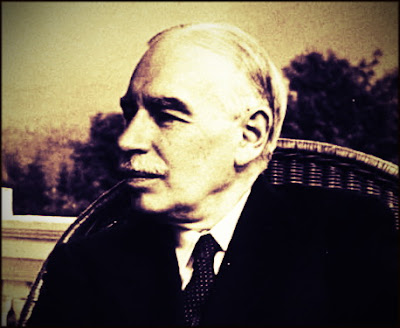
Appeasement was also seen as the price Europe was paying for the exaggerated and highly vindictive sanctions and contemptuous treatment to which the Allies had subjected Germany following the Great War. There was no more outspoken critic of those sanctions than renowned British economist John Maynard Keynes,

John Maynard Keynes
whose book, The Economic Consequences of Peace, published in 1919, was to become a worldwide bestseller. In that book and at the 1919 Paris Peace Conference, where he was the British Treasury delegate, Keynes argued that applying a “Carthaginian peace” with the purpose of further crushing an already defeated Germany would lead to new consequences for European peace in the future. He advocated not imposing crippling reparation payments that would impoverish the German people and lay waste to the country’s economy, or at least limiting those reparations to no more than two billion pounds.

Keynes’ advice fell on deaf ears among the Allies in their drafting of the Treaty of Versailles and other associated treaties. And the terrific hardships that the people of Germany suffered in the post-World War I years are historically cited as the main social and humanitarian catalyst that permitted Hitler to become the most powerful man in Germany and the country’s undisputed Fuhrer.

As Great Britain and the US began, during the late nineteen-twenties, to visualize the consequences of the Treaty of Versailles, appeasement commenced to be viewed as the most desirable way to avoid escalating new hostilities between Germany—allied with fascist Italy—and the rest of Europe. Appeasement garnered powerful support among the British upper classes, including the House of Lords, British royalty, and big business, at the time headquartered in the City of London. Conservative media, such as the BBC and The London Times, were also supportive of appeasement as a tool of peace.

The left and the lower and middle-class public at large were, however, far less convinced of the wisdom of permitting Nazi Germany to aggressively expand without drawing a line in the sand. As Hitler advanced beyond German borders, much of the liberal press and popular public opinion decried the former Allied powers’ increasing failure to contain Hitler and drive Nazi Germany back, Prime Minister Chamberlain could think of nothing better to do than to impose censorship on the liberal press, meet with Hitler in Munich and then declare himself the architect of “peace in our time”.

Much in the way that Putin is today seeing the desire of the West to maintain world peace and not get into a shooting war with him as acquiescence that he can take advantage of in order to prosecute his expansionist policies, Hitler seized the opportunity provided by appeasement to annex Austria, parts of Czechoslovakia, Bohemia and Moravia, before invading Poland, which finally became a bridge too far, and sparked the start of World War II.

Historians remain divided on the issue of appeasement, however, with one school of thought positing that the policy of appeasement was precisely what permitted Nazi Germany to become so powerful and to gain such a European foothold while the other school of thought is that in the run-up to the war, Hitler’s Germany was already so powerful that early engagement might have permitted him to win the conflict, while appeasement gave Europe time to better prepare for what was, in the end, an unavoidable conflagration.

Like Hitler in Germany following the Treaty of Versailles, Putin built his popular strength as a dictator on the rubble of the fallen Soviet Union. As a ranking intelligence officer in the former KGB, Putin worked closely with former head of state Boris Yeltsin, Russia’s first freely elected president following the fall of the Berlin Wall, and managed to become Yeltsin’s protégé. His reputation as a strongman and eminence gris behind Yeltsin placed him first in the line of succession when Yeltsin, in ill-health and highly unpopular after a crippling recession in Russia that some economists have compared to the Great Depression in the US and Europe, resigned from office in 1999. In exchange, one of Putin’s first acts was to provide immunity from prosecution to Yeltsin, who was facing possible charges of corruption and dereliction of duty.

If Yeltsin had tried unsuccessfully to convert Russia from a seventy-five-year-old communist regime to a free market economy overnight, Putin took a more pragmatic approach, taking advantage of the more open market to position himself at the forefront of a highly lucrative oligarchy that helped him consolidate his power and made him, as well as his cronies, a very wealthy man into the bargain. Although Yeltsin had considered the Soviet era over and done with, if anyone was paying attention, it was easy to see that, despite his taste for capitalism, Putin was nostalgic for the enormous power that the Soviet Union had wielded on the world stage, and which had waned to only a shadow of its former self under the post-Berlin Wall Russian Federation. In this regard, cavalierly relegating the two world wars to a position of secondary importance, Putin once said that the fall of the Soviet Union had been, “the greatest geopolitical catastrophe of the century.”

He also took clever advantage of the so-called “glasnost” policy first introduced by his predecessors Mikhail Gorbachev and Boris Yeltsin, which actively sought ever-closer ties with the West. He established strong trade ties with Western Europe and the US and succeeded in making some of the most powerful countries in Western Europe—most notably Germany—largely dependent on Russian oil and gas, the Federation’s main export.

He was at first seen in the West, then, as the new face of Russian democracy and capitalism and gained “most favored nation” trade status with Western nations including the United States—a status that, incredibly, even as he lays waste to Western ally Ukraine, he continues to enjoy, and it is only now that the US and Western Europe are reluctantly considering revoking it. It wasn’t until he was certain that he was in the best position possible to ensure that any Western moves against him would not come without injury to Western economies that he began to reveal who he really was—a ruthless, anti-democratic dictator with an agenda aimed at rebuilding the Russian Federation to the level of power once wielded by the Soviets, but without the all-pervading communist Politburo to hamper him.

Establishing a political partnership with Dmitry Medvedev in which they basically passed the offices of prime minister and president back and forth between them for nearly two decades—a “tandemocracy” as international journalists dubbed it—Putin was clearly always the strong man and Medvedev his shill. Two years ago, Putin decided that he had consolidated sufficient autocratic power to dispense with this farse and pushed Medvedev, who has since been demoted to deputy chairman of the Russian Security Council, to resign. Medvedev did so, saying that he was leaving office to permit Putin to introduce constitutional changes—obviously designed to further entrench him in power permanently.

"Strategic target" - a Ukrainian kindergarten
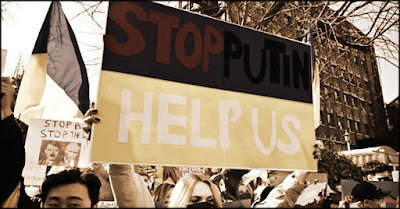
Putin’s invasion of Ukraine is utterly unprovoked and brutal. His main goal in doing so is to prevent Ukraine, as an independent sovereign nation, from seeking membership in NATO and the European Union and thus from becoming a basically Western country. A large country of more than forty million people with valuable resources, Ukraine was one of the many Eastern European nations dominated by the Soviet Union from World War II until the end of the cold war, when, like other former satellites of the USSR, Ukraine declared its independence from Moscow.

As of the start of his reign in 1999, however, Putin set to the task of re-introducing Russian domination by infiltrating Ukrainian politics and eventually installing a puppet government in Kyiv that was loyal to Moscow and beholden to Putin. In 2013, mass protests erupted in Kyiv and other Ukrainian cities, the main purpose of which was to seek closer ties with the West, and particularly with the European Union. Although opposed by the ethnic-Russian minority—mostly centered in Eastern Ukraine and Crimea—this movement became a full-fledged civil uprising known as the Revolution of Dignity, in which at least ninety-eight people were killed, a hundred went missing and some fifteen thousand were injured. In 2014, the protests boiled over into what was essentially a popular coup d’état, as a result of which Putin’s surrogate Viktor Fedorovych Yanukovych was removed from power and fled to Moscow.

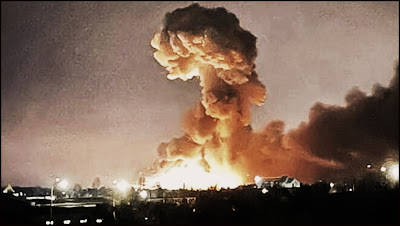
Putin is using thermobaric bombs that crush the 
lungs of anyone within their killing range.

New—this time free—elections were called, and Petro Poroshenko won by more than fifty percent of the votes, running on a pro-European Union platform. Since then, Putin has actively and violently moved to retake Ukraine by force, first through the direct annexation of Crimea and by providing material and military support to pro-Russian insurgencies in Eastern Ukraine, and now, with the strengthening of pro-Western overtures under the government of President Volodymyr Zelenskyy, by means of the full-scale invasion and destruction of the country as a whole.

The excuse of NATO for not doing more to militarily help the Ukrainians—among other things, at least establishing a no-fly zone so that cities in that country don’t have to contend with Russian air support for its bloody invasion—is that Ukraine isn’t a NATO country. But it’s not for lack of trying on the part of Kyiv. Since once and for all declaring its independence from Moscow, the main thrust of Ukraine’s foreign policy has been to be accepted into the West.

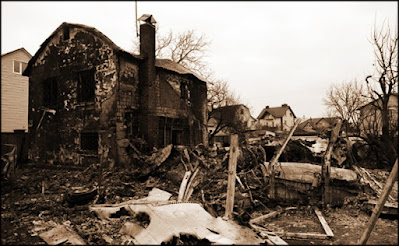
A Ukrainian school hit by Russian cluster bombs.
Clearly, Ukraine would be a positive addition to the West. It is the second-largest country in Europe by area (after Russia). Its population has free access to excellent education. Full secondary school is compulsory, and the country has a literacy rate of about ninety-nine percent, compared to the US with only an eighty-eight percent literacy level. Higher education is free with admissions being provided on a competitive basis. The country’s Lviv University was established in 1616, and the rest of Ukraine’s major cities also host centuries-old institutions of higher learning—a total of nearly one hundred fifty, with a student population of eight hundred fifty thousand.

The country boasts significant natural resources, including lithium, natural gas, kaolin, timber, and an abundance of arable land with a temperate climate that permits a long growing season—even if in certain regions it is vulnerable to environmental issues such as inadequate potable water, air and water pollution, and radioactive contamination in the northeast due to the Chernobyl atomic reactor disaster that took place in 1986, while Ukraine was still dominated by the USSR.

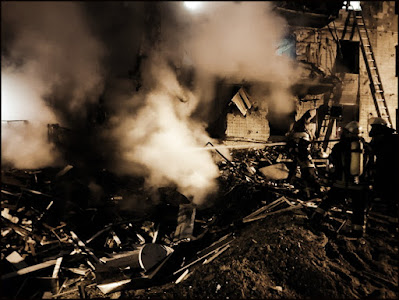
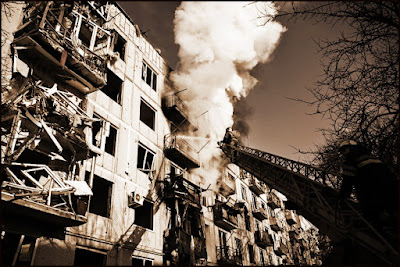
A bombed out apartment building
Ukraine has a score of major industries including power-generation, fuel, ferrous and non-ferrous mining, chemical and petrochemical production, natural gas, machine-building, metallurgy, forestry, woodworking, wood pulp and paper production, construction materials, and food production, among others. The country also has a massive high-tech industrial base in such areas as electronics, arms production and aerospace. 

Unfortunately, its economic performance fails to reflect its very real potential since it has always been subject to the vicissitudes of the Russian economy or has been punished by Russia for seeking its independence, a problem that Western Europe and the US have failed to systematically offset. Add to this the fact that, in just three weeks, Russia is estimated to have destroyed a hundred billion dollars in Ukrainian economic assets—or a little less than two-thirds of the GDP—and Ukraine is currently the poorest nation in Europe.

So why hasn’t the EU done more to embrace Ukraine and make it a progressive Western emerging economy, since the country is not only willing but eager to do just that? Again, the answer is appeasement. It is the West caving to Putin’s refusal to allow a sovereign nation to exercise self-determination. Had the West moved in 2014 to bring Ukraine into the European Union, and more importantly, into NATO, it would have taken a much bigger Russian commitment to war than the one it is now making by ruthlessly invading Ukrainian territory.

While it may be a laudable goal to try and avoid Western armed conflict with one of the world’s two most advanced nuclear powers—especially considering that it is someone as ruthless and brutal as Putin who currently has his hand on the Russian nuclear trigger—as happened with Hitler before World War II, appeasement very likely will prove to be a policy of postponement rather than of avoidance in facing down the Russian dictator. Seeing Putin’s performance to date, it is very hard to imagine that following NATO appeasement in Ukraine, he will not want to test the Western alliance’s resolve in acting on its all-for-one-and-one-for all Western defense policy.

Russia with a defeated Ukraine would pose an immediate threat to Moldova, Estonia, Latvia, and, thanks to its alliance with Belarus, Lithuania. Poland would also be immediately vulnerable, as Putin sought to make good on his dream of returning to the past glory of the powerful Soviet Union.

The choices are clear: How NATO in general and the US in particular react to further Russian expansion will almost certainly either lead to a NATO-Russian shooting war, or it will lead to the nullification of NATO as a viable body for the protection of Western security and to the severe erosion of world security as a whole.

Meanwhile, Ukraine remains the sacrificial lamb in a still cold war between East and West. Putin is determined to use unadulterated state-terrorist tactics to bring Ukraine to its knees, while the West appears to be content to stand by with its arms folded in the hope that Putin will shoot himself out in that country and perhaps not then push on to attack others. 

The price of both opposing strategies is tragic. Ukraine, in just three weeks, has suffered indiscriminate bombing in sixteen of its twenty-five regions. As in Syria and Chechnya in the past, Putin’s war isn’t nearly as much on the Ukrainian military as it is on the Ukrainian people. His bombs have repeatedly destroyed apartment blocks, food and water supplies, heating facilities, stores and shops, markets, schools, churches, and, at last count, at least twenty-four hospitals. His attack on that country is the largest in any European country since World War II, already generating two and a half million refugees, predominately the elderly, women and children. In some locations, like the city of Mariupol, it has given rise to unprecedented humanitarian crises. Also in Mariupol, in just three days of Putin’s siege, at least one thousand three hundred civilians were slaughtered, and Ukrainian officials were forced to start creating mass graves to handle the war dead.

In short, the valiant people of Ukraine—who only sought to live in peace and democracy—and their courageous president are being sacrificed as pawns in the latest East-West power struggle, constituting the most heart-breaking human tragedy in Europe since the end of World War II.