Showing posts with label National Reorganization Process. Show all posts

Monday, May 3, 2010

Iron Mothers

This past week, the Mothers of Plaza de Mayo celebrated the 33rd anniversary of the first time they defied the Argentine dictatorship known as the National Reorganization Process by gathering in Plaza de Mayo, the main square in the City of Buenos Aires, to protest against the disappearance of their children at the hands of the former military regime.


Caption: The Mothers' white head scarves have become a human rights symbol. Here it is painted on the tiles of Plaza de Mayo - tiles worn by the Mothers' 33 years of resistance marches.

The importance of this group in drawing local and international attention to gross human rights violations and crimes against humanity under the “Process” cannot be overstated. It has clearly and consistently been the most high-profile and active of social institutions in defense of human rights in the country and even to this day, its leaders have refused to relegate to the forgotten past the issue of what happened to the thousands who “disappeared” during nearly eight years of military rule. Nor have they abandoned their struggle to see the perpetrators of that massacre brought to justice, despite legislation like the “full stop” and the “due obedience” laws passed under successive democratic administrations in attempts to assuage the military rebellions that marked the early years of democracy following the fall of the Armed Forces regime.

The Mothers are known worldwide and their cause has been immortalized in books, songs, photographs, documentaries, biographies and feature films. Their emblematic white head scarves bearing the embroidered names of their missing children have become an internationally recognized symbol of persistent resistance to tyranny and of the unflinching bravery of women in defending their families.


Caption: A poster from a documentary film about the Mothers by Lourdes Portillo and Susana Muñoz.

Admittedly, as often happens with grassroots protest movements, aims can become denatured and skewed as these loosely formed groups start to become “established institutions”. And the Mothers, at least in part, have been no strangers to this phenomenon. In fact, this was precisely what would eventually lead to an inevitable schism, which took place in 1986, three years after the country’s return to democracy.

By and large, this controversial politicizing of the Mothers of Plaza de Mayo has been taken out of context. The most vocal and radical of the two separate lines within the movement, the Mothers of Plaza de Mayo Association, has come to be considered, among many people at a local level, the “true face” of the Mothers and has thus served to discredit the movement as a whole. At an international level, most people have no idea that there are two separate lines within the movement, and therefore, she who shouts the loudest is seen as the face and voice of the Mothers. That would be Hebe Bonafini, head of the radicalized, extreme leftist Association, and a woman who has become such a caricature of far-left revolutionary ideals that she has lost all credibility as a serious defender of human rights and of peaceful protest. Although often profiled as a simple woman with an eighth-grade education, Bonafini has shown herself to be a canny developer of contacts and positioning, a skill that, combined with her often incendiary comments, has helped her to maintain a position of predominance, in the eyes of the public, in detriment to the traditional Founding Line of the Mothers of Plaza de Mayo. This second group advocates peace and non-violence, rule of law and respect for human rights and, paradoxically, it is probably because of the very decency of their endeavors that theirs is the lesser known of the two factions.

The Mothers emerged in April of 1977, a year after the coup that brought the Armed Forces ‘Process’ to power, and in the midst of the bloodbath that followed. At the time, it was not, by any means, a formal organization. It sprang, rather, from the decision of a tiny group of women to band together, in order to draw strength from one another and to find creative ways to draw attention to their plight. All of them were seeking information on the whereabouts of members of their families who had been abducted by paramilitary hit squads for having alleged ties to leftwing terrorism, subsequently falling through the intentional cracks in the “justice” system and simply “disappearing”.

The dozen women who took part in the first quiet protest in Plaza de Mayo were: Azucena Villaflor de Vicenti, Berta Braverman, Haydée García Buelas, Delicia González, Pepa Noia, Mirta Baravalle, Kety Neuhaus, Raquel Arcushin de Caimi and four sisters – María Adela Gard de Antokoletz, Julia Gard, María Mercedes Gard and Cándida Gard. Their original organizer was Azucena Villaflor. In her rounds of different government offices, where no one wanted to talk to her, she started bumping into other women who were also looking for missing family members. She convinced them that they were never going to get anywhere on their own. She said that they needed to band together if anyone were ever to take any notice of them.

They had no real plan for that first protest other than drawing attention to themselves and their call for information about their missing children. So where better to do it than under the noses of the Junta, in Plaza de Mayo, in front of Government House, and across from the Metropolitan Cathedral, headquarters of a Church hierarchy that had thrown in its lot with the military government? Azucena Villaflor’s idea was that if they could get enough women to gather each week in the Plaza, there would come a time when the government could no longer ignore them. That was the strategy, pure and simple. And her immediate goal was to get a meeting with the head of the Junta, Lieutenant General Jorge Rafael Videla.

Nor was that first protest meant to be a “march”. But when Federal policemen standing guard in the square saw the women gathering, they warned the Mothers that they would either have to “circulate” or leave, because under the dictatorial decrees of the military regime the right to public assembly was revoked and they could be arrested for holding a public gathering. And so they started circling the central pyramid in the Plaza, the revered symbol of Argentina’s May 1810 Revolution.

And the next week, they were back again. By simple word of mouth their number had grown and one of the Mothers who was at that second meeting was Hebe de Bonafini from the provincial capital, La Plata, who was to eventually become the firebrand leader of the group. Before long, it had become widely known that the Mothers met every Thursday afternoon from 3:30 until 4:00 in Plaza de Mayo and walked around the May Revolution Pyramid.

The first person to make sure that this was widely known was my boss at the time, British-born newsman Robert J. Cox, editor of the English-language daily, the Buenos Aires Herald. Bob not only wrote about the Mothers (who, in the trans-Atlantic jargon of our paper became known as ‘The Mums’), but also started going as often as he could to the Plaza, to lend his moral support to the women. He encouraged those of us who worked with him to do the same. It was easy enough to do, since it was mostly a matter of just being there. At the time, the women’s gatherings were a great deal like the way migratory birds start flocking together in the autumn. At around 3:30 each Thursday they would enter the Plaza one at a time until a handful of them got together and started walking around the May Revolution monument, and then the others would join in. Most of us younger Herald staffers went from time to time. Some occasionally interviewed the Mothers, or even became friendly with them. Others, like myself, simply went to add strength in numbers to their cause and sat on park benches nearby, watching the movement grow in importance and effect, week after week, and seeing how we could work them into the stories we wrote for the foreign publications we were ‘stringers’ for.

Each week there would be new mothers and wives and brothers and sisters of missing people and each week there would also be new supporters who showed up to look on or to join in the march. Eventually, someone in the movement came up with the idea of the headscarves, first just white, then later with the names of the missing embroidered on them. Some of the Mothers also carried pictures of their missing children or wore images pinned to their blouses or wraps. This set the Mothers apart from the rest of the passers-by in the Plaza, and wherever those easily distinguishable scarves were, a handful of other people also gathered and risked being photographed by government agents that passed themselves off as reporters.

And there were indeed reporters. As the movement grew, so did coverage. And as he had done from the outset with the plight of the ‘disappeared’, Cox sought every opportunity to get the Mothers into the international media. His theory was that the more people around the world who knew about what was going on, the harder it would become for the ‘Process’ to keep grinding lives up in the cogs of its counterterror machine. So whenever international correspondents would pay a courtesy call to him at the Herald, he would ask if they had heard about the Mothers of Plaza de Mayo and encourage them to visit the Plaza on Thursday.

By late 1977, the Mothers had managed to draw enough attention to themselves as to have the Junta take notice of them. But not the attention they were clamoring for. On December 10th (International Human Rights Day) the group published an ad listing the names of all of their missing children. That same night, a paramilitary death squad snatched Villaflor from her home in Villa Domínico (Avellaneda). Two other founding Mothers, Esther Careaga and María Eugenia Bianco, were also abducted. The military denied knowledge of their whereabouts. Like their children before them, they had joined the ranks of the ‘disappeared’ – the growing thousands of missing people that a sinister and cynical General Videla would describe by saying: “The missing are just that, missing. Neither alive nor dead. They’re not here. And if they’re not here, they don’t exist.”


Caption: On International Human Rights Day, December 10, 1977, Villaflor and two other Mothers joined the ranks of the 'disappeared'.

That, of course, was a lie. They did indeed exist, in over 300 concentration camps and safe houses around the country. And if they weren’t there, they were dead. But alive or dead, they still existed, every Thursday afternoon in Plaza de Mayo, when the Mothers and their supporters turned out to ensure that the public knew of their existence and to be a reminder to everyone that the same thing could happen to them or to their loved ones, that the greatest threat to the citizens of the country was their very own government. You didn’t have to be an armed terrorist to ‘disappear’. You only had to incur the wrath of the military or any of its powerful friends. Sometimes you didn’t even have to do that. Your name on the lips of a torture victim, your street and telephone numbers in the address book of a detainee were enough to earn you a blindfold and a ride in a government-issue Ford Falcon with no license plates.

Unlike many of the missing, who vanished without a trace, Azucena Villaflor’s fate, and that of the other two mothers who ‘disappeared’ with her, was found out. In 2005, the famed Argentine Anthropology Team (best known for having discovered the long lost body of Marxist revolutionary Ernesto “Che” Guevara in Bolivia, where he was summarily executed in 1967, thirty years before), on a search mission to find the bodies of Argentina’s ‘disappeared’, discovered three corpses, which they were later able to identify as those of Villaflor, Careaga and Bianco. All three presented the kind of bone fractures consistent with death by falling from a great height. Further investigation has led to the conclusion that they were probably detained at a clandestine torture and holding facility that operated at the Navy Mechanics School on posh Avenida Libertador in Buenos Aires, before then being placed on one of the regime’s so-called “death flights” in which prisoners were drugged, stripped and heaved out of aircraft into the ocean. Early on in the ‘Process’ bodies were also disposed of in the wide River Plate Estuary that separates Argentina from Uruguay, but prevailing currents meant that the corpses kept washing up on the Uruguayan shore and some less scandalous way had to be found to get rid of the mounting number of cadavers. The death flights over the Atlantic were one such solution, as was nocturnal incineration in the city crematorium at the sprawling Chacarita Cemetery.

That same year, at the Mothers’ 25th Annual Resistance March, Azucena Villaflor’s ashes were interred at the foot of the May Pyramid in Plaza de Mayo on her daughter Cecilia’s orders. Cecilia said: “Here is where my mother was born into public life and here is where she must stay forever. She must stay here for everyone.”

In looking back and commemorating the 33rd anniversary of the founding of the Mothers of Plaza de Mayo, I feel this is the point I want to make: that the founding idea of Azucena Villaflor and the women that joined her on that first march and the idea of the Founding Line of the Mothers never was one of specific political ideologies, of vengeance or of militancy under the flag of any political color. Their cause, and the one that made the Mother’s famous worldwide was that of decency, human rights and rule of law. Each woman to form part of the movement surely has had her own convictions and political bent. Only women of a strong and vibrant nature could have stood up to the years of abuse, arrests, threats and persecution that they had to endure to make their cause known. But just as surely, most of them have adapted or put aside the individual political axes they may have had to grind in order to be of undying service to their greater cause.

Caption: Hebe Bonafini
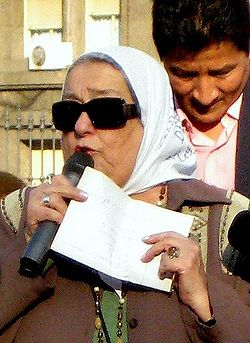
This has unfortunately not been the case of Hebe Bonafini. While no one can justly question the fearlessness, motivation, energy and strength she has shown in her three decades as a leader in the movement, she can indeed be almost solely blamed for the criticism of which the Mothers as a whole have become the target in the years following the end of the dictatorship. She has consistently alienated even many of those who championed the Mothers previously by being the first to believe in her own bigger-than-life status and believing that it gives her the right to state her own personal beliefs as if they applied to the Mothers as a whole. She has sought to align the Mothers with autocratic leaders like Hugo Chavez and Fidel Castro, merely because they peddle ‘Marxist’ rhetoric while repressing their own people in much the same ways that the ‘Process’ did while supposedly “defending Western and Christian ideals”. She has distanced herself from the movement’s original humanity by publicly stating her satisfaction at hearing about the nine-eleven attack that destroyed the World Trade Center in New York killing thousands of innocent people, implying that it was a just act considering the thousands of civilians killed in successive US incursions into the Middle East. And so, through her, the discourse of the Mothers would appear to the general public to call for an eye for an eye, rather than rule of law and respect for human rights.

She has further created an almost ‘carnal’ union between the governments of Néstor and Cristina Kirchner and the Mothers Association, thus aiding and abetting the almost flagrantly autocratic Kirchners in waving the flag of human rights in the face of the world at large, while, at home, using gang tactics and boss rule to try and muzzle freedom of expression and distract attention from the rampant corruption that has been the hallmark of their reign.

The saddest part of this is not that Bonafini has discredited herself as a true defender of human rights, but that, in the process, she has sullied the reputation of one of the noblest institutions to emerge in Argentina’s recent history.

Wednesday, March 24, 2010

A Day of Remembrance

Today marks the 34th anniversary of the coup d'état that ended the government of Argentine President María Estela Martínez ('Isabel') de Perón, on March 24, 1976, and of the start of the nearly eight-year reign of bloody dictatorial horror that followed. This is an excerpt from a book-length work that I am currently writing on my memories of those times, when I was a newsman with the Buenos Aires Herald.

Not Even a Fly

On the eve of the coup that ended Isabel Perón's government and marked the starting point for the bloody 'National Reorganization Process', a little man called Goyena who, officially speaking, was the Herald's 'man in Government House', walked into our already frantic newsroom, said, "Buenas tardes," walked over to where Editor Robert Cox was reading cables as they chattered out of the teletype machine, and in a loud clear voice announced: "Hello, Chief. I just want you to know that not even a fly is stirring."

Caption: The three members of the Argentine military junta that led the coup on March 24, 1976. Lt. General Jorge Rafael Videla (center), Admiral Emilo Massera (left) and Air Force General Orlando Agosti.


A couple of journalists who heard him guffawed. We had known for some time that a coup was in the offing and by that late hour of the eve of the coup, everybody in the media knew that tonight was the night. Cox just turned slowly and looked at the bearer of this news with an expression of something akin to awe on his face. He kept staring at him for a brief moment and the question on his lips was surely, "How in bloody hell can you hang around the Government House newsroom all day and have no idea what's going on?" But he didn't ask it. Always the English gentleman, he took the little envelope full of official press releases Goyena extended to him and said, "Thank you, Goyena. Thank you and good night."

Goyena, with the serenity of a simpleton said, "Good night everyone," and was off for home, mission accomplished.

But his reaction was not a lot different than that of the rest of the country. Since Perón's death, the country had been divided into a them-and-us mentality by which there was the government and its entourage that ruled and the people that did not and the trick was simply to try to avoid becoming a victim of the government. People lived their lives despite the government and sought ways to get around whatever ridiculous new action the State decreed while avoiding the eyes of its thugs that randomly roamed the streets in plate-less Ford Falcon Sprints, four or five to a car, door-to-door goons with sawn-off pump shotguns bristling from the windows. All they needed to change your whole life forever — or to end it — was an excuse and any excuse would do, even looking at them the wrong way. They reminded me of the gang of bandoleros in the western classic "The Magnificent Seven", heavily armed, ignorant scum that terrorized a little Mexican town until the city fathers finally had had enough and scraped up sufficient money to hire seven very scary American gunslingers to settle the score. Except that these guys were terrorizing a whole major city, an entire country, and had a whole government, the police and, yes, even the Army behind them. You weren't going to stop them by hiring Yul Brenner, Steve McQueen and company, no matter how fast they were on the draw. So the trick, as I say, was to avoid them.

Blending In

I had learned my lesson early on, some time before the coup, when I was still quite green. My wife and I had gone to a movie and when we came out of the cinema on stylish Avenida Santa Fe, one of these sinister Ford Falcons, heavy with goons and hardware was coasting slowly along the curb. All of the occupants but the driver were looking toward the crowd coming out of the cinema. The two closest to the curb leered out the front and back passenger windows at the girls in the crowd. I realized that they were 'cruising chicks' more than patrolling the streets. It wasn't as if they really believed they could pick one up on their own merit, but so what? They had the power to pick up whomever they pleased. If they saw a young woman they 'fancied' they could always take her in for 'questioning' and if her male companion protested, he could always end up 'resisting arrest'. At any rate, when I noticed that the two on the curb side of the car were looking my wife up and down while making barely veiled rude gestures and noises, I stopped, turned and stared at them as coldly as I could. I don't know what on earth I was thinking, but I was young, not long out of the U.S. Army, with my head full of fatuous North American ideas about citizen's rights, about the invulnerability of American citizens abroad, about never backing down no matter what the odds, and so I tried to stare the thugs down.

Well, that obviously didn't work. My wife was tugging at my sleeve and warning me in English to move on. "Don't look at them! Come on, let's go!" she hissed. But it was too late. All but the driver were suddenly out of the car, shotguns at port arms or 9-millimeter pistols in hand, hustling me up against a store front.

"Documento!" one of them shouted as they spun me around and muscled me up against the wall face first.

"He doesn't understand anything," Virginia was saying in Spanish. "He's American. He doesn't understand what's going on. He didn't know you were policemen. He's American," she kept saying more than anything else, I think, for the benefit of the little crowd that was gathering on the sidewalk around us, perhaps so that if we got hauled away, someone might call the American Embassy. I don't really know. It all happened very fast and was quite confusing but I didn't have an Argentine permanent residence ID yet and handed them my U.S. passport. It seemed to cool them down somewhat, as did the crowd of witnesses on busy Santa Fe, who were waiting around to see the outcome. After making us stand there for a few minutes several of the plainclothesmen started slowly making their way back to the car. On their way they addressed the bystanders saying, "What are you looking at? Move on! Circulate! Nothing's happening here."

Nothing was ever happening anywhere but things happened every day and when they did, people disappeared or died.

The one who remained, turned me back around and stood toe to toe with me, obviously looking at the full beard I had only recently grown after leaving my job at the hotel, where beards had been strictly forbidden. He got close enough to me that I could smell his sweat and said, menacingly, "If I see you with that beard again, I'll burn it off. Get rid of it or we might mistake you for a guerrilla." He slapped my passport up against my chest. I took it and he turn on his heel and went back to the car, which roared off up the avenue…

The trick, I learned, was to blend in, not to draw attention to yourself. If you did that and remembered the details of what you saw, you could be a good reporter. If you didn't, you could 'disappear'.

Coup d’État

I was reminded of that frightening personal experience on my way home that night in 1976, after I had headlined the March 24 Herald 'Tanks Roll Toward Buenos Aires' and put the paper's coup edition to bed. By the time that I saw the paper off, and hit the street, Isabel Perón had already been arrested and flown away from Government House by helicopter. That had happened at half past midnight, less than an hour before the paper was coming off the press and I left for home with a copy in my briefcase.

Already the downtown streets were firmly in the grasp of the Armed Forces. There were troops and trucks and jeeps on practically every corner. Soldiers in full combat gear, and slung with light automatic weapons were stopping cars and pedestrians and checking their identity papers by the beams of their flashlights. Those who had apparently failed to identify themselves properly were being herded aboard 5-ton trucks fitted with benches in their beds and with their back ends covered by canvas tarps. The Army had also commandeered some city buses that were being loaded with prisoners. In my young mind, it was a scene that was far too reminiscent of the World War II movies I had grown up on, in which the Nazis would raid an entire neighborhood, loading Jews, Gypsies and other 'undesirables' onto trucks similar to these, to drive them off to God-knew-where for extermination.

I was on foot, unable to find any sort of transport to take me home, and while it was an incredible opportunity to observe the movement in the streets in the early moments of the military takeover, I couldn't help also having an intuitive sense of sheer survival that kept urging me to cut and run in panic. The term 'bloodless coup' didn't at all prepare one's mind for the overwhelming military force that was out in the streets and the effect was chilling to say the least. I remember feeling glad that I was wearing a suit and tie and looking as respectable as possible and that I had my identity and permanent residence documents in order. I ended up having to make my way on foot for at least 20 blocks, during which I was stopped and frisked and asked for my papers no fewer than four times, also having to show my Herald ID to back my story about being out in the wee hours because I was a journalist and had just got off work. But I was eventually able to slip onto the side streets and catch a rogue cab that took me the rest of the way to my mid-town neighborhood.

State of Siege

In the frightening days of lawlessness in high places prior to the coup, people liked to console themselves with the thought that it couldn't happen to them. That if the stayed clear of 'politics' they would be safe. (Hence the brilliant line of a character accused of leftist sympathies in a novel by the late Osvaldo Soriano, who lived out the dictatorship, like many other Argentine artists and intellectuals, in exile: "I've never been involved in politics," says Soriano's character. "I've always been a Peronist"). And when someone went missing whose disappearance they couldn't explain, people sought to ease their own minds by, saying: "Well, if they disappeared, they must have been 'into something'." If that was a common attitude in the pre-coup days, it became broadly prevalent after the March 24, 1976 takeover.

The fact was, however, that the process by which people in Argentina 'disappeared' in those days of the 'state of siege' was vicious and almost random. And it turned even more random with the advent of military rule. Long before that time, Cox and (then-Herald news editor Andrew) Graham-Yooll had already begun to keep lists and to receive relatives of the missing at the Herald offices in order to document the cases. They still believed in the courts. And we all continued to cling to Justice as our last hope throughout the nearly eight years that the military dictatorship lasted. The judicial system was indeed flawed, but it was better than nothing and could sometimes be used to the disadvantage of the country's rulers, who were otherwise untouchable.

In order to at least vaguely protect themselves and the newspaper, Bob and Andrew required that the relatives who appeared at the paper to state their missing family members' cases file a writ of habeas corpus with the court before the Herald would publish a line about it. It was a tenuous maneuver at best under the state of siege in which all constitutional guarantees were suspended, but it was a way to at least be able to claim that the case was official and, thus, public knowledge. The Herald could avoid being accused of publishing false reports, since the information was culled from public court records. It didn't matter that, in point of fact, the process worked in reverse. Indeed, sometimes the filing of the habeas corpus functioned as the peg on which our story hung. Furthermore, it was a way of making the State, through the courts, recognize that people were going missing, even if nobody was about to do anything about it. The Herald, then, without really wishing to, became more than just a newspaper. It gradually turned into a kind of ombudsmen for the missing and their families, or at least a sort of 'scorekeeper' in what was to become known as the 'Dirty War'.

Cox never saw it that way, however. I once said something to him about the Herald's being 'a century-old institution'. He winced and said, "The Herald is a newspaper, not an institution. It's our job to report and if we can't do that, we might as well pack it in. But please don't call it an institution, Dan. Every time something gets called an institution, it's because it's already dead."

I stood corrected and on deeper thought, took that as my own credo: Who was the government, any government, to tell me what I could or could not say, if it was the truth? If I was a journalist, a chronicler, a writer, I was duty-bound to tell the truth as I saw it and report what I knew. Otherwise I had best shut up altogether.

Truth, obviously, was in very short supply both before and after the coup. The three-man Junta, made up of Army General Jorge Rafael Videla, Air Force General Orlando Agosti and Admiral Emilio Massera of the Navy, led the country to believe that they were a stopgap. Videla, leader of the strongest force and soon-to-be-president of the country, acted as the official spokesman for the Junta, assuring local and foreign journalists alike that his government was pro-democracy. He said that the situation had been intolerable under Isabel, that democracy had been severely endangered and that the purpose of the Junta was to shore up the country's damaged institutions, repress subversive activities and return power to the people's elected representatives, where it belonged. Considering the dire and dangerous times in which the country had been living prior to the coup, this sounded highly reassuring to practically everyone, and particularly to major local and international businesses. It was precisely what the country needed, big businessmen contended — to get reorganized, to change its faltering image, to get serious and buckle down, to get the trains running on time, so to speak.

Videla himself was, he suggested, a professional soldier and a patriot, a man bound to serve his country in any way he could. And the sooner he could do this job and get back to barracks, the better.

That was, basically, in fact, what Videla told Cox when the Herald editor had a first meeting with him. Bob approached Videla early on about the question of the 'missing'. Seeking to set the tone, Bob suggested that now that there was an organized, pro-democratic government in place, it might well be time to start bringing formal charges against the prisoners the government was taking and giving them a proper trial instead of continuing with this barbaric practice of making them 'disappear', a tactic that was obviously not democratic or even legal in any real sense. Failing this, he suggested, they should surely be released. Furthermore, something had to be done about what had become institutionalized torture as a method of interrogation for even the most circumstantial of detainees. Videla indicated that he was not in agreement with such tactics either. But of course, he claimed, “One gives orders and they are not always carried out in the manner that one might wish.”

Looking back, it was a lame, cynical, repulsive and outlandish answer, but one which, accompanied by assurances that everything possible was being done to remedy the situation, seemed to Cox, in those early days of the 'National Reorganization Process' to be sincere. I recall his telling me, when I asked how Videla had seemed to him, that the general appeared to be a basically decent and rather self-effacing fellow. I remember him describing Videla as somewhat cartoonish, rather like a rabbit that you could almost imagine lowering its ears in submission when you talked nicely to it or stroked its head.

"You know," said Cox, "that they call him the Pink Panther behind his back." And we both laughed about the moniker, because there was something about Videla's small head, thin neck, slicked-back hair and large rectangular moustache that indeed made him resemble that sympathetic cartoon character. Or at least it did until we all got to know him better. From then on, everything about him would start to look sinister and insincere.

It wasn't long before Cox learned to read the 'good cop' image that Videla tried to cultivate as a complete sham. He was clearly a cruel and ruthless dictator and this was not the benign caretaker regime that it had made itself out to be. In a subsequent meeting, feeling duped and angry, Cox told the general so. When el señor presidente started in again on his old saw about how orders were given in one sense and were carried out in another, Bob said that it was simply not an acceptable response anymore. People continued to be torture and killed and others were either being arrested by the score and held without formal charges or they were 'disappearing' altogether. As the visible head of a military government, Videla obviously had control over how the orders were carried out and if he wasn't doing anything about murder, torture and kidnapping, Cox indicated, it was because he bloody-well didn't want to.

Not Even a Mention

Obviously the mood of that meeting deteriorated quickly and from then on, Cox's contacts with the Junta were most frequently limited to the kind of calls newspapers got now and then in which the Editor would be 'invited' to 'have a cup of coffee' with this or that official. These were not social visits but thinly veiled reprimands for publishing items that displeased the country's rulers.

Perhaps the most blatant of these 'invitations' was from Admiral Emilo Massera's office. The Herald's editor was summoned for a time late in the afternoon. After cooling his heels in the waiting room for a very long time, Cox finally became impatient and told the admiral's assistant that he really couldn't wait much longer, since he had a paper to get out. The assistant took the complaint to Massera and returned telling Bob that the admiral would see him now. When Cox was led into the Junta member's sprawling office, he found several other men sitting in front of Massera's desk, evidently in the midst of a meeting. Nicknamed 'Popeye', obviously because he was 'a sailor man', but more because of the stubborn set of his lantern jaw, Massera forewent all niceties and said that he had just wanted to tell Cox personally that he didn't want him ever to mention him in the paper again. I don't think Bob was ever sure exactly what it was the admiral was upset about, but the demand obviously took him aback. He told Massera that it was an impossible request, that as a member of the Junta that was governing the country, his name was bound to come up quite frequently.

"Not even a mention, Cox," the admiral repeated. And then, as if he had just given an order to one of his subordinates, he dismissed Bob, letting him find his own way to the door.

Obviously, after hearing this story from Cox, we did indeed mention Massera's name. Probably quite a lot more than we might have otherwise. As we learned more and more about the Navy's role in the ever-increasing disappearances, it wasn't hard to figure out why this sinister 'Popeye' sought anonymity. There was never a more blatant symbol of the raw and unrepentant repression wrought by 'The Process' than the Navy Mechanics School, better known as the ESMA, an impressive public building on one of the most stylish avenues in the city. There military trucks repeatedly unloaded nameless scores of prisoners who would pass through the ESMA's doors, never to be seen again. It was clear proof that the Junta knew exactly what was going on, despite President Videla's repeated claims of ignorance. And it was proof too that Massera, at least, couldn't have cared less who knew it...as long as they didn't mention it.

Wednesday, April 1, 2009

Remembering Dr. Alfonsín


Dr. Raúl Ricardo Alfonsín, who died yesterday at the age of 82, will very likely be judged more fairly by history, as the major statesman he was, than he has been in his own lifetime. The former president of Argentina has often been more highly criticized for passage of the so-called “Full Stop” Law – putting an end to trials against repressors who kidnapped, tortured and murdered citizens and foreigners alike under the military’s bloody National Reorganization Process – or for leaving office six months early (after what was arguably the most arduous presidency in Argentine history) than he has been praised for taking the former military juntas to trial or for capably putting down an extremist military revolt that threatened to immerse the country in civil war.
In terms of the unrealistic expectations that President Alfonsín’s rise to office generated and the largely unfair criticism that his administration’s term in office ultimately elicited, parallels might well be drawn with the Obama Administration in the United States. In both cases – and making allowances for subtle degrees of ignominy - the voting populations were reacting to eight years of unprecedented abuse of authority, disrespect for human rights, undermined rule of law and hidden yet clearly underlying economic chaos and manipulated stagnation. Like Barack Obama, Raúl Alfonsín’s election victory brought an almost delirious outpouring of popular celebration. Dr. Alfonsín’s December 1983 rise to office produced a spontaneous manifestation of public support that choked the streets of downtown Buenos Aires and the lawn of Plaza de Mayo in front of Government House with cheering crowds estimated at well over a million people. Never before had Argentine politics witnessed such a mass demonstration of political frenzy and celebration – not even in the days three decades before when Juan and Eva Perón harangued the “descamisados” from the balcony of the presidential offices.
For nearly a decade – starting with the reign of terror that began even before the 1976 military coup, provoked by the band of thugs that formed part of the entourage surrounding Isabel Perón when she took office following President Juan Perón’s death in 1974 – Argentines had lived in fear of authority, in fear of politics, in fear of almost anything but going from their homes to their jobs and from their jobs back home. President Alfonsín, very much like President Obama, seemed to represent the blazing beacon at the end of a very dark tunnel. And the brilliance of that light made Dr. Alfonsín – like Mr. Obama – seem just a little bit bigger than life.
Such tall expectations, however, can be a true liability. Colorless leaders in boring times have the advantage of being quickly forgotten and free from blame. Leaders of great promise are subject to close scrutiny and to myriad accusations when what they seek to achieve falls even slightly short of the mark (as witnessed by the campaign of “de-mystification” mounted against President Obama from his first hour in office and the demands that he keep his campaign promises word for word and show instant results after only two months in office).
The newborn democracy that President Alfonsín inherited was, in a sense, a “democracy by permission” from the military. It was semi-transitional in the sense that there was nothing unconditional about the political and judicial power in place at the time. The military had taken steps to ensure that its members would continue to enjoy the impunity they had during their seven-and-a-half-year usurpation of power: General Reynaldo Bignone, the last in the series of dictators at the head of the ‘Proceso’, handed a sweeping general pardon to all military personnel and officers for their part in the massive human rights abuses and murders that took place under the regime.
Considering the earlier half-century of Argentine history, in which elected presidents had been removed from office like barely tolerated pawns by one military coup after another, it was a truly bold move on Dr. Alfonsín’s part to rescind the Bignone pardon and push ahead with the long and highly publicized trial of members of successive ‘Proceso’ juntas. Bolder still was his forming of the National Commission on Missing Persons (CONADEP), the high profile of which he ensured by asking world famous Argentine novelist Ernesto Sábato to head it. The CONADEP did its job swiftly and thoroughly, bringing home the truth about some 30,000 disappearances under the military regime by gathering documentable evidence on as many cases as possible. When Mr. Sábato handed the report to Dr. Alfonsín, 8,900 victims of State terror were no longer stuck forever in the limbo of “the disappeared”. Suddenly, they had names and faces and the details of their abductions, incarcerations and deaths were published in black and white for all the world to see. And people like Lieutenant General Jorge R. Videla – the emblematic first president of the dictatorship – who had cynically stated that the word “missing” said it all, that those who had disappeared simply “didn’t exist”, was now in court, sitting before the special tribunal at a table with the other ‘Proceso’ accused.
Despite the fact that successive military uprisings led by insurrectionist extremists in the middle ranks from lieutenant colonel down would force the president to negotiate an end (albeit temporary) to further court action against the former regime, the trials and sentencing against the general officers of the military juntas stood, in what was an unprecedented victory for national democracy.
And Dr. Alfonsín made other rapid inroads against armed forces domestic dominion, by shifting the concentration of military might away from the Federal Capital and into areas of strategic importance in case of foreign attack, as well as by restricting the economic autonomy of the Armed Forces. One of the major ways in which he did this was to remove the country’s top defense contractor, the powerful Fabricaciones Militares, from Armed Forces control and place it under the administration of the Federal Government. This was a move so unpopular within the military that the Alfonsín Administration was forced to order literally scores of general officers (generals and admirals) into retirement to quell opposition to the action and thus prevent organized resistance.
Despite concessions made in putting down the revolts of the so-called carapintadas (painted-faces) – a relatively reduced group of military rebels who hid their identities by smearing their faces with camouflage grease-paint – President Alfonsín demonstrated outstanding leadership in not only rallying public support from the civilian population, but also by maintaining the backing of the bulk of the Armed Forces, in the face of a situation that could well have sparked civil war and the return of a military faction to dictatorial rule. Even the “Full Stop” on prosecution of military men accused of human rights abuses and crimes against humanity was not an outright ban as such. It limited legal action against several hundred suspected repressors to trials against only those who could be indicted within a 60-day period following passage of the law. Be that as it may, due to the reluctance to testify of many of those who had suffered at the hands of the ‘Proceso’ and considering the plodding pace of the Justice System, a two-month statute of limitations was practically an effective ban and clearly compromised the otherwise stellar return of rule of law in Argentina. But in all fairness to Dr. Alfonsín, and in 20-20 hindsight, at that point in history, his pragmatism on this point is very likely what kept the country from being plunged back into a pending coup mode – and this time led by rightwing extremists who would have made the ‘Proceso’ look like a walk in the park.
Furthermore, his democratically elected successor, opposition Peronist politician, Dr. Carlos Menem, far from rescinding the amnesty, further sealed it, by promoting the so-called “Due Obedience” Law. This law basically stated that the former juntas that had already been tried and convicted were the only officers responsible for the horrendous crimes of the ‘Proceso’ era and that all others were “only obeying orders”. Despite the Nazi-like ‘logic’ behind the tenets of this law and the international precedents for placing no statute of limitations on heinous crimes against humanity, it is only now, a quarter-century after Dr. Alfonsín’s election triumph and nearly two decades after the Menem Administration took over from him, that the ban has been lifted and a handful of aging repressors are finally tottering before the court for indictment and trial.
Despite such setbacks, with the election of President Alfonsín, Argentines breathed a new air of freedom on the streets of the country’s cities. For the first time in decades, citizens could look policemen and military men in the eye and not fear being detained, beaten or tortured on an arbitrary whim. The government went from being the nation’s jailer to being at the service of the people and the law. The courts became independent of Executive “oversight” and people’s civil and human rights were fully and demonstratively respected. Journalists, politicians and the common folk regained their voices and posed their opinions. Dissidence was once again considered a right, and taking a stance almost became a moral and ethical obligation. Artists, writers and intellectuals who had lived in exile – and often in hiding, even abroad – came back by the score, some with pre-adolescent children, or husbands and wives, who had never known their spouses’ or parents’ native land. It was a celebration of freedom and democracy, a national honeymoon with a new destiny. But expectations were blatantly unrealistic and jealous political motivations made them even more so. In the end, President Alfonsín would find himself embattled and berated on all sides, in spite of his having consolidated a new national legacy of democracy, ethics and respect for the individual like no other in recent memory, and having done it all in a mere half-decade.
In point of fact, President Alfonsín’s most powerful enemy – like that of President Barack Obama – was the economy he inherited. And his merciless political opponents, particularly in the Peronist movement, used it to their advantage to undermine his government’s popularity and credibility at every turn, while creating a climate of impending chaos. The chief opposition party made use of its pressure groups, and particularly of the Peronist labor unions grouped under the General Federation of Labor (CGT), to severely hamper the administration. While to his credit, firebrand CGT leader Saúl Ubaldini had previously organized several nationwide general strikes against the military, during President Alfonsín’s administration he promoted no fewer than 13 general stoppages that paralyzed the country.
The economy inherited from the military was in ruins, with the juntas having run up tens of billions of dollars in foreign debt spent on Pharaonic projects and arms for a near war with Chile and an effective conflict with Great Britain – the Falklands (Malvinas) War, the loss of which spelled the beginning of the end for the regime – at a time when international interest rates were on the rise. Although the country was recording modest growth and a better than modest trade surplus, these attributes were ravenously swallowed up by the looming shadow of the burgeoning international debt, which had reached crisis proportions. Already by the end of the military regime, following the South Atlantic War fiasco, the country’s inflation was soaring at around 18% a month. But by Dr. Alfonsín’s second year in office, it had skyrocketed to almost twice that much, breaking world records, and the country’s currency was devalued practically by the hour.
Seeking to counter this and inject new confidence into the economy, the Alfonsín Administration created a new currency, the austral, which was swapped for the old peso argentino at a rate of a thousand pesos to one austral. President Alfonsín tied promotion of the new currency to the similar promotion of a plan to move the Federal Capital from Buenos Aires to Viedma, gateway to Patagonia, seeking to de-concentrate the population in and around the country’s largest city, while sparking a wave of development and settlement in the largely under-populated interior of the country.
Meanwhile, the administration sought renegotiation of the foreign debt and injections of new direct foreign capital investment into the economy. But for the most part, international confidence in Argentina’s economy was shattered and the crisp new austral, that had opened foreign exchange trade at a higher than parity rate against the US dollar was not sufficient (even with imposed product price controls) to stem the tide of rampant inflation at home.
Complicating matters still further, Ronald Reagan was president of the United States and was clearly unfriendly to the Alfonsín Administration. Mr. Reagan had had two years to get to know the military regime and one of his first acts back then was to send word to Buenos Aires to tell the ‘Proceso’ leaders that the Jimmy Carter era, with its human rights priority in foreign diplomacy was over and that the military’s stand against international communism was more important now to Washington than the atrocities the regime had committed against its own citizens. Even when the regime took over the South Atlantic islands and courted war with Britain, the ‘Proceso’ managed to maintain fairly civil relations with Reagan’s Washington. US-Argentine relations became severely strained, however, when the Alfonsín Administration withdrew support for Washington-backed Contra guerrillas that were resisting the leftist Sandinistas that overthrew pro-US dictator Anastasio Somoza in Nicaragua. The ‘Proceso’, for its part, had been providing the Contras with material support in order to win favor with Washington. The Alfonsín Administration further miffed Reagan by turning down an offer to reinstate US arms sales to Argentina, telling Washington that “arms were not a priority” for the nation’s new democratic government. So it was that the Reagan Administration remained
less than receptive to Buenos Aires on principle throughout the rest of President Alfonsín’s term in office.In spite of the lack of solidarity shown by Washington and the flurry of rising criticism over the “Full Stop” Law from formerly staunch allies in the international human rights movement, the Alfonsín Administration managed to start mending fences with Britain and to promote the end of a border dispute in the Beagle Channel with neighboring Chile, as well as scoring numerous other international diplomatic victories and positioning the country as a moral and ethical force in the Americas and the developing world.
But without the economic help and massive investment that the country needed to rise above its economic woes, the moral capital accrued and the democratic legacy constructed by the Alfonsín presidency was doomed to be overshadowed by impending economic and social chaos. Hyperinflation spun out of control, rendering the austral worthless and opposition political shock forces took advantage of the confusion to organize rioting and supermarket looting that thrust the country into a nightmare of disorder and decay. By the end of Dr. Alfonsín’s presidency, most people had forgotten what his election had signified for democracy and what his outstanding leadership had done toward consolidating the republic and ensuring that the ‘Proceso’ was the last of Argentina’s myriad de facto governments.
Today would be an excellent day to recall what Raúl Alfonsín and his presidency signify from a panoramic historical viewpoint and honor him as the great Argentine statesman that he was. Twenty years ago, when Dr. Alfonsín was practically shoved from office in near-disgrace, his former Foreign Minister, Dante Caputo, placed things in historical and political perspective when he admitted that there were still grave economic problems to be resolved in Argentina, but added: ''The fundamental accomplishment of Alfonsín has been to prove that we Argentines – not just the Government – were capable of breaking the vicious cycle [of authoritarian rule] and constructing a democratic country.''

Captions:

  • Top - President Alfonsín wearing the Presidential sash.
  • Lower - Crowds jam Plaza de Mayo on Inauguration Day.