Showing posts with label human rights. Show all posts

Tuesday, March 24, 2026

GOLDEN ANNIVERSARY OF A RECURRENT NIGHTMARE


First Junta of the National Reorganization Process (left to right) Massera, Videla, Agosti

Today marks the fiftieth anniversary of the coup d’etat that preceded a nearly eight-year nightmare known as “El Proceso” (National Reorganization Process) in Argentina. This date, March 24th, 1976, is an important one for me since I, along with my superiors and colleagues at the Buenos Aires Herald lived those times first-hand, and up close and personal.

I’m commemorating this historic anniversary in the best way possible. I’m in Buenos Aires, and attended a special ceremony of the Argentine branch of PEN Club international—an esteemed organization of writers and journalists worldwide—to honor my friend, mentor and former boss, Robert J. Cox. Although none of us at the Herald back in those times would have bet a plug nickel on our chances for getting far into middle age, let alone entertaining any chance of seeing old age, incredibly, Bob is now a very lucid and active ninety-two-year-old, and I’ve reached the ripe old age of seventy-six. No one is more pleasantly surprised than the two of us.

Cox speaking at PEN Buenos Aires
The honor bestowed on Bob Cox at the PEN was for “defense of free expression and human rights.” It is well-deserved. And it wasn’t the first international award that he has received for his courage and professionalism in those dark days. Few newspaper editors in history have risked as much as Bob and the Herald did during that bloody military regime.

Recalling that first day of the new regime in particular, my memories are vivid. We had been expecting  a military uprising for several days before it happened. In fact, given Argentina’s history, which for  nearly half a century by that time, had been characterized by pendulum swings between shaky democracies and spontaneous coups, we found it rather amazing that it hadn’t happened sooner, since the country had, quite literally, descended into chaos.

Already for two years by then—coincidentally, my first two years as a newsman at the Herald—the left and right of Peronism, following the death of the movement’s iconic leader, General Juan Domingo Perón, had been busy trying to kill each other off.  Perón had sought to model his last wife, Isabel Martínez, after his late wife, Eva Duarte de Perón—who had been just as iconic as Perón himself and, depending on which side of the political spectrum you came from, was both the most revered and most hated woman in Argentine history. It didn’t take, of course. Isabel was no Eva. Evita was unique and an incredible if short-lived populist firebrand.

José "El Brujo" López Rega
Isabel was utterly incompetent, and even before Perón returned from nearly eighteen years of exile in Spain to once again become the constitutional president of the Argentine Republic, she had fallen under the spell of Perón’s private secretary, José López Rega, a Rasputin-like character known as “El Brujo” (the Sorcerer), who had convinced Isabel that he could imbue her with the living spirit of Eva Perón.

Instead, he merely manipulated Isabel, who had succeeded Perón as president, and, through her, ran the country. This is a totally subjective description, however, since from  an objective viewpoint, Isabel Perón was completely incapable of governing the country, and  what López Rega “ran”, was Argentina into the ground. By the time of the coup, hyperinflation had reached seven hundred percent a year. Prices literally changed by the hour. And seeing the writing on the wall, López Rega had already fled the country eight months before the coup took place.

He would manage to live in hiding abroad for a decade, until his arrest in the United States in 1986 and his extradition to Argentina which, by then, was living under a stable democracy. He would die in prison in Argentina, awaiting trial for his many crimes.

López Rega’s shadow-government was basically a criminal association. He headed up a clandestine paramilitary organization known as the Argentine Anti-Communist alliance, or Triple-A. A retired Federal Police corporal—who would promote himself to police commissioner-general —López Rega had no tools for governing and, instead, surrounded himself (and Isabel) with people who were just as lawless, ineffective and bloodthirsty as he was. The Peronist left and mafia-style Peronist labor unions were vying with him for control of power, as the country was descending into economic and political chaos.  With, as I say, prices changing by the hour, the government of Isabel Perón was constantly signing compulsory monopoly-money-style pay hikes, decreed under Peronist union pressure by both Congress and the Casa Rosada (government house) in a futile attempt to help workers keep pace with rampant inflation. It was, in a word, utter pandemonium.

Meanwhile, it was López Rega’s Triple-A that would initiate what, under the military, would later on be known as Argentina’s Dirty War. By the time that bloodbath was over nearly a decade later, thirty thousand people in Argentina would be “missing” and/or murdered. But López Rega’s brief but ruthless chapter in this history would account for more than six hundred of those disappearances and deaths.

The only reason the last truly Peronist government tottered on for as long as it did was thanks to a political maneuver in which Senate President Italo Luder bundled Isabel off to the country in Córdoba Province “for health reasons,” took temporary control of the government and, in one of his first acts, declared a “state of siege”, a modified form of martial law in which, under the terms of Luder’s proclamation, the country’s military was given a free hand to “annihilate subversion.” It was actually a carte blanche to kill or jail everybody the far-right had ever felt like getting rid of.

There’s a problem—I mean other than the obvious one—of giving the military free rein to do as it pleases, beyond the bounds of the Constitution and the rule of law. And that is that in a situation in which an administration rules by force rather than by law, it is the military that outguns everyone else. Inevitably, then, there came a time when the Armed Forces decided to cut out the middleman (or woman, as it were) and take over government themselves. That’s precisely what happened on March 24th, 1976.

There was word before the coup took place of unusual activity on the military bases surrounding Buenos Aires and near other major cities. Hours before the coup took place, we knew that armored vehicles were rolling toward the Capital.

Cox at the Herald, circa 1976

Funny story. Bob, as editor, had inherited a Government House correspondent who was more of a bureaucrat than a journalist. It didn’t cost much to keep him there and it saved having to send somebody to pick up daily government press releases, which were of little use anyway, except to get the “official story”. The guy’s name was Goyena. He was a descendant of Pedro Goyena, a 19th-century legal expert, journalist and politician. 

Goyena would come in at the end of his day, say hello to everyone in the newsroom, go to Bob’s office, wish him a good evening and drop off the government handouts. Then he would bid us all goodnight and leave. He was the bearer of the official story and was otherwise clueless about and completely uninterested in what was actually going on in the country.

So, on the night of the coup, Goyena breezes in, looking dapper as always in his three-piece suit. We are all hard at work gathering information, reading cables, talking to contacts, etc. A real hive of frenzied activity as the coup approached.

Just as Goyen is reaching Bob, who is standing in the doorway of his office reading a wire service cable, I ask him to tell me what’s going on at Government House. He turns and answers, “Nothing, chief. Not even a fly is stirring.”

Bob and I both stared at him in disbelief, our mouths hanging open, wondering how a man could sit in the press room at the center of government all day and not have a clue what was going on.

Oblivious, Goyena hands Bob the press releases as usual, smiles, bids us all good night, and is gone. Bob and I just stood there looking at each other and shaking our heads. Right after that, I sent a sixty-point banner headline to the shop that read: TANKS ROLL TOWARD BUENOS AIRES.

March 24, 1976, Buenos Aires, Casa Rosada
But I mention this because Goyena’s reaction to the impending coup wasn’t all that atypical. Quite a large segment of the population was content to bury their heads in the sand, and act like nothing was wrong, that it was just business as usual, and no business of theirs. Years later, Cox would write in an editorial that perhaps the hardest job of a good journalist was attempting to tell readers things they didn’t want to hear about subjects they preferred to ignore. It was a brilliant analysis of reality under martial law in Argentina.  And I think it’s an apt analysis of what’s happening in far too large a segment of the population today in my native United States, where authoritarianism is alive and well once more.

When I left the paper well after midnight the night of the coup—I didn’t have a car yet then—there was no public transport and the streets downtown were full of Army trucks  and swarming with armed troops. I had to walk many blocks to find a renegade cab, trying my best to dodge the checkpoints that had been set up. I saw soldiers standing guard over long rows of mostly men who were face-first up against walls, legs back and spread, being patted down and their IDs checked by NCOs and platoon officers. Some of them were unceremoniously loaded up on trucks and driven away. Most of the troops armed with FAL assault rifles were conscripts—nervous, frightened young guys, barely more than boys. It was a dangerous climate, I finally caught a cab with a nervous, suspicious driver, about twenty blocks from the Herald and was able to safely reach my midtown apartment in the wee hours of the morning.  I took an immediately dim view of where this was heading.

This scene and many more from those times have been replaying vividly in my head recently as I’ve watched news footage of federal agents and paramilitary thugs acting with impunity and outside of the law in major opposition cities throughout the US. It is chilling to think that the horror I experienced and reported on in Argentina fifty years ago is today taking place in real time in a country once considered the greatest democracy on earth—my country.

The Herald’s response in the beginning was the same as that of most of the rest of the country, except for the far-left fringe. The lawlessness and bedlam of the Isabel Perón/López Rega regime had been so all-pervasive that having the patriarchal power of the Armed Forces step in and “make things right” seemed like the only quick solution.

Still, Bob Cox in his editorials, and we in the news coverage at the Herald were very careful not to praise the military. We took the attitude that the National Reorganization Process should be just that. That is should basically “take out the trash” and start over with a clean and pluralistic democratic society. We wanted to believe that it was a caretaker regime that would reestablish constitutional order. This would quickly be proven an erroneous assessment.

But I recall that, in one very early editorial—I think the first one after the military arrested members of the Peronist regime and took over—Bob talked about the former government’s having died of its own accord and that now all that was left to do was to remove the corpse. It was a powerful analogy that underscored the very real gravity of the situation.

Bob and Dan, 2026, fifty years after.
I think perhaps because of his thinking of Economy Minister and “Chicago boy” José Alfredo Martínez de Hoz (Dr. Joe in Herald lexicon) as a serious and internationally respected economist, and of his own friend and attorney Walter Klein, who seconded the minister, as an honest and decent human being, Bob was at first willing to give the regime the benefit of the doubt. He wanted to trust that their intentions were honorable.


However, it didn’t take long for Bob to realize that while the head of the Junta, General Jorge Rafael Videla, was disseminating the message that the last thing the military wanted was to rule indefinitely—that they were just there to reestablish constitutional order and make the country safe for democracy again—the new regime was, in fact, simply doubling down on the brutal tactics of the former one. And they were doing so with much greater military efficiency and non-partisan ruthlessness. The Triple A hadn’t disappeared. It had merely been absorbed, placed under “new management”, as well as being vastly expanded under the military regime.

Bob very soon started employing a tactic (almost a ruse) to keep the Herald on a tightrope above the fray. On the one hand, he praised the new regime’s economic initiatives under Minister Martínez de Hoz and Walter Klein as Economic Coordination Secretary. On the other he was sharply critical of continuing clandestine paramilitary activity including an ever-mounting tally of disappearances and murders.

I recall when he first met Videla, only shortly after the coup. I asked Bob what impression he’d had. They were already calling Videla “The Pink Panther” behind his back because of his striking resemblance to the cartoon character. Bob said he reminded him more of a rabbit with its ears laid back so you might want to pet its head. That perception was short-lived, however.

At first Videla tried to get Bob to believe that disappearances, murders and torture being reported to us were simply a big mistake. Videla’s consistent message was, “We give specific orders, but can’t always control how they are carried out.” But no one who had ever been in the military, which both Bob and I had—I in the US Army, and he in the British Navy—could be very easily convinced by that argument.

After the same horrific things not only kept happening but also increased by leaps and bounds, the next time Bob was in a meeting with the general, and Videla reiterated the lies about not being able to control the plainclothes paramilitary’s action, Bob caught the president off guard by responding that in the beginning he was willing to accept that excuse, but that since then, the government had done nothing to rein that sort of behavior in, and, on the contrary, state violence was expanding exponentially. Videla’s excuses, Bob insisted, were no longer valid or believable.

As a result, there began to be a much frostier relationship between the paper and the regime, and Bob’s editorials reflected that. This was true not just of the Army, which was the dominant force, but also of the Navy. I recall once, after Bob wrote an editorial about the increasing role of the Navy in repression, he was summoned to the office of Junta member Admiral Emilio Massera. Bob arrived promptly for the appointment in the early evening, his busiest time of day at the paper. Massera kept him cooling his heels there for more than an hour. When Bob asked the Admiral’s aide to remind Massera that he was waiting, Bob was told to be patient, that the admiral knew he was there.

Eventually, Bob made it clear that if the Admiral wasn’t going to see him soon, he would have to leave because he had work to do. After a brief consultation, the aide said the Admiral would see him now. When Bob was ushered into the enormous inner office, Massera was seated at a table with a number of other men, who seemed annoyed at the interruption. With little or no prelude, Massera turned to Bob and said, “I don’t want to appear in your newspaper anymore, Cox. I don’t want you to even mention my name.”

Bob started to protest that since Massera was one of the three most powerful men in the country, that request would be impossible to fulfil. Massera repeated, “not even a mention, Cox.” And Bob was ushered out. Of course, Bob being Bob and the Herald being the Herald, he came back to the paper and immediately wrote an editorial about Massera.

News editor Andrew Graham-Yooll announced he was leaving shortly after the coup. I have a feeling that the disappearance of his friend, novelist Haroldo Conti, was a factor. It was shortly after Conti was snatched—and subsequently murdered—that Andrew got word that he was on a list for execution. Very likely the same task list Conti had been on. He had long been receiving telephone threats and finally decided to take them seriously, packing up his family and moving to London. Andrew would later write that when he told Cox he was leaving, Bob had said, “You can’t! I need you.” But then apologized for having been insensitive to Graham-Yooll’s plight.

Andrew would continue and even intensify his campaign against the regime from Fleet Street. But he would no longer be at the Herald for the duration of the dictatorship. Bob, almost immediately after that, promoted me to a news editor post and had me overseeing both the International Desk (known at the Herald as the “the Night Desk”) and the City Desk, but brought in a Herald alumnus, Andrew McLeod, who had been living in Brazil, to actually run the Night Desk post that I’d been filling since 1974, and take the day-to-day pressure of that job off of me to free me up for local news coverage, where Andrew’s absence had left a gaping hole. It was during this period, from 1976 until Bob’s forced exile toward the end of 1979, that our friendly boss-employee status was transformed into an intensive working relationship and a clearcut friendship.

It was self-affirming that Bob was putting his trust in me. Although, in reality, he had little choice. That became clear to me when he one day said, “Since Andrew is gone, The Telegraph is looking for someone to be their Buenos Aires stringer. I thought of you.”

I accepted, and it was from that point on that I took an ever-increasing role in reporting what was happening in Argentina to the world. And every new free-lance contact I made as a  correspondent was thanks to Bob. Former Herald reporter David Hume, who was leaving Argentina after receiving credible death threats, handed his ABC Radio News string over to me, as well as The London Daily Express for which he had been free-lancing. When McGraw-Hill World News moved their Buenos Aires full-time correspondent Ernie McCrary to Río, Bob and I took over that Buenos Aires string together as well, until Bob found he didn’t have the time for it and left it to me entirely. McGraw-Hill had fifty specialized publications (including Business Week), and I found myself writing regularly for four or five of them that were interested in certain aspects of the regime.

Bob wrote for several very major international publications, and once left me on call for them while he was on vacation in Europe. That was how I ended up covering an important international story for Newsweek, when an Army task unit sought to arrest People’s Revolutionary Army chief Mario Santucho, a move that ended up in a gunbattle in which both the leader of the Army unit and Santucho died. Suddenly, without realizing how it was happening, I’d become the international free-lance correspondent I’d always dreamed of  being, and I had Bob to thank for it. That made me work all the harder to be a good writer and reporter, because I was grateful and didn’t want to let Bob down. He was, in a very real sense, my mentor. And remains so to this day.

Meanwhile, my job at the Herald was ever more demanding, and I found myself leading the same kind of fast-pace life that I’d always observed in Bob and Andrew, playing international correspondent during the day and working at the paper all night, catching a few hours of sleep whenever I could. Despite the tragedy of those dangerous times, it ended up being the most exhilarating chapter of my life, and I’ve never found anything to match it since, in terms of self-fulfillment. We were actually accomplishing something. We were writing a piece of history, day by day, on which no one else was reporting as thoroughly as we were.

Far too many others weren’t lucky enough to make it through that entire period unscathed.  At least a hundred journalists would perish. Many other journalists, academics, actors, writers, artists and intellectuals in general would go missing. And by the end of the first year of the Proceso, Videla’s interior minister, General Albano Harguindeguy, was making it clear that the Proceso was there to stay. The ballot boxes, he said, were well stored, and that’s how they would remain until the military decided it was time to get them out again.

That turned out to be nearly eight years after the coup. And the only the only thing that accelerated the regime’s demise—despite growing popular dissent—was the military’s attempt to remain in power by carrying out the military occupation of the Falkland Islands, known in Argentina as La Malvinas. There had been a diplomatic dispute between Argentina and Britain for a century and a half over those South Atlantic islands, and the Proceso reasoned that taking them over militarily would cause Argentines to rally round the flag and give the faltering regime a new lease on life. What they never counted on, oddly enough, was a British military response that would lead to a bloody and tragic ten-week war.

In other words, the Falklands/Malvinas were where the military regime went to die. In a very real sense, the tragedy of that war nevertheless led to a true celebration of democracy following some of the darkest years in Argentina’s history.

Neither dead nor alive...'disappeared'
Throughout the long, dark years of the Proceso,  foreign correspondents, prompted by Cox and the Herald, would ask Videla repeatedly, “What about the missing?” But it would be in answer to a renowned local journalist, José Ignacio “Nacho” López,  that General Videla would, in 1979, finally provide a response to that question that was as cynical as it was chilling, and as definitive as “disappearance” itself. Videla would tell López, “They are an unknown, they have no entity, they are neither alive nor dead. They are ‘disappeared’.”

 The golden anniversary we mark today should be a tribute to the thirty thousand missing and dead. It should be in remembrance of brave human rights activists who struggled and died, of intellectuals murdered because the regime felt ideas posed a threat to its existence, of third world priests, seminarians and nuns executed for the “crime” of serving the poor and destitute. And it should be a tribute as well to my friend and mentor Robert Cox for ensuring that the Herald reported in English what other local media were silencing in Spanish. And a tribute to him as well for inspiring those of us who stayed and carried on the fight for truth for the next three years after he himself was forced into exile. 

In the end, however, this fiftieth anniversary of the Proceso should be a time of reflection for Americans like me, because the similarities to what happened back then are striking within the context of what is happening in the US today, where a two-and-a-half-century democracy, once considered the greatest democracy on earth, is fast-descending into despotism and chaos.

I can truly say that I’ve seen this movie before, and I know how it ends. No day better than today to renew my commitment to telling people my experience, telling them what I have been part of, and what I have lived through, in the hope that they wake up before having to see that same nightmare through to the bitter end. 


Friday, January 16, 2026

A STARK MEMORY OF THE PRESENT AND FUTURE


We said it  “could never happen in America." Our fathers and grandfathers fought and died in two world wars to make sure it never did.  Other tens of millions died in the name of peace, freedom and democracy.

But here we are, suffering from acute memory loss and a profound ignorance of history.

So it's a new day, my friends...but it’s the same old fascism.

And history repeats itself, because we stubbornly and obtusely refuse to learn from it.


Sunday, April 7, 2024

NETANYAHU’S VICIOUS WAR ON CHILDREN


As we today mark precisely six month's since the Hamas terrorist organization's brutally violent attack on Israeli citizens, it is no longer possible for anyone with even a glimmer of humanitarian moral conscience to condone Israel’s disproportionate response to that heinous attack suffered last October 7, in which twelve hundred Israeli citizens tragically lost their lives. Here’s a piece of data to back this pronouncement: In the ensuing months, Israeli bombs and artillery have slaughtered more innocent Palestinian children in the Gaza Strip than have been killed in all other worldwide conflicts combined over the past four years recorded.

I should be clear here that, when I refer to Israel, I am not talking about Israelis as a whole, but rather, about the extreme right-wing government of Prime Minister Benjamin “Bibi” Netanyahu. Indeed, for a combination of reasons that range from the strictly humanitarian to the purely political—such as the sagacious argument that Netanyahu’s brutal policies are creating more terrorists than they are destroying—the prime minister and his administration are facing ever-increasing and expanding internal protests and unrest.

Israeli PM Benjamin Netanyahu

And it is clear too that he represents only a scant minority of his people, since latest polls show his popularity crashing and burning at well under twenty percent of the population. In other words, it’s not difficult to surmise that it is in Netanyahu’s selfish political interests to ensure that he can make his personal war on the Palestinian people (make no mistake, Hamas is a mere excuse for the genocidal policies the prime minister is employing against an entire people) last as long as he can possibly stretch it. Or better said, as long as the United States will not only put up with this outrage, but also keep shipping him all the fire-power he needs to wipe the Gaza Strip off the map, and a large segment of its general population with it. Hence, his staunch resistance to any sort of ceasefire or negotiation—especially any negotiation that includes the slightest hint of an eventual two-state solution, which, as diplomats and foreign policy experts all over the world agree, is the only sort of solution that will ever permit peace in that area of the Near/Middle East. In simple terms, when and if the war ends, Netanyahu’s time as head of the Israeli government will very like end with it.

As with former President Donald Trump in the US, losing office is, for Netanyahu, a much bigger problem than a mere political setback. He has also long been facing investigations surrounding corruption during his former terms as prime minister. These have not gone away, but have merely been put on hold since he returned to office at the end of 2022. He had previously served as Israeli PM between 1996 and 1999, and between 2009 and 2021.

For anyone who might feel that the title of this essay is a bit over the top, people a great deal more in touch with the issue than I am are also calling the brutal and indiscriminate attacks on the Gaza Strip “a war against children.”

To this point, Commissioner-General Philippe Lazzarini of the United Nations Relief Work Agency has said, “This war is a war on children. It is a war on their childhood and their future.”  Lazzarini used the term “staggering” to describe the cold hard facts. He said that latest Gaza health authority reports indicate that at least 12,300 youngsters have died in the Israeli attacks on the Gaza enclave in the months since Netanyahu’s war began. He compared that figure with the 12,193 children killed in all other worldwide conflicts combined in the four years between 2019 and 2022 (the last years for which final data is available). Seen in this light, it seems ludicrous to keep referring to the mass slaughter of civilians in Gaza as “collateral damage.”

The UN relief official described the leveling of entire neighborhoods in Israeli shelling and bombing raids, and repeated international calls for an immediate ceasefire. Latest data from local health authorities indicate that, since the beginning of the scorched-earth attacks unleashed by Netanyahu’s government, 31,184 Palestinians have been killed and 72,889 injured, the vast majority of them innocent civilians. By comparison, as of March 12, Israel had lost 247 Israeli soldiers in ground operations following weeks of shelling and bombing. Another 1,475 Israeli troops have been injured, according to information from the Israeli Army. Also by comparison, unverified estimates reported in Israel claim that five thousand Hamas militants have been killed out of some thirty thousand that existed before the war.

News agency reports indicate that, just in the first hundred days of the war, Israeli forces dropped at least 30,000 bombs (nearly all supplied by the United States as “defensive” weaponry) in its air raids on infrastructure and on the homes of Gazan citizens.  According to Lebanese-born Mohamad Safa, a diplomat and UN-accredited human rights activist, the total of bombs that Israel had dropped on the Gaza Strip in those first one hundred days was equivalent to eight times the number that the United States released over Iraq in six years of war. Some observers say that in terms of use of firepower and destruction per square kilometer, there has been no heavier bombing anywhere since the US carpet-bombing of North Vietnam in 1972 (Operation Linebacker II).

Reporting in The American Prospect, a respected online liberal bimonthly publication that specializes in discussions on public policy, editorialist Harold Meyerson recalled that, in public remarks about Israel’s war in Gaza, US President  Joe Biden had urged Israel not to make the same mistakes America made in responding to the attacks of 9/11: overreacting, which, in the case of the United States, consisted of taking the war to a country (Iraq) that wasn’t even involved in the attacks, and to another country (Afghanistan) where Americans remained enmeshed for 20 years. But Meyerson points out that, if anything, “Israel has opted to ape an even greater American folly. It is waging war on Gaza much as we waged war on Vietnam.”

Meyerson writes that, despite killing millions in Vietnam with its carpet-bombing raids, the US was unable to stop the advance of the Vietcong, or prevent them from rolling into Saigon in 1975, while the US beat a hasty and humiliating retreat, after a decade of futile war. The crux of Meyerson’s impeccably researched article was simple: “Mass bombing didn’t destroy the Vietnamese Communists and won’t destroy Hamas, but it sure kills lots of civilians.”

Another patent sign of Netanyahu’s intentionality in crushing not just Hamas, but the Palestinian people as a whole, is his utilization of famine as a weapon of war, as is the intentional bombing of housing, hospitals and other vital infrastructure. While the US has soft-pedalled in its “requests”,  rather than demands backed by action (for instance, the suspension of military aid until said requests are fulfilled) to ensure that food, water, medical supplies and other humanitarian assistance are getting to the civilian population in Gaza, Netanyahu has pursued a cruel and internationally illegal policy of purposely withholding even the most basic of assistance, adding this to the destruction of an estimated seventy percent of all Gazan housing and infrastructure, as a means of bringing the entire Palestinian population to its knees.

Even the much-touted reopening of the Erez border crossing between Gaza and Israel—closed since the Hamas attacks on Israel last October—following a reportedly tense phone call between Netanyahu and US President Biden, appears to be little more than a publicity stunt, since news correspondents on the ground, who were forced to leave the immediate area by IDF personnel, reported hearing continued shelling and gunfire on the Gaza side of the crossing. They also reported that the road on the Gaza side had been heavily shelled and was full of bomb craters, as well as having been mined near the border, which didn’t bode well for the chances of semi-trucks and trailers carrying food and medical supplies being able to actually cross into Gazan territory, particularly not in any great numbers.

Aid workers' truck targeted by Israel
In addition to these hazards have been clearly intentional attacks on aid workers and convoys. An appropriately great deal has been made of a missile attack last week that killed seven humanitarian workers traveling in an unmistakably well-marked vehicle belonging to the World Kitchen group. But it is important to note that this was only one of many times that aide workers and convoys have come under Israeli attack.

UNRWA Commissioner-General Lazzarini recently reported a targeted attack on one of his group’s facilities. In that attack on a UNRWA food distribution center in Rafah, at the southern edge of the Gaza Strip, one of the UN group’s staffers was killed and twenty-two others were injured. Said Lazzarini, “Today’s attack on one of the very few remaining UNRWA distribution centers in the Gaza Strip comes as food supplies are running out, hunger is widespread and, in some areas, turning into famine.”

He was clear about the intentionality of that attack as well: “Every day, we share the coordinates of all our facilities across the Gaza Strip with parties to the conflict. The Israeli army received the coordinates including of this facility…”

Since Netanyahu initiated his war of attrition on the Palestinian people half a year ago,
the UNRWA has recorded an unprecedented number of violations against its staff and facilities. At least one hundred sixty-five UNRWA team members have been killed, including while in the line of duty. More than one hundred fifty of the agency’s facilities have been hit, many schools among them. And there are reports of at least another thirty-five combat-related deaths among aid workers from other organizations making an effort to help Palestinian civilians.

These are all tactics that have been vigorously condemned when employed by regimes considered to be enemies of the West. The best example is that of Syria, where the cruel regime of Bashar Al Assad, with the enthusiastic backing of the even crueler regime of Russian President Vladimir Putin, has employed exactly the same methods to end opposition to his authoritarian rule, and, in the process, slaughtered at least a quarter-million Syrian civilians. But so far, the US has led the West in giving Netanyahu a mildly reluctant pass in this sense, far too long supporting Israel’s claims of mere defensive action with a certain amount of “collateral damage.” In point of fact, civilian deaths due to “collateral damage” have already topped fatal enemy combatant casualties by a rate of six to one. And that doesn’t begin to take into account the number of Palestinians who face death daily due to induced dehydration, starvation and deprivation of medical supplies and attention.

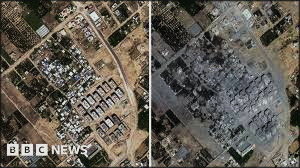
Before and after - greenhouses and gardens targeted

UN aid workers reiterate daily their warnings regarding the catastrophically perilous situation in Gaza.  UN estimates indicate that one in four Gazan Palestinians are living in a state of near-famine. This comes to a total of at least 576,000 people. Already, twenty-five people have died of acute malnutrition. Again, children are the most vulnerable, and twenty-one of those deaths were child fatalities.  UNICEF estimates that 1.7 million Gazan—out of a total of 2.2 million total—have been uprooted from their homes. Of those displaced, a million are children, and some seventeen thousand of those are kids who are either separated from their parents or who have evacuated war zones unaccompanied. This renders them even more vulnerable, since children are among the people least able to cope with hunger, disease and general neglect.

The international watchdog organization Human Rights Watch terms the tactics employed by Israel under Netanyahu “a war crime.” HRW clearly accuses Israeli forces of “deliberately blocking the delivery of water, food, and fuel, while willfully impeding humanitarian assistance, apparently razing agricultural areas, and depriving the civilian population of objects indispensable to their survival.”

The human rights group points to public statements from Israeli Defense Minister Yoav Gallant, National Security Minister Itamar Ben-Gvir and Energy Minister Israel Katz from the beginning of the war, indicating that their aim is to deprive Gaza civilians of food, water and fuel, an apparent policy reflected in the concrete actions of IDF officers and troops. Some Israeli officials have also indicated that aid would be withheld as a sort of ransom, until Israeli hostages are released or until Hamas has been destroyed.
Two days after the brutal Hamas attack on Israel last October, Defense Minister Gallant said: “We are imposing a complete siege on [Gaza]. No electricity, no food, no water, no fuel–everything is closed. We are fighting human animals and we must act accordingly.”

National Security Minister Ben-Gvir tweeted a week later, “So long as Hamas does not release the hostages, the only thing that should enter Gaza is hundreds of tons of air force explosives, not an ounce of humanitarian aid.”

And five days after the Hamas attack, Energy Minister Katz said:

“Humanitarian aid to Gaza? Not a switch will be flicked on, not a valve will be opened, not a fuel truck will enter until the Israeli hostages come home. Humanitarian for humanitarian. Let no one lecture us about morality.”

In support of its claims that Israel is not only withholding food but is also destroying Palestinians’ own essential food production capabilities, HRW has provided before-and-after satellite images showing thriving Gazan fields, orchards and greenhouses apparently bulldozed by Israeli operatives just days after the Israeli war on the Gaza strip began. High resolution satellite imagery of farmland near the Erez border crossing shows both bulldozer tracks and soil bulldozed into mounds surrounding former agricultural plots.

According to Human Rights Watch Israel and Palestine Director Omar Shakir: “…Israel has been depriving Gaza's population of food and water, a policy spurred on or endorsed by high-ranking Israeli officials and reflecting an intent to starve civilians as a method of warfare. World leaders should be speaking out against this abhorrent war crime, which has devastating effects on Gaza’s population.”

And there can be little doubt that human rights leaders are justified in referring to Netanyahu’s actions as a war crime. According to international humanitarian law and internationally accepted rules of war, intentionally starving civilians as a method of warfare is prohibited.  The Rome Statute, under which the International Criminal Court operates, takes this a step further by providing that “depriving (civilians in war zones) of objects indispensable to their survival, including willfully impeding relief supplies” is a war crime. Nor does criminal intent require the attacker’s admission of such acts. These can be inferred from the totality of evidence and of the circumstances involved in any military campaign.

Additionally, Physicians for Human Rights Israel reports, with regard to thousands of Palestinian prisoners who have been held without charge over the course of the last six months, “Since October 7th, any semblance of restraint has been cast aside regarding the treatment of Palestinians in Israeli incarceration and detention facilities. Forced disappearances, torture, and severe violations of human rights, particularly in terms of health, are now inherent in the practices and policies of Israeli security bodies responsible for Palestinians in custody. These actions have garnered support and, at times, were explicitly demanded by the political ranks. Simultaneously, the judicial system has allowed these blatant deviations from professional and ethical standards to persist without intervention.”

According to human rights activists and newspaper reports from media ranging from Al Jazeera to The New York Times, this trend has only worsened over the course of the war, with the number of Palestinians detained, many innocent bystanders and random men of military age, having burgeoned to some nine thousand. According the Physicians for Human Rights report published in ReliefWeb, “Efforts to push Israeli courts to intervene and prevent the systematic disregard of reasonable incarceration standards have so far been unsuccessful. Similarly, efforts to encourage the medical community to safeguard the right to adequate care have also failed. As a result, Israel’s vindictive policies and unofficial punitive measures in prisons continue unchecked and unchallenged.”

Accusations including holding prisoners for extended periods naked, hooded and shackled in infra-human conditions, systematic humiliation and beatings, denial of basic medical care, as well as other forms of torture and sexual assault. Sadly, there has been nearly no international outcry regarding these blatant rights violations other than those coming from the world human rights community.  

We Americans have always stood with Israel. We recall the Holocaust and the fact that the Jewish people have been the most persecuted and victimized social group of modern times. We remember this as a major rallying call for rising up against fascism and crushing it in the deadliest war of all time. We recall and hold as nothing short of sacred the memory of the six million Jews exterminated by Nazi Germany during World War II, in what was the worst genocide in history. In much the same way, we remember the twelve hundred Israelis and foreign visitors murdered by Hamas terrorists last year.

But Benjamin Netanyahu is taking unfair advantage of the deference that the West has bestowed on Jews in general and on the State of Israel in particular. Worse still, he is employing, in a sense, the same sort of indiscriminate and genocidal tactics in his personal war on the Palestinians that led to the Holocaust during World War II. While he insists that his only purpose is to wipe out the Hamas terrorist organization, his mass killing of Palestinian civilians can no longer be ignored, condoned or excused.

Netanyahu’s war is an all-out war on the Palestinian people. It is a war that shows no mercy for civilians in general, or for women and children in particular. And making war on children is clearly contrary to his stated aim of doing away with Hamas. Making war on children definitively guarantees a whole new generation of ever more ruthless, anti-Israeli fighters. As such, this will be the cruel and dangerous legacy of Netanyahu’s war, bequeathed by him both to the people of Israel, and to the Palestinian people.


Sunday, July 17, 2022

CAPITULATION


With what he may have thought was a harmless and indifferent gesture, US President Joe Biden this past week issued a powerful message not only to Saudi Arabia but also to human rights advocates everywhere: When it comes to the choice between defense of human rights, free speech and democracy or cheap fuel for America’s gas-guzzling SUVs, we’ll take cheap gas.

Murdered journalist Jamal Khashoggi

There can be little doubt that when Biden had to confront the inevitable photo op with the ruthless Saudi leader, Crown Prince Mohammed Bin Salman, it was an embarrassing moment. It looked way too much like what it was—humiliation, desperation, the flailing of a drowning man. 

After all, this was the guy whom Biden had promised in fiery campaign speeches a couple of years ago that he was going to hold to account and shun as “the pariah that he is.”  But with Putin’s war in Ukraine turning the oil market head over heels, and soaring gasoline prices at home fueling nearly double-digit inflation and inversely scuttling the president’s popularity ratings on all fronts, the question Biden probably asked himself was, as the BBC’s veteran worldwide correspondent John Simpson quipped, “Who has a lot of oil? Exactly!”  

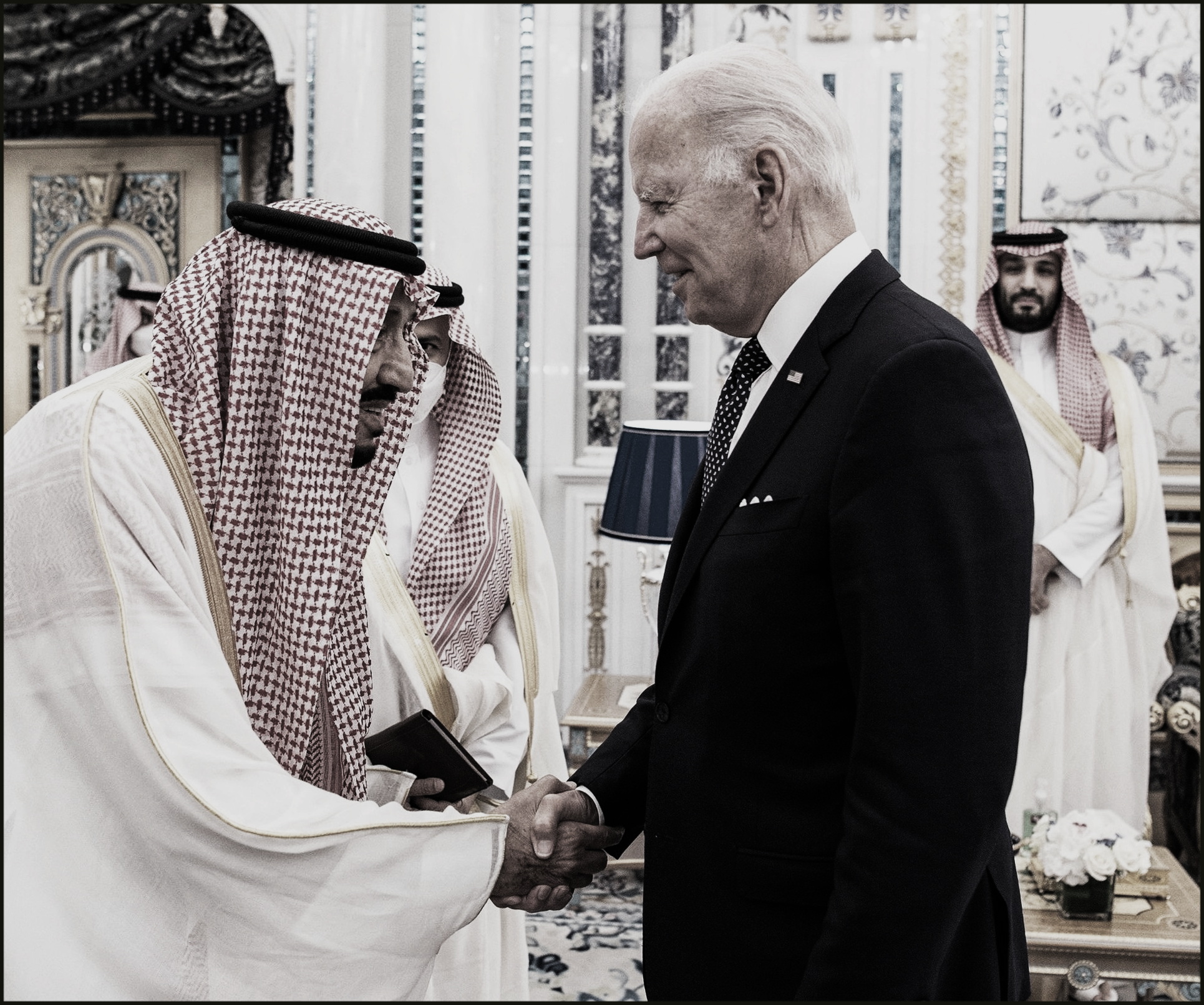
While the president would share a warm handshake with Saudi King Salman bin Abdul-Aziz, he made sure that it was clear that MBS only merited a quick fist-bump. One wonders if this was supposed to allay the concerns of the liberals who had voted for him or to have prompted the international community and human rights activists to say, “Ha, see there, fist-bump. I guess Biden showed him!” Because if that was supposed to be the message, it didn’t take. The word that more likely seems to have been the first to come to mind was “capitulation” rather than scorn.

The politically costly fist-bump
In the lead-up to this unfortunate meeting, Biden’s West Wing had indicated he might not meet at all with MBS and would instead only officially meet with the king. But too many foreign affairs experts made it clear that if that was the plan, he might as well stay home, because the cock who currently rules the roost in Saudi Arabia is the crown prince. The king, they pointed out, is a mere figurehead for life, with no real power to decide anything. If you want to talk to the Saudis, you can’t avoid talking to MBS, because Saudi Arabia is a one-man show.

Which is precisely the point about the murder of Saudi Washington Post columnist Jamal Ahmad Khashoggi. Nothing of consequence happens in the Saudi regime without the knowledge and complicity of MBS. To believe the official story of the Saudi government that the murder was committed by rogue outliers without the crown prince’s knowledge is to believe in fairytales—especially since the grisly assassination took place within the premises of a Saudi diplomatic mission.

For anyone who might need to refresh their memory regarding this major international incident, here’s a brief summary of the facts. Jamal Khashoggi was a high-profile Saudi dissident, journalist and author, who had long campaigned against the bloody regime, not as a radical, but as a moderate who was willing to advocate gradual democratic improvement without pushing for the overthrow of the Saudi government. Prior to his work as a columnist for the Washington Post’s Middle East Eye section, Khashoggi had served briefly as the editor of Al Watan, a Saudi newspaper that he sought to mold into a platform for progressives seeking respect for human rights and a more democratic opening. He was a particularly strong advocate of equal rights for women in his country. But his trenchant opposition to the regime’s domestic policies caused him to be sacked.

No fist-bump for the Saudi king.

After the Saudi regime banned him from Twitter in 2017 for his criticism of the brutal policies supported by the king and crown prince, Khashoggi had reason to believe that his life was in danger and in September of that year, he left Saudi Arabia for self-imposed exile in the US. While in exile, besides working for the Washington Post, he also became general manager and editor-in-chief at the Al-Arab News Channel, and continued to be a powerful voice for democratic change in his native country.

He was, additionally, a staunch critic of the war on Yemen waged by Saudi Arabia with US backing, which had fostered one of the world’s worst humanitarian crises. Of that war, he once wrote: “The longer this cruel war lasts in Yemen, the more permanent the damage will be. The people of Yemen will be busy fighting poverty, cholera and water scarcity and rebuilding their country. The crown prince must bring an end to the violence…Saudi Arabia's crown prince must restore dignity to his country by ending Yemen's cruel war.”

On October 2, 2018, the fifty-nine-year-old journalist was happily planning his upcoming marriage to then thirty-six-year-old Hatice Cengiz of Turkey. On that date, Khashoggi went to the Saudi Embassy in Istanbul to request some documentation he would need for his marriage. CCTV footage recorded him entering the embassy, but he was never recorded coming out. Later investigation revealed that the journalist had been brutally murdered inside the premises of the diplomatic mission and his body dismembered and removed to another location.

After releasing a series of thin and conflicting stories to try to cover up the heinous crime, the Saudi government eventually admitted that the murder had occurred but has maintained ever since that it was carried out without the crown prince’s involvement or knowledge. This, despite the fact that in 2017, MBS had told another Saudi journalist that Khashoggi's work was tarnishing his image, and that he would go after Khashoggi “with a bullet.”

Less than two months before his murder, Khashoggi wrote, “Saudi Arabia's Crown Prince…is signaling that any open opposition to Saudi domestic policies...is intolerable." As an example of this repressive policy, he pointed to government measures “…as egregious as the punitive arrests of reform-seeking Saudi women.” He wrote that “while MBS is right to free Saudi Arabia from ultra-conservative religious forces, he is wrong to advance a new radicalism that, while seemingly more liberal and appealing to the West, is just as intolerant of dissent.” Khashoggi went on to write: “MBS's rash actions are deepening tensions and undermining the security of the Gulf States and the region as a whole.”

Following careful investigation, the CIA has concluded that there is no doubt that Khashoggi’s assassination was on orders from MBS and that the crown prince had reached across international borders to carry it out, sending a hit squad of more than a dozen agents to murder the journalist in Turkey and make his body disappear. This is consistent with the fact that no few of the regime’s other opponents have simply disappeared without a trace.

Despite President Biden’s initial promises to hold MBS and Saudi Arabia to account for the murder and for the generally ruthless policies of the regime, and in spite of repeated calls from human rights advocates and liberal politicians for the severing of diplomatic ties with the Saudi regime, this past week’s meeting with the crown prince rendered his good intentions moot. Furthermore, that single meeting overshadowed Biden’s entire Middle East tour, eclipsing everything else, which, even without the MBS factor, didn’t go well.

To wit, besides fist-bumping his way into one of the still most burning human rights controversies of today, sparking the outrage of every human rights group at home and abroad that was looking to this administration to restore the basic decency unceremoniously trashed during the Trump presidency, he failed to get anything significant in return. There is no real evidence to suggest that Saudi Arabia has the installed capacity to significantly increase its production, or that, like the rest of the international oil cartel, it would be willing to do anything that might spark a drastic decrease in the price of oil. And the trip rendered no immediate solution to high fuel prices in the rest of the region either.

While Biden managed to give the appearance of inching bitter enemies Saudi Arabia and Israel somewhat closer together, there’s no reason to believe that MBS will risk major conservative opposition at home to appease Washington and Tel Aviv, nor is there any guarantee that the right-wing Netanyahu camp won’t return to power in Israel and undo any progress made. Furthermore, while he did his best to appear tough on Iran, he simultaneously said that his administration still believed that diplomacy was the answer and made clear his commitment to piecing the Iran nuclear accord achieved under the Obama administration back together. While that was sure to please those of us who believe that the way to deal with Iran is by bringing it back into the concert of nations, it is a policy that is unlikely to garner any support whatsoever after the mid-term elections when Democrats may very well lose their tenuous hold on Congress.

To add insult to injury, while he was touring the Middle East, Biden was once again blindsided by West Virginia senator and Democratic outlier Joe Manchin, who again threw the president’s domestic policy plans into utter chaos.

So what could the US president possibly have to gain from capitulating to MBS? The answer is “nothing,” and his advisers should have made him aware of that fact. Because by fist-bumping with a ruthless murderer, the only thing the president has earned is the contempt of the international human rights community and the further erosion of his support among liberal Democrats.