Showing posts with label Supreme Court. Show all posts

Monday, June 27, 2022

THE LONG TAIL OF THE DECISION TO REVERSE ROE VERSUS WADE

 If there was one thing we learned in the first stage of the Trump Era, it was that no matter how bad things got, they could only get worse. We were seeing things happen that would have been unthinkable previously, and none of them were good. They all tended toward a concerted assault on freedom and democracy. We even witnessed something that we, and most other people around the world, would have thought an utter impossibility in the United States of America: a serious attempt to foster a violent overthrow of the prevailing order and to install an autocratic, single-party regime in power.

The other thing we learned in the first stage of the Trump Era was that there is a second stage. Although the majority of Americans breathed a collective sigh of relief when the democratic transfer of power actually took place—after being unable to believe our own eyes and ears when it seemed that it wouldn’t—that relief has proven a false friend. There has been no return to normalcy, no prosecution of the real perpetrators of the almost coup, no vindication of those who literally risked everything to re-establish democratic order. On the contrary, the offending parties are bolder than ever, are defying legal processes and are counting on again taking over power, while changing voting laws, districts and procedures (and, in the process, violating hard-won minority voting rights) in any way they can to ensure that they do.

Perhaps the biggest sigh of relief that true democrats breathed was when, in the aftermath of the 2020 election, it became clear that, finding no accomplices for his patently false accusations of election fraud amid more than sixty federal judges, a number of whom he had appointed to the court, a defeated but implacable Donald Trump planned to use the Supreme Court—which he had packed with three ultra-conservative justices—to seek to legitimize his phony fraud claims. Our relief came when none of the Trump appointees agreed to hear voter fraud cases brought to the Court by Trump surrogates including, prominently, attorney Sidney Powell. The only dissenting opinion in the Court regarding hearing any of the cases that Trump World sought to bring before it was that of Associate Justice Clarence Thomas. Thomas’s wife Ginni has since been outed as a diehard Trump supporter who may well have played an important role in propagating the so-called Big Lie and in other efforts to overturn the legitimate presidential election results.

Once again, however, we were falsely lulled into believing that the checks and balances were working, and that, even when the Republican side of Congress was packed with coup-mongers, the Supreme Court would still prevail in protecting the inherent rights of American citizens against violation by a far-right autocratic conspiracy. Nevertheless, if those attempts at undermining the election rights of Americans were too blatant for the Court to abide, we are now seeing that the far-right onslaught is continuing in not much subtler ways.

Kavanaugh, Coney Barrett, Thomas and Alito
The first open manifestation of this agenda took shape this past week when the conservative majority of justices struck down a half-century old SCOTUS decision (Roe v Wade) that basically determined that it was unconstitutional to deny women the right to an abortion, and thus, the right to the pursuit of their own destiny and to exercise control over their own bodies. Among the five assenting opinions were those of the three Trump appointees. While this may come as no surprise, it is worth noting—as have no few liberal members of Congress and even a few conservatives—that during their congressional confirmation hearings, all three testified under oath that they viewed Roe v Wade as a “settled precedent” and thus, the law of the land.

In constitutional law, settled precedents are, as the name suggests, questions of law that have been settled once and for all. In the case of Roe v Wade, what that meant—should anyone be in doubt—was that, in the US, abortion was a constitutionally guaranteed women’s right, a fact that coincides with international human rights standards. Authoritative interpretations of international human rights law have long established that denying women and girls access to abortion is a form of discrimination and jeopardizes an entire range of human rights. United Nations human rights treaty bodies regularly call on governments to decriminalize abortion in all cases and to ensure access to safe, legal abortion in at least certain circumstances—rape, incest, pregnancy in minors and pregnancies that jeopardize the health and welfare of the potential mother.

No matter how you look at it, the action taken to strike down a substantive legal precedent that has empowered and protected a woman’s right to autonomy over her life and body is invasive and difficult to justify. In the face of opposing opinions that are more dogma-based than practical, the Supreme Court could have just as easily allowed the settled precedent to stand as to reverse it. That is to say, the Court has gone out of its way to overturn a decision supporting a human and civil right based largely on the subjective beliefs of a minority portion of society.

Indeed, nationwide polls have shown that more than eighty percent of Americans believe that abortion should be legal at least under certain circumstances—incest, rape, etc. And the vast majority believe that it is a right that the state should protect rather than interfere in.

Polls also indicate that only a little more than a third of the country wanted to see Roe v Wade overturned—not surprisingly that proportion is about equal to the segment of society that currently supports Trump World and the Big Lie. Coincidence? Probably not. Meanwhile, a full two-thirds of those polled have consistently said that Roe v Wade should stand.

More revealing still was one poll that indicated that more than sixty percent of Republican women surveyed believed that abortion was a matter between a woman and her doctor in which government should have no role. So, on whose behalf was the Court deciding to strip women of a right guaranteed by a long-settled precedent? The answer is, a subjective, non-secular minority—likely made up to a much larger extent by men than by women (who are now more vulnerable to discrimination than before)—that is seeking to impose its self-righteous authoritarian principles on the whole of the population in detriment to majoritarian democratic society.

There is a ripple effect in breaking with long-held principles. If one person’s rights can be legally violated, then all people’s rights are placed at risk. So the Court’s decision has also debilitated the judicial security of other sectors of American society. While Justice Alito, who wrote the conservative majority opinion, hastens to say that "we emphasize that our decision concerns the constitutional right to abortion and no other right,” and that, “nothing in this opinion should be understood to cast doubt on precedents that do not concern abortion,” this would appear to be a personal opinion or wishful thinking with no real legal foot to stand on.

Thomas

Indeed, in a separate concurrence that he wrote to accompany his sign-off on the quashing of Roe v Wade, Justice Thomas gave his own far-right view, saying “I write separately to emphasize a second, more fundamental reason why there is no abortion guarantee lurking in the Due Process Clause. As I have previously explained, ‘substantive due process’ is an oxymoron that ‘lack[s] any basis in the Constitution.’” According to Thomas, substantive due process (i.e., rights granted by court decision rather than directly by the Constitution) has to do with the Constitution’s guarantee of due process before someone is denied the right to life, liberty or property. But he opines that it has no bearing on what those rights actually encompass. Thomas says that since the Due Process Clause “does not secure any substantive rights,” including a right to abortion, then the Supreme Court should “reconsider all of this Court’s substantive due process precedents.”

Other writing by Thomas on constitutional law suggests that he favors an enormous departure from how the SCOTUS has traditionally approached the right to due process—a legal tradition that goes back one hundred fifty years. In keeping with that historical approach, the Court had interpreted the basic rights granted by the Fifth and Fourteenth Amendments to protect substantive rights granted by legal precedent. In that way, the US legal system has granted an ever-growing list of liberties that we citizens enjoy, rather than seeking interpretations of the Constitution that strip citizens of legally acquired rights, as the reversal of Roe v Wade does.

Now that the Court has set an entirely new precedent for removing rather than protecting rights granted by law, Thomas has made it clear that he wants to see all such due process rulings reviewed. And he has specifically—despite Alito’s assurances that this is a one-shot deal—indicated that such a review should first focus on Griswold v Connecticut, 1965 (governing the general right to privacy and the specific right of married couples to use contraception), Lawrence v Texas, 2003 (decriminalizing intimate relations between persons of the same sex), and Obergefell v Hodges, 2015 (legalizing same-sex marriage).
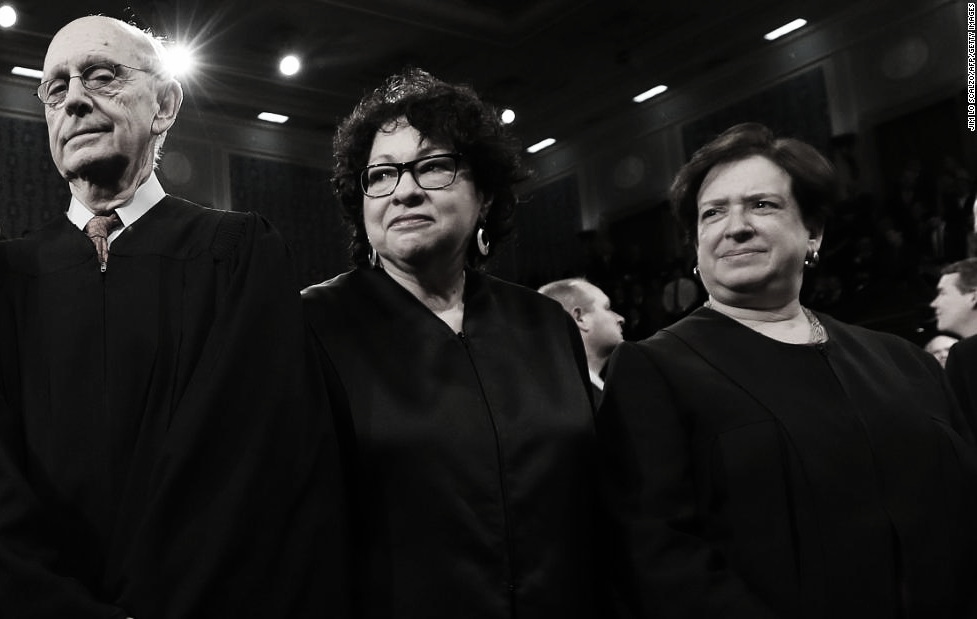
Breyer, Sotomayor and Kagan
If Obergefell were thrown out, perhaps the most significant human right acquired in the twenty-first century (the right to love whom you wish) would be torn from the law books, which could in turn re-criminalize same-sex relations altogether (Lawrence v Texas). The Court could further invade American bedrooms by banning such preventive contraception methods as IUDs and morning-after pills. It’s not hard to imagine further progressions to anything that “interrupts pregnancy”, such as vasectomy for males or tubal ligation for females.

In their dissenting arguments, Justices Breyer, Sotomayor and Kagan addressed this issue head-on, saying, "Either the mass of the majority's opinion is hypocrisy, or additional constitutional rights are under threat. It is one or the other…" They added, "We fervently hope that does not happen because of today's decision…But we cannot understand how anyone can be confident that today's opinion will be the last of its kind." 

The departure from a healthy legal tradition that this decision signifies appears to also have opened a veritable schism in the Court, one that Chief Justice Roberts’ usually moderating influence has been unable to span. Indeed, last week’s decision seems to signal that Roberts has lost control of the court, with Justice Thomas riding on the cusp of an extreme right turn in which his influence as a senior justice is added to the willing cooperation of the three Trump appointees (Kavanaugh, Coney Barrett and Gorsuch) and to the acquiescence of Alito.

Chief Justice John Roberts

In the controversial majority opinion, Alito wrote that abortion was not mentioned as a right in the Constitution as such, nor was the right to privacy. Incredibly, this last has not been stressed by the media, but the idea, according to the Court, that we have no constitutional or precedential right to privacy should come as a shock to Americans as a whole and should be a source of genuine outrage.

In their minority opinion, Breyer, Sotomayor and Kagan noted that since the framers of the Constitution were all men, “perhaps (it is) not so surprising that the ratifiers were not perfectly attuned to the importance of reproductive rights for women's liberty…" More specifically, the dissenting justices stated: "When the majority says that we must read our foundational charter as viewed at the time of ratification (except that we may also check it against the Dark Ages), it consigns women to second-class citizenship."

The dissenting opinion adds that the court's ruling discards a balance set by past abortion decisions. "It says that from the very moment of fertilization, a woman has no rights to speak of." 

It would be difficult not to characterize last week’s Supreme Court decision as blatantly political rather than judicial. There are clear indicators that support this. First and foremost is the fact that this sort of decision is unprecedented in the highest court in the land. Although extremely rare, it’s not that the Supreme Court has never reversed a former decision. But the fact is that when this has happened in the past, it has consistently been in the interest of granting ever-greater freedom to Americans and ever-growing autonomy in the face of authoritarian advances by government.

This is a glaring exception to that rule. This is the power of the court being used to suppress a right and freedom that citizens had already won. It’s clearly a far-right revisionist attempt to turn back the hands of time to a more repressive era and to undo one of the major victories of the battle for broader women’s rights. The question now is, which other legally acquired rights will follow as the “evangelical” far-right continues its implacable assault on freedom and democracy.         


Saturday, July 18, 2009

‘Wise Latina’ Proves Simply Brilliant

  • Caption: Judge Sonia Sotomayor (Official White House Photo)

Hey, do you hear that? Me either…That’s the sound of Judge Sonia Sotomayor NOT making headlines. Yesterday morning was the first time in days that President Barack Obama’s controversial pick for the Supreme Court – the first nominee for the high court named by a Democrat in 15 years and the first Hispanic appointee in history – wasn’t leading the news schedules.

I have to admit that, at first, I found the silence eerie and a bit disquieting. But then I checked around a little and figured it out: The usually flamboyant jurist, whose blunt comments have openly rankled conservative white Republican senators had handled herself with such admirable restraint as she stood up to grueling interrogation starting on Monday of this week, that by the end of the week she had successfully “underwhelmed” everybody. No longer even a headliner, she appeared to be on a course toward sure approval, no matter how hard far-right holdouts tried to delay the inevitable. In fact, one could say that, by now, if by some Republican-hardliner “miracle” she were not confirmed as a Supreme Court justice, it would be one of the greatest travesties in the history of Senate oversight.

All week long, in the Senate hearings to decide whether or not lawmakers would honor the President’s wish for her to become one of the nine justices charged with the task of making the country’s most difficult legal decisions, Democrats sought to raise a protective net around Judge Sotomayor, while Republican opponents to her appointment attacked her with rabid enthusiasm, gnashing away at her to see if they could get her to show what they had speculated were her “true colors”.

Before the 17-year veteran of the Federal Courts had ever gotten to the confirmation hearings, far-right senators and news commentators had already done their best to characterize her as a hothead, an activist, a reverse-racist, an over-emotional and perhaps even dangerous Latina of far-left persuasions, who decided cases based more on her gut than on the law. By the time Judge Sotomayor settled into the appointee’s seat before the panel of Senate ‘inquisitors’, a number of mainstream Americans were probably a little surprised that she didn’t arrive wearing olive drab fatigues and puffing a Cuban corona.

But the public hearings put that myth to rest immediately – or rather, Judge Sotomayor’s stunning performance before the hearing committee did. If she was any of the things far-right Republicans tried to lead the public to believe she was with their racist, sexist, paranoid gossip, there was never a glimpse of it all week. In fact, she received and answered (or sidestepped answering) all of their accusatory grilling with serenity, logic, grace and eloquence, demonstrating herself to be the well-focused and utterly brilliant jurist and intellectual that she is.

It was surely clear to no few objective observers that the most fervent of her opponents came to the hearings with an at least pre-conceived if not downright prejudiced bias against her. Their line of questioning made that fairly easy to see. For instance, South Carolina Republican Lindsey Graham saw nothing wrong with reading out a list of anonymous insults – more than criticisms - from alleged jurists who “knew” Sotomayor. Or did the senator just make them up himself? Anybody who has taken Journalism 101 knows that if you’re going to hurl accusations you had better have the sources to back them up. And in a court of law, Graham’s assertions would certainly have been referred to as “unsubstantiated hearsay” designed to bias the jury.

He claimed he knew of people who had called her “nasty”, “a bit of a bully”, a “terror” and “lacking in judicial temperament”. Graham then asked her if she thought she had a “temperament problem”. (This was tantamount to classic loaded questions of the sort of “Is it true that you’re no longer a drunk?”).

But even as insulting and gratuitous as Graham’s line of sophomoric questioning was, you could almost feel the yogini-like ooooooooooommmmmmmm vibrating in the jurist’s chest as, without allowing a flicker of the irritation she must have felt show on her face, she calmly answered, “No, sir, I can only talk about what I know about my relationships...” adding that she was on cordial terms with those she considered her colleagues, and going on to say, “…when I ask lawyers tough questions, it's to give them an opportunity to explain their positions on both sides and to persuade me that they're right.”

Obviously miffed that he couldn’t get a rise out of her, Graham, himself a lawyer, came back at her again saying, apropos of nothing, “I never liked appearing in court before a judge I thought was a bully.” To which Judge Sotomayor said that she did indeed ask attorneys tough questions, but that she did so even-handedly, on both sides of each case.

Prior to the hearings, Graham had been quoted as telling Sotomayor that “unless you have a complete meltdown, you’re going to be confirmed.” He was apparently trying to provoke just such a ‘meltdown’, but his attempt – clumsy and unsophisticated - was frustrated. In the end, the one who seemed rattled was the senator himself as he churlishly and condescendingly said that perhaps the hearings would provide Judge Sotomayor with “a time for self-reflection”. Nor was it the only time he sought to treat Sotomayor as his inferior. Twice he asked her if she recalled her now famous “wise Latina” remark (which, she had already explained, had been taken out of context and had been meant as a rhetorical device in a debate situation), then calling on her to recite it for the senate panel. When she hedged the second time he said he “had it right here” did she want him to read it? And he proceeded to do so. But to what end, other than harassment and attempted character assassination was anyone’s guess.

Clearly, the only bully in this case was Senator Graham, who seemed to be making a puerile attempt to get back at all those judges of the past that he had just admitted being scared to face in court. And like all bullies, he ended up looking flustered and foolish and decidedly un-gallant when faced with someone of true strength and self-confidence.

Earlier in the week she had also shown this strength when senior Republican committee member and Alabama Senator Jeff Sessions badgered her about the same “wise Latina” remark from a 2001 speech she had made and tried to tie this alleged “attitude” to how she would rule in cases with racial implications. She said that it had been a rhetorical device gone awry and indicated that her rulings as a judge were clearly based on the law and not on anything else. The indication was that her record spoke for itself. In further questioning about racial profiling which was also linked to fears of terrorism that have been rampant in the United States ever since the nine-eleven Twin Towers attack, Sotomayor referred to a World War II Supreme Court decision that upheld the internment of Japanese-Americans saying that the decision had been wrong. Considering the obvious parallel with present attempts to combat terrorism, she also explained how current courts could keep from repeating the mistakes of World War II. In conclusion she said: “A judge should never rule from fear. A judge should rule from law and the Constitution.”

By the end of the week Senator Sessions was showing no further interest in blocking Sotomayor’s appointment and even said, “I look forward to you getting that vote before we recess in August.” And Lindsey Graham had gone as far as to say that he “might even vote” for her, stating that her decisions as a judge had been “generally in the mainstream”, an impression echoed by Republican Senator John Cornyn of Texas.

In the end, the conservative Republican committee members’ line of questioning showed that their doubts were obviously more about their own racial bias and unfounded fears than about the judge’s judicial record or her outstanding qualifications as a jurist. And throughout the questioning, Sotomayor consistently managed to underscore the fact that she was precisely what she had had to apologize for being all week long: a “wise Latina” and a brilliant professional, clearly suited to the Supreme Court seat.


Monday, July 13, 2009

Sonia Sotomayor: Does White Make Right?

  • Caption: Judge Sonia Sotomayor. (Official White House Photo by Pete Souza).


US Republican Senator Jeff Sessions of Alabama has just had a lightning-bolt revelation. Namely, that President Barack Obama’s candidate for the Supreme Court, Federal Judge Sonia Sotomayor, is “out of the mainstream”...

I’ll wait a moment for the applause to die down before I go on.

You kind of have to figure that if Senator Sessions is just now noticing this about the New York-born Hispanic judge he either wasn’t listening before or he is just hopelessly obtuse. Well, of course, then there’s the other possibility: that he’s just now bringing it up and saying it on a nationwide news broadcast because he is still hoping against hope to hurt the 55-year-old jurist in the her confirmation hearings that started today, July 13.

One of Judge Sotomayor’s most avid defenders in the Senate, Democrat Patrick Leahy, has sought to show that the scare tactics the Republican opponents to the nomination are using are clearly unwarranted. The Associated Press has quoted him as stating that "…in truth, we do not have to speculate about what kind of a justice she will be because we have seen the kind of judge she has been. She is a judge in which all Americans can have confidence. She has been a judge for all Americans and will be a justice for all Americans…"

Leahy was talking about Sotomayor’s 17-year career as a Federal Judge, an achievement in itself considering that when she rose to the Federal bench she was approximately a decade and a half younger than most jurists are who receive that honor. Leahy stated that her record in the Federal Courts proved that she was “mainstream”.

Senator Leahy is also missing the point, however. Sonia Sotomayor is not mainstream. Not by a long shot. If her nomination makes it through the Senate hearings, she will be only the third woman ever to reach that august post, following the appointment of Sandra Day O’Connor in 1981 and that of Ruth Bader Ginsburg (currently serving) in 1993. She will also be the first Hispanic ever to sit on the Supreme Court bench and only its third minority member in history, sharing this well-deserved honor with Thurgood Marshall (first African American, appointed in 1967) and Clarence Thomas (the only serving black Justice, appointed in 1991). But apart from these obvious differences between Judge Sotomayor and other select jurists who have acceded to the highest court in the land, there is her own personal style to be considered. Sotomayor’s absolutely stunning honesty and audacious directness are what have gotten her into trouble with traditional white male conservative opponents. They question her statements regarding her Latin-ness, about the ability of a “wise Latina” to perhaps make clearer-cut decisions than some white males. And they have strived to connect her straightforward way of talking with her court’s decisions that they have attempted to brand as unfair, when, in fact, if they have erred at all, they have done so on the side of justice for all.

The fact is that what opponents are seeking to pass off as “weaknesses” in the argument for her appointment to the Supreme Court are really among Sonia Sotomayor’s strengths. Saying what the public wants to hear and making judgments according to popular belief rather than being true to oneself and one’s values and making decisions based on sound legal and ethical analysis is not what a Supreme Court justice should be known for, nor should running with the pack.

That Judge Sotomayor is capable of seeing the world from an angle other than that of the head-on mainstream should, in fact, be considered a welcome addition to the Justice system in the United States. Clearly, as a human being, no judge, no matter how lofty a position he or she attains, can see cases without doing so through the filter of their own upbringing, education and ethnic background. While it is their duty to be objective, it is their burden but also their virtue to be able to apply what they know about themselves and their own lives to the decisions they make and the opinions they give. And one would like to think that they are appointed, among other reasons, precisely because of their personal virtues.

The arguments that have been presented against Judge Sotomayor’s appointment to the Supreme Court, while dressed up in the guise of judicial issues, have been clearly racist and sexist in their underlying tone. Many mainstream, white, conservative Americans would probably like to continue to think of the Supreme Court as nine gray-headed, grumpy old white men, there to preserve and defend to the death the white Anglo-Saxon Puritan heritage that they would like to perceive as the “real heart and soul” of America. And these people tend to find Sotomayor downright “uppity”. But the truth is that the United States is an immigrant melting pot and that it has been this highly creative life-force that has been responsible for a large proportion of the country’s development and strength, its amazing diversity and its incredible adaptability. Never has this been truer than today, when in just a few short decades, the Hispanic population of the United States has gone from a scant 9 million to more than 45 million today, with projections for as many as 100 million US Hispanics to be living in the country by 2050.

Presuming that Judge Sotomayor should have to “answer for” her ethnicity and gender as an Hispanic woman is unquestionably gender and race-driven. For her opponents to try and pretend that race only enters into the issue in as much as Sonia Sotomayor is viewed as a “racist Latina” is truly hypocritical. Would they permit themselves to be questioned regarding their pride at being of “traditional” white origin or as a result of their making decisions that reflect their own ethnic background? And if not, does their “whiteness” somehow place them in the permanent position of inquisitor rather than respondent?

Fortunately, her approval appears almost assured even if it is highly improbable that she will win the approval rating of her white women predecessors, Sandra Day O’Connor, who received a Senate approval vote of 99 to 0, and Ruth Bader Ginsburg who was sworn in after a vote of 96 to 3. In the end, however, the outcome of the vote matters little, as long as it is positive, thus permitting the United States to enjoy the advantage of having a brilliant jurist with a fresh take on major issues sitting on its highest Court.