Showing posts with label abortion. Show all posts

Wednesday, August 9, 2023

OH O-HI-O!!!


My home state of Ohio topped the national news earlier this week in a litmus test for the GOP’s less than prudent bet against women’s reproductive rights.
  But while abortion rights topped the agenda of Ohio’s Issue One, which was soundly defeated in a special referendum on Tuesday, it also piggybacked other themes that were aimed at expanding the power of state and at restricting the influence that the people can exert on their elected officials.

Conservatives portrayed the referendum as vital to “protecting the state constitution.” But, in fact, it was an attempt to make it harder for common citizens to introduce constitutional amendments. Since 1912, amendments have been passed in the state by a simple majority (fifty percent plus one). Issue One was designed to raise that bar to sixty percent.

It is worth noting that, historically, less than a third of amendments to the Ohio constitution have passed by a sixty percent majority or more. But that wasn’t the only way in which Issue One would have restricted citizens’ political power. According to the terms of the referendum, citizens who sought to petition for the proposal of a constitutional amendment would have needed to collect at least five percent of signatures from voters in the previous gubernatorial race, and furthermore, that proportion of signatures would have had to come from all eighty-eight Ohio counties. Currently, a constitutional amendment can be elevated for consideration with the signatures of five percent of the voters in just forty-four of the eighty-eight counties.

But Issue One also sought to affect voter rights in an even more direct way, by proposing the elimination of current legislation that permits any voter whose signature has been deemed questionable by the office of the secretary of state to provide a signature-correction within a ten-day period after his or her ballot has been challenged. In other words, had the proposal passed, the secretary of state could have arbitrarily challenged ballot signatures and thrown the votes out without the voters’ having any recourse under the law. Considering the currently uncertain climate in which we have seen Republican attempts to steal an election through fraud on a national scale, this would have placed extraordinary authoritarian power in the hands of the secretary of state and, indeed, the state itself.

Although the referendum may have appeared, at first glance, to separate greater amendment restrictions from the abortion issue, they were, in fact, inextricably linked. Last year, Ohio’s legislature enacted one of the country’s most restrictive bans on abortion. Strong opposition to it, however, has kept that legislation from taking effect, since the Ohio Supreme Court agree to place it under judicial review. In the meantime, Ohio pro-choice activists have mounted a campaign to draft an amendment that would protect women’s reproductive rights.

Across the country, ever since the heavily conservative US Supreme Court overturned Roe v Wade, which had protected these rights for fifty years—despite data demonstrating that a vast majority of Americans across party lines are, to a greater or lesser degree, pro-choice and were against the end of Roe-v Wade—grass-roots efforts to protect pro-choice rights at a state level have been put together across the country. The result has been six successful proposals to protect reproductive rights in as many states since Roe v Wade was dismantled.

This fact has thrown the Ohio GOP—which is clearly playing to the radicalized base of Donald Trump, despite all indications that the majority of voters oppose a flat ban on abortion—into panic mode. In spite of conservative attempts to sell Issue One as “protecting the constitution”, Ohio Secretary of State Frank LaRose pulled no punches prior to the vote when he said that the referendum was “one hundred percent about keeping a radical, pro-abortion amendment out of our Constitution.”  Considering, as mentioned previously, that only about one in three amendments pass with a sixty percent majority, this tended to indicate that Issue One was less about constitutional integrity than about the GOP’s trying to appease the Trump evangelical base by keeping a pro-choice amendment from finding its way into law.

In the end, the inordinate stress that the Ohio GOP is placing on stripping women of their right to choose, and virtually making their wombs wards of the state, under the scrutiny and control government, may well be a very risky bet. The rejection of Issue One is clearly a strong indicator that this is true, especially in highly populated areas of the state, which Republicans can’t help but covet in their future election campaigns.

The numbers tell the story. Twice as many people voted in the referendum as in Ohio’s last primary. Overall, the measure was defeated by fifty-seven percent. In all major cities in the state, however, Issue One was spectacularly rejected by margins of between sixty-one and seventy-six percent.

Perhaps the Ohio GOP would be smart to stop tuning their discourse to the Trump base, rethink making abortion a major plank in their campaign and start concentrating on more practical issues.


Tuesday, July 5, 2022

FOURTH OF JULY REFLECTIONS


I wanted to wish all of my fellow Americans a happy Fourth of July yesterday…but I couldn’t. I just couldn’t. Couldn’t muster any happiness about what’s happening in my native country today. It’s all just too grim.

Maybe it’s the weather. Here in Patagonia, it’s raining and snowing, cold and dark. It’s more fitting of the state of my nation—once the beacon of democracy, the temple of individual rights—than a sunny day full of brass bands, fireworks, picnics and beer.

But then again, if we give any thought at all to the actual significance of the Fourth of July, we Americans—at least every small-d democrat among us—should have been in mourning yesterday. Not for our origins, which were noble, but for what we’ve lost along the way, and especially what we’ve lost in the last five and a half years.

I would like to say—have wanted to say since January 20, 2020—not to worry. That things can only get better. But that appears to be a fatuous lie. Indeed, in terms of freedom, civil rights and justice, we are abysmally worse off than we were just last month. With the far-right in Congress throwing their full support behind an insurrection that—let’s stop pussyfooting around and call it like it is—sought to overthrow the government of the United States and perpetuate the reign of an autocrat who had clearly lost a free and fair election, and with that self-same autocrat refusing for the first time in US history to leave office peacefully after his election defeat, the Supreme Court was the last bastion standing against this indubitable war on democracy and what used to be known as “The American Way”. But in the last days of June before the Fourth of July recess, that ship clearly sailed as well.

Events in that democratic bloodbath at the Supreme Court in the fateful last days in June included a judicial restructuring that very apparently sought to bolster the ambitions of one segment of the population while debilitating the rights of another. In the process, the power of the Court—like the GOP before it—was unmistakably usurped by the far right, effectively sidelining the normally moderating influence of the chief justice. That institution’s erstwhile principles of respect for settled judicial precedent when it favors individual freedoms, as well as for legally acquired rights, were cavalierly tossed out the window.

This was the intended mission that former President Donald Trump—and the major party that he managed in a few short years to take over through a veritable political reign of terror—hoped the three justices they named to the Court would take up. They haven’t been disappointed. And those newly appointed justices have found an echo for their extreme beliefs in senior Associate Justice Clarence Thomas, who was previously a sort of judicial lone wolf in his far-right opinions.

In the latter days of June, and in practically one fell swoop, the Supreme Court of the United States struck down one of the most essential of women’s civil rights—the right to autonomy over their own bodies and their own destiny. This was a hard-fought right that had been federal law in the United States for very nearly a half-century.

With the exception of the right to vote, which women didn’t enjoy for the first time until 1920, and which was a mere first small step in their equal rights struggle that continues today, Roe v Wade was arguably the most consequential decision in favor or women’s rights in the history of the United States. It eschewed the political and religious strictures that had been imposed on women since the nation’s founding (a sort of Christian “sharia law” that precluded a woman’s right to corporeal autonomy), and upheld the right of women to invoke the principle of “my body, my choice.”

Coco Das, an organizer with Rise Up 4 Abortion Rights, put it succinctly when she told The Guardian, “This decision not only goes against the will of the people—the majority of people support abortion rights, legal abortion—it goes against modern progress, the progress of history.” Das describe the Supreme Court’s controversial decision to overturn Roe v Wade as being “based on biblical literalism, a fundamentalist Christian fanatical movement.” As I said before, the equivalent of Christian “sharia law”. She added that the Court’s so-called “conservative” majority are “really trying to transform (American) society to one that’s dominated on the basis of white supremacy, male supremacy, Christian supremacy. It’s very dangerous. Without the right to abortion, women can’t be free, and if women aren’t free, nobody’s free.”

But the Court didn’t stop there in its June onslaught in favor of the extreme right. Its far-right justices also ruled in majority decisions against states’ rights when it comes to arms control, against environmental protection, against Native tribal law, and against the founding constitutional principle of separation of Church and State.  

The Court ruled to disallow a 1911 New York state gun law that imposed strict restrictions on carrying firearms outside the home. The decision, in New York State Rifle & Pistol Association v Bruen, came halfway through a year in which the US has suffered a record three hundred nine mass shooting incidents in which two hundred twenty people have died. In his opinion, echoed by the “conservative” Court majority, Justice Thomas posited that New York laws that recognized people’s right to keep guns in their homes, but restricted the right to carry them freely in the street without good cause violated the “right to bear arms” embodied in the Second Amendment.

The Court also voted in favor of a former high school football coach who was suspended for praying with athletes on the field after games, a practice which imposes religious manifestations on secular public school activities and flies in the face of a sixty-year-old precedent indicating that imposing prayer of any kind on public school children violates their First Amendment right to freedom of religion. The justices also rejected a Maine law that prohibited religious schools from drawing tuition aid from public funds. In her dissent against this measure, Justice Sonia Sotomayor wrote, “This court continues to dismantle the wall of separation between church and state that the framers fought to build.” 

And finally, the Court also in June moved against a long-held precedent of tribal law on Native land and curbed the power of the Environmental Protection Agency to pursue major polluters. The rightist majority decided that, from now on, state prosecutors will be able to pursue criminal cases for crimes perpetrated by non-Native persons against Native persons on tribal land—a decision which, according to Cherokee Chief Chuck Hoskin Jr, signifies that “the US Supreme Court (has) ruled against legal precedent and (against) the basic principles of congressional authority and Indian law.” The next day, the Court decided to support litigation brought by West Virginia that insisted the US Environmental Protection Agency (EPA) be restricted in its regulation of planet-heating gasses from the energy industry.

Regarding this last measure, former New York Mayor and current special envoy to the UN Michael Bloomberg said, “The decision to side with polluters over the public will cost American lives and cause an enormous amount of preventable suffering, with the biggest burden falling on low-income communities and communities of color.” 

Lawrence Gostin, a law professor at Georgetown University and director of the World Health Organization’s center on Global Health Law made a realistic assessment of the current situation in the US when he said, “We’re absolutely in a constitutional crisis. And our democracy is now one of the most fragile democracies among our peer nations. We haven’t fallen over the cliff—we still abide by the rule of law, more or less, and still have elections, more or less—but the terms of our democracy have really been eviscerated by the Supreme Court.”

This is not a conspiracy theory. The lines of what’s happening have been sharply drawn. Never, since the Civil War, has the United States been so deeply divided, or so in danger of democratic dissolution. To my mind, then, this year’s Fourth of July was the saddest in all of my seventy-two years. I’m fervently hoping that better, more democratic times lie ahead, but I won’t hold my breath while I wait.      

Monday, June 27, 2022

THE LONG TAIL OF THE DECISION TO REVERSE ROE VERSUS WADE

 If there was one thing we learned in the first stage of the Trump Era, it was that no matter how bad things got, they could only get worse. We were seeing things happen that would have been unthinkable previously, and none of them were good. They all tended toward a concerted assault on freedom and democracy. We even witnessed something that we, and most other people around the world, would have thought an utter impossibility in the United States of America: a serious attempt to foster a violent overthrow of the prevailing order and to install an autocratic, single-party regime in power.

The other thing we learned in the first stage of the Trump Era was that there is a second stage. Although the majority of Americans breathed a collective sigh of relief when the democratic transfer of power actually took place—after being unable to believe our own eyes and ears when it seemed that it wouldn’t—that relief has proven a false friend. There has been no return to normalcy, no prosecution of the real perpetrators of the almost coup, no vindication of those who literally risked everything to re-establish democratic order. On the contrary, the offending parties are bolder than ever, are defying legal processes and are counting on again taking over power, while changing voting laws, districts and procedures (and, in the process, violating hard-won minority voting rights) in any way they can to ensure that they do.

Perhaps the biggest sigh of relief that true democrats breathed was when, in the aftermath of the 2020 election, it became clear that, finding no accomplices for his patently false accusations of election fraud amid more than sixty federal judges, a number of whom he had appointed to the court, a defeated but implacable Donald Trump planned to use the Supreme Court—which he had packed with three ultra-conservative justices—to seek to legitimize his phony fraud claims. Our relief came when none of the Trump appointees agreed to hear voter fraud cases brought to the Court by Trump surrogates including, prominently, attorney Sidney Powell. The only dissenting opinion in the Court regarding hearing any of the cases that Trump World sought to bring before it was that of Associate Justice Clarence Thomas. Thomas’s wife Ginni has since been outed as a diehard Trump supporter who may well have played an important role in propagating the so-called Big Lie and in other efforts to overturn the legitimate presidential election results.

Once again, however, we were falsely lulled into believing that the checks and balances were working, and that, even when the Republican side of Congress was packed with coup-mongers, the Supreme Court would still prevail in protecting the inherent rights of American citizens against violation by a far-right autocratic conspiracy. Nevertheless, if those attempts at undermining the election rights of Americans were too blatant for the Court to abide, we are now seeing that the far-right onslaught is continuing in not much subtler ways.

Kavanaugh, Coney Barrett, Thomas and Alito
The first open manifestation of this agenda took shape this past week when the conservative majority of justices struck down a half-century old SCOTUS decision (Roe v Wade) that basically determined that it was unconstitutional to deny women the right to an abortion, and thus, the right to the pursuit of their own destiny and to exercise control over their own bodies. Among the five assenting opinions were those of the three Trump appointees. While this may come as no surprise, it is worth noting—as have no few liberal members of Congress and even a few conservatives—that during their congressional confirmation hearings, all three testified under oath that they viewed Roe v Wade as a “settled precedent” and thus, the law of the land.

In constitutional law, settled precedents are, as the name suggests, questions of law that have been settled once and for all. In the case of Roe v Wade, what that meant—should anyone be in doubt—was that, in the US, abortion was a constitutionally guaranteed women’s right, a fact that coincides with international human rights standards. Authoritative interpretations of international human rights law have long established that denying women and girls access to abortion is a form of discrimination and jeopardizes an entire range of human rights. United Nations human rights treaty bodies regularly call on governments to decriminalize abortion in all cases and to ensure access to safe, legal abortion in at least certain circumstances—rape, incest, pregnancy in minors and pregnancies that jeopardize the health and welfare of the potential mother.

No matter how you look at it, the action taken to strike down a substantive legal precedent that has empowered and protected a woman’s right to autonomy over her life and body is invasive and difficult to justify. In the face of opposing opinions that are more dogma-based than practical, the Supreme Court could have just as easily allowed the settled precedent to stand as to reverse it. That is to say, the Court has gone out of its way to overturn a decision supporting a human and civil right based largely on the subjective beliefs of a minority portion of society.

Indeed, nationwide polls have shown that more than eighty percent of Americans believe that abortion should be legal at least under certain circumstances—incest, rape, etc. And the vast majority believe that it is a right that the state should protect rather than interfere in.

Polls also indicate that only a little more than a third of the country wanted to see Roe v Wade overturned—not surprisingly that proportion is about equal to the segment of society that currently supports Trump World and the Big Lie. Coincidence? Probably not. Meanwhile, a full two-thirds of those polled have consistently said that Roe v Wade should stand.

More revealing still was one poll that indicated that more than sixty percent of Republican women surveyed believed that abortion was a matter between a woman and her doctor in which government should have no role. So, on whose behalf was the Court deciding to strip women of a right guaranteed by a long-settled precedent? The answer is, a subjective, non-secular minority—likely made up to a much larger extent by men than by women (who are now more vulnerable to discrimination than before)—that is seeking to impose its self-righteous authoritarian principles on the whole of the population in detriment to majoritarian democratic society.

There is a ripple effect in breaking with long-held principles. If one person’s rights can be legally violated, then all people’s rights are placed at risk. So the Court’s decision has also debilitated the judicial security of other sectors of American society. While Justice Alito, who wrote the conservative majority opinion, hastens to say that "we emphasize that our decision concerns the constitutional right to abortion and no other right,” and that, “nothing in this opinion should be understood to cast doubt on precedents that do not concern abortion,” this would appear to be a personal opinion or wishful thinking with no real legal foot to stand on.

Thomas

Indeed, in a separate concurrence that he wrote to accompany his sign-off on the quashing of Roe v Wade, Justice Thomas gave his own far-right view, saying “I write separately to emphasize a second, more fundamental reason why there is no abortion guarantee lurking in the Due Process Clause. As I have previously explained, ‘substantive due process’ is an oxymoron that ‘lack[s] any basis in the Constitution.’” According to Thomas, substantive due process (i.e., rights granted by court decision rather than directly by the Constitution) has to do with the Constitution’s guarantee of due process before someone is denied the right to life, liberty or property. But he opines that it has no bearing on what those rights actually encompass. Thomas says that since the Due Process Clause “does not secure any substantive rights,” including a right to abortion, then the Supreme Court should “reconsider all of this Court’s substantive due process precedents.”

Other writing by Thomas on constitutional law suggests that he favors an enormous departure from how the SCOTUS has traditionally approached the right to due process—a legal tradition that goes back one hundred fifty years. In keeping with that historical approach, the Court had interpreted the basic rights granted by the Fifth and Fourteenth Amendments to protect substantive rights granted by legal precedent. In that way, the US legal system has granted an ever-growing list of liberties that we citizens enjoy, rather than seeking interpretations of the Constitution that strip citizens of legally acquired rights, as the reversal of Roe v Wade does.

Now that the Court has set an entirely new precedent for removing rather than protecting rights granted by law, Thomas has made it clear that he wants to see all such due process rulings reviewed. And he has specifically—despite Alito’s assurances that this is a one-shot deal—indicated that such a review should first focus on Griswold v Connecticut, 1965 (governing the general right to privacy and the specific right of married couples to use contraception), Lawrence v Texas, 2003 (decriminalizing intimate relations between persons of the same sex), and Obergefell v Hodges, 2015 (legalizing same-sex marriage).

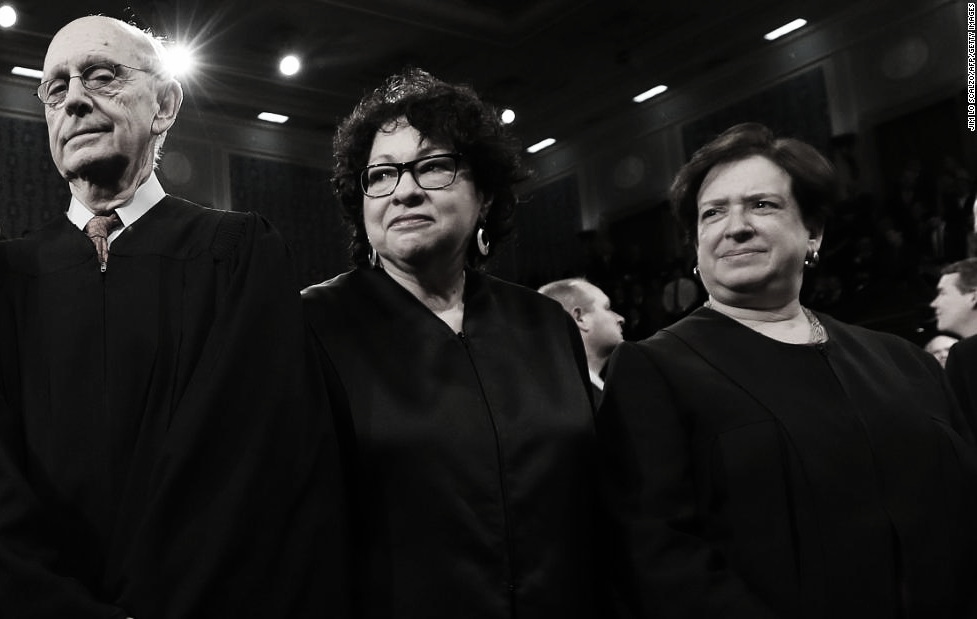
Breyer, Sotomayor and Kagan
If Obergefell were thrown out, perhaps the most significant human right acquired in the twenty-first century (the right to love whom you wish) would be torn from the law books, which could in turn re-criminalize same-sex relations altogether (Lawrence v Texas). The Court could further invade American bedrooms by banning such preventive contraception methods as IUDs and morning-after pills. It’s not hard to imagine further progressions to anything that “interrupts pregnancy”, such as vasectomy for males or tubal ligation for females.

In their dissenting arguments, Justices Breyer, Sotomayor and Kagan addressed this issue head-on, saying, "Either the mass of the majority's opinion is hypocrisy, or additional constitutional rights are under threat. It is one or the other…" They added, "We fervently hope that does not happen because of today's decision…But we cannot understand how anyone can be confident that today's opinion will be the last of its kind." 

The departure from a healthy legal tradition that this decision signifies appears to also have opened a veritable schism in the Court, one that Chief Justice Roberts’ usually moderating influence has been unable to span. Indeed, last week’s decision seems to signal that Roberts has lost control of the court, with Justice Thomas riding on the cusp of an extreme right turn in which his influence as a senior justice is added to the willing cooperation of the three Trump appointees (Kavanaugh, Coney Barrett and Gorsuch) and to the acquiescence of Alito.

Chief Justice John Roberts

In the controversial majority opinion, Alito wrote that abortion was not mentioned as a right in the Constitution as such, nor was the right to privacy. Incredibly, this last has not been stressed by the media, but the idea, according to the Court, that we have no constitutional or precedential right to privacy should come as a shock to Americans as a whole and should be a source of genuine outrage.

In their minority opinion, Breyer, Sotomayor and Kagan noted that since the framers of the Constitution were all men, “perhaps (it is) not so surprising that the ratifiers were not perfectly attuned to the importance of reproductive rights for women's liberty…" More specifically, the dissenting justices stated: "When the majority says that we must read our foundational charter as viewed at the time of ratification (except that we may also check it against the Dark Ages), it consigns women to second-class citizenship."

The dissenting opinion adds that the court's ruling discards a balance set by past abortion decisions. "It says that from the very moment of fertilization, a woman has no rights to speak of." 

It would be difficult not to characterize last week’s Supreme Court decision as blatantly political rather than judicial. There are clear indicators that support this. First and foremost is the fact that this sort of decision is unprecedented in the highest court in the land. Although extremely rare, it’s not that the Supreme Court has never reversed a former decision. But the fact is that when this has happened in the past, it has consistently been in the interest of granting ever-greater freedom to Americans and ever-growing autonomy in the face of authoritarian advances by government.

This is a glaring exception to that rule. This is the power of the court being used to suppress a right and freedom that citizens had already won. It’s clearly a far-right revisionist attempt to turn back the hands of time to a more repressive era and to undo one of the major victories of the battle for broader women’s rights. The question now is, which other legally acquired rights will follow as the “evangelical” far-right continues its implacable assault on freedom and democracy.