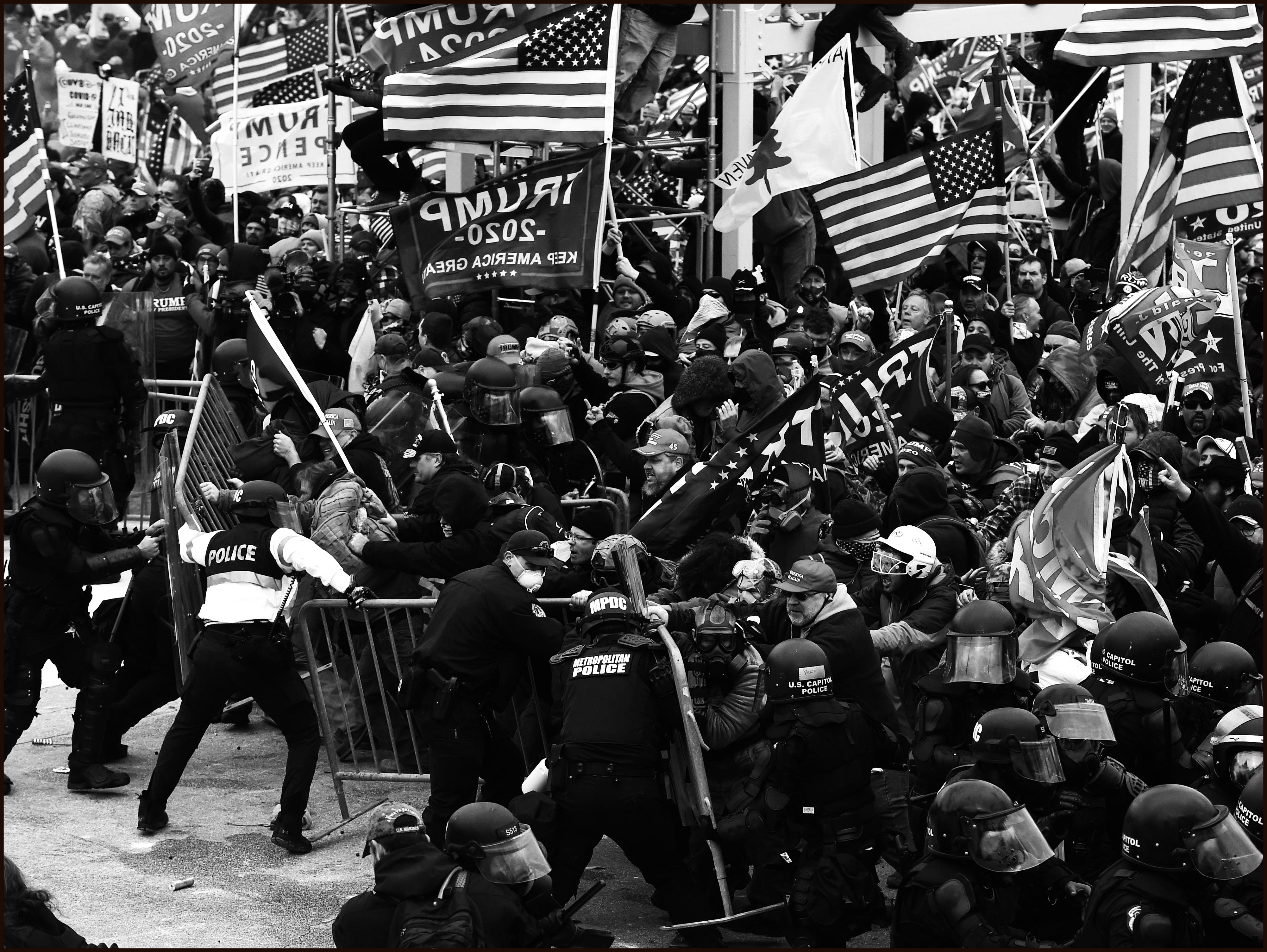
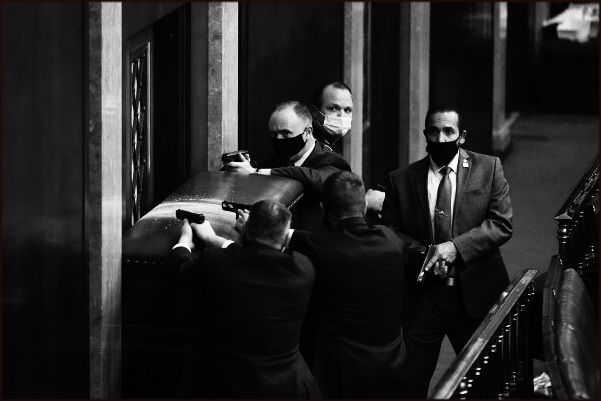
Considering that, in light of the election results, the current AG's office has decided to put the brakes on its special counsel's investigation and on the charges against Donald Trump for leading an insurrection and seeking to illegally overturn the results of the 2020 election, and his gross mishandling and illicit hoarding of highly-sensitive classified material—as if none of it ever happened—and with the 34 felony counts on which he has already been convicted being utterly ignored because he now has a get-out-of-jail-free card, not to mention his promise to weaponize the new AG's office as a tool to take vengeance on everybody he has a grudge against, the US can pretty much kiss the concept of “the rule of law” goodbye. And without the rule of law, a country and any autocrat running it become, in a word, "lawless".
Veteran newsman/traveler/writer Dan Newland comments from a maverick's viewpoint on global affairs, people and places, and on political and social issues affecting North America, South America and the world.
Sunday, November 24, 2024
Monday, November 18, 2024
TRUMP, THE GOP, AND THE MORLOCK FACTOR
In 1895, when he was twenty-nine years old, the “father of science fiction”, H.G. Wells, celebrated a couple of major events. Having left his first wife—his cousin Isabel, whom he had married four years earlier—he was re-married to his former student, Amy Robbins, and then, he promptly published his first work of fiction. It was a novella that he titled The Time Machine. It was that book that made him decide to become a serious writer. Fifty more titles would follow before his death in 1946, a number of them in this genre known today as sci-fi.
While The Time Machine is seen by
sci-fic buffs mostly as an early reference to time travel and to the dream-adventure
of being a time traveler, it is also, on a deeper level, a darkly dystopian
story about class struggle and culture wars. Wells pictures the far distant
future—802,701 AD—as a place that, on the surface, appears idyllic, a land of
peace, love and plenty. But it is also a world that belies a dark and dangerous
secret. That world is, of course, visited by the protagonist of the story, a Victorian-era English scientist known only
as the “Time Traveller”.
The Time Traveller tells his academic colleagues that he has built a machine on which one can literally travel into the future. The machine moves through time rather than space and can take one to the same spot on which it stands at any point time. He carries out his experiments in time travel privately. He sits in the strange machine, throws its levers and, voilà, the images of future times pass by his sides in a blur, his home and laboratory collapsing and being replaced by a sometimes frightening, sometime inspiring landscape.
When the Time Traveller sees the most attractive landscape of all, a lush, green, Garden of Eden-type image in that far-distant future, he activates the machine’s levers again and stops. It is indeed a beautiful, almost heavenly place.
![]() |
| H.G. Wells |
Long story short, the Time Traveller comes
across a small civilization in the forest, a people Wells calls the Eloi. They
live in a benign climate and seem not to have a care in the world. They are
immune to stress and are unencumbered by intellectual curiosity or cultural
development. They are just content to live in this beautiful place, this Eden, in
small peaceful villages. It is a place of love and beauty, where the
inhabitants apparently want for nothing, a place ostensibly untouched by
violence, in which they live entirely on the plentiful fruits that grow
everywhere.
The Time Traveller is introduced to this
idyllic humanoid non-culture by a beautiful Eloi named Weena. He quickly
becomes infatuated with her but knows he will eventually have to return to his
world. He toys with the idea of taking Weena back with him to his own era. But
when he hikes back to the place where he has hidden his time machine, it is
gone. In searching for it, he enters one of a number of strategically located, deep
dry wells, and it is there that he encounters the cave world of the Morlocks.
The Morlocks are a simian-like race which, on the one hand, is in charge of
maintaining all of the underworld machinery that creates the heavenly
environment in which the Eloi blithely live, but, on the other, depends on the
flesh of the Eloi for its own survival.
Never has the gist of the social principle
involved been better explained than by actor Gary Sinise in the 1996 film, Ransom. Sinise plays the part of a rogue New York
City police detective, Jimmy Shaker, who has formed an underground gang that
kidnaps and holds for ransom the young son of multimillionaire airline owner
Tom Mullen (Mel Gibson). Mullen decides to ignore FBI protocol and pay the
ransom Shaker’s gang is demanding. He has gone to great lengths to lose his FBI
tail and is going alone to the meet. As
then scene opens, he is receiving instructions by car phone from Shaker as he
drives.
![]() |
| Shaker tells Mullen about Morlocks |
Det. Jimmy Shaker:
[talking as they are both driving in separate cars and out of sight of one another]
You a movie fan, Tom? Ever seen that
movie, The Time Machine?
Tom Mullen:
No.
Det. Shaker:
It’s the land of
the future, right? There are only two kinds of people left in the world now,
the Morlocks and the Eloi…
Mullen:
Okay.
Det. Shaker:
The Eloi, they live above ground... they wear togas, they're all blond. They
eat grapes and shit like that. It’s like the Garden of Eden out
there, I mean basically everybody just plays around.
Mullen:
How do I get my boy
back?
Det. Shaker:
The
Morlocks, they live underground, all right? Big hairy ugly suckers, like
you wouldn't wish on an ape. Down there with all this machinery,
they're doing all the labor, they're making sure that the Eloi have enough food
and togas...
Mullen:
Are you gonna
answer me?
Det. Shaker:
Oh, great deal if you are an Eloi, right? There’s only one thing—every
once in a while, a Morlock comes up to the surface and snatches an Eloi, takes
him down there...
Mullen:
All right, I’m done driving until you tell me what I want to know!
Det. Shaker:
The Morlocks, they
don't eat grapes... They're cannibals. They eat Eloi. So when I think of The
Time Machine, it kind of reminds me of New York City, you know? See, you’re an Eloi. You and all your friends walking
around like zombies with no fucking idea of the shit going on down below. So…does
this make me a Morlock? I don’t like to think of myself like…(pauses) I
guess it does. And every once in a while, one of you gets snatched.
Chilling.
But, okay, so why am I telling you this
story about H.G. Wells, and Mel Gibson, and Gary Sinise, and the Eloi and the
Morlocks, and all that?
Well, because, in a sense, we’re living
it. And we’re living the chilling plots of a lot of other dystopian novels as
well. The story just struck me when I was trying to explain our current climate
to myself. And I can’t promise it will be the last time I’ll make references to
the clairvoyance of dystopian writers. Indeed, I can guarantee you that
I will be referring to other such stories, because a number of them are coming
true, all at once, right before our eyes.
But for today, let’s look at the evidence
for this comparison.
Prior to January 6, 2021, the Republican Party—or at least the most traditional segments of it—still had the deluded notion that the party belonged to them. Indeed, many in the GOP leadership felt that they were using Trump. They, like many Americans, thought the checks and balances, so carefully crafted into the Constitution by the framers, would take care of any populist authoritarian tendencies Trump, or any other candidate, might have. They trusted a long and, until then, sacred history of democracy and tradition, of separation of powers. They trusted in the peaceful transfer of power that had always characterized the American way of life and of politics.
They were slow learners and believed their
own nonsense about Trump having a peculiar way of talking, but that it was “just
his style.” They still thought of him as, in the end, rational and, in spite of
everything, innately American. They ignored the fact that he referred to neo-Nazis,
white supremacists and anti-American “militias” as “very fine people” or that
he had told the Proud Boys to “stand down and stand by.” They didn’t find it
the least bit insane that he talked about biker gangs as having his back. Or
that he had repeatedly hinted that martial law was a presidential option.
As members of Congress, they had, they presumed, the frying pan by the handle. They were willing to go to unusual lengths to win elections. Even to that of allowing a man known to be bereft of conscience, principles, honesty, sincerity, government experience, ethics, scruples or historical and political knowledge (a man known more for being crafty than for being intelligent) to represent them—as long as he brought his sizable following with him. Besides, if things did go awry, it would be the Democrats on the receiving end, and hey, who cared?
They thought of the MAGA folks as an amorphous if critical mass of unsophisticated votes. They had that in common with the Democrats. It was that attitude, by both parties, which permitted the rise of Trump and MAGA. Trump and his team got it. They were strategic. They simply played on the fact that there was a very large segment of the population that would follow this reality show host and grifter no matter where he led them—an ignored and disenfranchised segment who feared becoming even more invisible in the future, and who were willing to follow anybody who could come along and convince them that he was going to take vengeance for them, that he was a superhero, and that he was going to blow it all up. They were mad as hell and weren’t going to take it anymore. The GOP leadership didn’t understand what made those people tick—Trump did—but they knew there were a hell of a lot of them and that Trump could bring their votes to “the party”.
But then, Trump lost. Just as he had lost
the by-elections for the party in 2022. In
the face of that defeat, a large part of the Republican elite was thinking that
they’d had four years, and the loss was bad for the party, but maybe now they
could take the party back from this guy and send him home. There was just too
much drama with him in government. Surely, in the end, he would accept the
election result, come to heel, follow the long-held democratic tradition, shake
hands with the victor and go home. For good.
Not Donald Trump. He kicked and screamed and fought and shouted fraud. He disputed the election results in the courts, and when his campaign’s cases were found to be without merit, when his own attorney general said there was no fraud, he sought to pressure state officials, anyway he could, to rig the results and snatch the victory out of his opponent’s hands. He falsely accused poll workers and voting machine makers. He stubbornly refused to concede, and tried to get his own vice president and MAGA members of Congress to back up his story of a rigged election and refuse to certify the election results. And when none of that looked as if it would be enough to return him to office, he scraped the bottom of the lowest reaches of his movement for the most violent elements he could find.
In other words, Trump gave his very own
Morlocks permission to rise up from the dark, disenfranchised, violent
underworld. And this time they had permission from their leader—indeed, for
many, from their god—to remain on the surface and to wreak havoc. Their mission
was to devour the Eloi in Congress. And it was on that day that fat, complacent,
millionaire Republicans, perennials in Congress, realized for the first time that
when the crap hit the fan, they too were in the line of fire. Being an Eloi
wasn’t exclusive to their political opponents. They too were Eloi, and the
Morlocks were coming for them.
That was the day that the GOP officially
ceased to exist and became the Party of Trump. Despite pseudo-patriotic
speeches by the traditional old white guys in the former Republican leadership
(clearly, they were no longer in charge no matter what their nameplates said)
about how this was the last straw, and they were done backing Trump, in their
frightened arrhythmic hearts, they realized that Sergeant Jimmy Shaker was right: They were Eloi. Them
and all of their fat, privileged, entitled friends, “walking around like
zombies with no fucking idea of the shit going on down below.” And in a matter
of hours, they had all changed their soiled trousers, and their tunes, and were
kissing the ring of their new party leader.
It was a Morlock-eat-Eloi world, and, clearly, if you were in the Party of Trump, you were either with him all the way, or the Morlocks were dragging you down to the underworld for lunch.
Sunday, November 10, 2024
DEMOCRACY'S LOSS: AN ELECTION POST MORTEM
More than forty-eight percent of Americans who bothered to cast votes in the presidential election last Tuesday are in varying stages of shock, mourning, anger and dismay. And yes, the US remains pretty much a fifty-fifty country in terms of the split between those backing Donald Trump and everyone else. This was clearly a punishment vote against the Biden administration and in keeping with people’s perception (as opposed to the actual fundamentals) of the economy. But it was also, I can’t help thinking, about racism and sexism.
That said, this was obviously no ordinary
election between two normal everyday candidates with somewhat different points
of view about policy. This was, and remains, the most consequential election
since the Civil War, when democracy triumphed over sedition. Unfortunately, the
result is just the opposite this time. The candidate placed in charge by the
will of the majority is a man who violated the Constitution, sought to subvert
a former electoral process and refused to submit to a peaceful transfer of
power—for the first time in American history. Obviously, with the backing of a
hijacked Republican Party, he is now being rewarded for his consistently bad
behavior. And you can bet that these next four years will be even worse than
anything we have ever seen from him before. Be advised: It will cost democracy and
Americans dearly.
But perhaps democracy isn’t anything the
majority cares about any more. This was, unquestionably, a free, fair and
democratic election. But the result has placed a repeatedly confessed autocrat
in charge. So, maybe this will be the last free and fair election the United
States ever has.
Perhaps people just care more about the
price of gasoline and eggs than they do their inalienable rights. Maybe they
care more about controlling what other people do with their bodies and whom
they love than they do about guaranteeing individual rights (everyone else’s,
but, in the end, their own as well) and the sanctity of the rule of law. Maybe
they care more about their children’s “education” being based on their own
subjective “beliefs” than they do about their learning the proven facts and
science of how the world and the beings and systems in it function. And almost
certainly, it is more important to them to have a white male chauvinist in
charge, no matter how morally and ethically flawed he might be, than to embrace
the sexual and ethnic diversity that is, whether they like it or not, the
United States of America.
That said, each person votes his or her
conscience, or, perhaps, better said, his or her immediate to short-term
convenience, and that is the general idea behind representative democracy—even
when the outcome may well damage democracy beyond repair. What the majority
seems to have failed to do in this case is vote with the future of the US as we
know it in mind.
A survey run by the Associated Press seems
to bear this out. While six in ten of the one hundred twenty thousand people
surveyed indicated they were fearful of what Trump might do in a second term
with no guardrails, many of them said they were voting for him anyway. Indeed,
more than half indicated that, while they were hoping to keep drama to the
minimum, they were also bent on seeing substantial change in the way the
country was being governed. More telling still, three out of ten—not coincidentally, I
surmise, about the proportion of the population made up of Donald Trump’s most
fanatical cult-followers—said they were hoping to see “total upheaval” in the
way the country is run.
But from a strictly liberal independent
viewpoint, there’s a lot of accountability to go around for Tuesday’s
presidential election outcome. And here, I take full responsibility for the
theories that I’m about to posit. They are, indeed, mine, and the product of my
own critical thoughts and ponderings.
![]() |
The person most to blame for this
election outcome is Joe Biden.
From the outset, after snatching the primary from a highly competitive Independent, Bernie Sanders, Biden had said that he would be a transitional leader. And
yet, he failed to seize propitious opportunities to make it clear that he would
be a four-year president. Many in his party insisted that he was “the only
Democrat who could beat Trump” (again). In hindsight, that belief on their part
was exactly that, “a belief” with no real basis in fact, since, by the
midterms, his popularity was already languishing, and by shortly afterward,
very real concerns were arising about his physical fitness and his mental acuity.
The mid-terms, or slightly thereafter, would have been the time for him to
announce that he wouldn’t stand for another term, thus permitting the party to
run a primary race and establish a public consensus for choosing a candidate. I
blame both the party and First Lady Jill Biden for pushing him to go for
another term when both she and the party leadership couldn’t help but see,
early on, what became public knowledge during the president’s absolutely
disastrous performance in his only debate with Donald Trump.
But still, even after that, he dragged his
feet, hunkered down and refused to go until the party made it clear that he had
to, for the good of the movement. To his credit, he resigned the race with
patriotism and understanding. But it was too little, way too late.
The Democratic Party basically threw
Kamala Harris to the lions. Democratic
leaders sent her on a kamikaze mission, on which, it must be said, she did
incredibly well. Indeed, putting aside the perennial vagaries of a controversial Electoral College system, Harris has swept better than forty-eight percent of the popular vote with little left to report. This was true despite the inescapable handicap of being an
incumbent VP, who had to try to convince people that she was her own woman
without challenging the authority of her boss or disavowing any of his
policies. A VP with the character of a Donald Trump would have thrown the
president under the bus during such a campaign. It speaks very highly of her
ethics and respect for the office of the presidency that she refused to do that.
But apparently, in today’s world, ethics are a liability that costs one dearly.
Women and minorities must live with
the fact that they voted against their best interests.
Or didn’t vote at all.
Democrats and, in particular, Joe Biden, have generally done well with African
American voters. In Biden’s case, this is not only because of his career-long
work in the field of civil rights and justice, but also because he was vice
president to the country’s first black president—and one of its most popular
presidents in US history. Black voters were a big help to Biden in defeating Trump
in 2020.
But that trend didn’t carry over to this
race. At least not with men. Despite the fact that Kamala Harris would have
been the second black and first woman president of the United States, Trump
managed to double his support among African Americans this time around. It
appears that this was due, almost entirely, to young African American males
trending toward the so-called “bromance”—men’s preference for a flawed old
white guy over a woman, and especially a black woman—that the Trump campaign
enjoyed.
In other words, a large contingent of
black, and especially young black, men preferred to vote for an aging white man with questionable mental acuity, and with provable ties to and sentiments toward white nationalist and white
supremacist groups than to vote for a dynamic woman of color of a younger
generation who clearly had their best interests, their history, and their
struggles in mind. I can only conjecture that this is a question of sexism, the
choosing of a male, even against their better interests, over an empathic
female. Perhaps many of these black male voters (along with their fellow white
bromance voters) cast their ballots in a conscious effort to ensure that women,
their women, were not further empowered or inspired to greater militancy
in favor of women’s causes. Perhaps the Handmaid’s Tale nature of Trumpian
politics and its goal of very apparently disenfranchising women seemed
appealing to them. Indeed, they may well have liked the idea of “protecting”
women “whether they like it or not.”
But they weren’t the only ones voting against their better interests. Trump
made significant gains as well among Hispanic voters. Part of that was, of
course, based on fears fueled by the Trump campaign of a sharp swing toward the
left. A segment of Latino voters, made up of the Hispanic diaspora from
so-called “socialist” countries such as Cuba or Venezuela are vulnerable to
buzzwords like “socialist”, “communist”, “leftist”, etc. That’s understandable.
Their families suffered hunger, penury, prison and torture in countries
claiming to be socialist.
It is very hard—believe me, I’ve tried—to get
people from those origins to focus on the success of liberal politics throughout
the West. Theirs is a kneejerk reaction that knows no middle of the road. Left
is bad. Right is good. They often fail to understand, for obvious reasons, that
the Castros, Hugo Chávez and Nicolás Maduro were never socialists. They were
always totalitarians, dictators, despots who wrapped themselves in a red flag,
in the same way that other former Latin American strongmen like Paraguay’s
Alfredo Stroessner, Chile’s Augusto Pinochet or Argentina’s Jorge Rafael Videla
wrapped themselves in the flag of capitalism and Western Christianity. So those
folks are pretty much always a lost cause for Democrats.
But this time, Harris bled votes among
other Hispanic populations as well. And particularly among Hispanic males. Why
did so many Latinos break with the Democrats? A number of pundits seem bent on trying
to convince us that, “It’s the economy, stupid.” But having my own hands-on
half-century of insight into Latin America, I think it’s more than that. The
economy may be a factor, or at least an excuse. But I can’t help thinking that much
of the shift came when it became clear that the Democratic candidate would be a
woman. In other words, never underestimate the power of machismo among
Latin males.
Meanwhile, the “macho man” to whom they
lent their support is the same one who has referred repeatedly to Latin
Americans pejoratively—with the latest offense being a reference from his campaign (which he failed to chastise) to Puerto Rico as a “a floating island of garbage”. But this was nothing new.
Trump has long generally referred to Mexican migrants as “rapists, criminals and
drug traffickers”, and to Hispanic migrants in general as coming from “shithole
countries”, and as “poisoning the blood of our nation.”
Under his first administration, Hispanic migrant
families were separated at the border, children were caged and later put into
foster care in far-flung regions of the US. Significant numbers of those
children were simply lost by the administration, and even after being
deported, it took some of their desperate parents months to be reunited with
those kids.
Now, one of Trump’s major campaign
promises is that “from Day One” he will mount the “largest deportation operation
in the history of the United States.” The president-elect has vowed that he
will deport a million people—the great majority Hispanics. Experts say that to
reach that massive number, the next Trump administration will necessarily have
to go after people for whom Kamala Harris supported providing a path to
citizenship. That is to say, people who have long been established in the
Unites States and have been making a useful contribution to American society.
Among others, this would include the so-called “Dreamers”—people brought to the
US by their migrant parents when they were still infants or children, and who
have basically spent their entire lives in American society, but who never had
American citizenship or visas.
What a critical mass of Latinos for Trump
have voted for, then, are situations in which members of their communities,
their friends, their relatives, will face the tragedy of deportation, no matter
how long they have lived, worked and thrived in American society. Their votes
have given Trump a weapon that he will turn on people they know, people with
whom they share cultural and ethnic ties, even people they love.
They share this dubious distinction with a segment of the Muslim community that could think of no better way to protest the admitted lack of decision by the Biden administration in taking Israel to serious task for its genocidal military operations in Gaza. In other words, Muslims who “punished” Harris—who had made it clear that her administration would take a new tack regarding the Israeli-Palestinian war, and that she would push for a two-state solution—did so by helping elect Israeli leader Bibi Netanyahu’s closest American ally, and a man who initiated his former administration, in 2016, by declaring “a complete and total ban” on Muslim immigration to the US. A ban that remained in place until Democrats sued, taking the issue all the way to the Supreme Court, where it was finally shot down.
Latinas, meanwhile, let her down. Although
Harris still got a traditional Democratic majority of Hispanic women’s votes,
she did so by about five percentage points fewer than Joe Biden did in 2020.
In such a consequential election for women’s rights and Latin American migrant
families, this outcome can only be seen as illogical and counterintuitive. Did
that sliver of Latinas simply join their male partners in defecting to Trump?
It seems likely, but we’ll never know.
White women are quite often split fifty-fifty in American elections between Republicans and Democrats. But again, this was no common everyday election. This was an election that would have given women their first president in history. Nor was that the only consideration. The female candidate in question is a campaigner for women’s rights, an advocate for the reproductive rights of which women have already been stripped by Trump, who has repeatedly bragged about doing so. More shocking still, Trump improved his election performance this time around young white women, the ones with the most to lose in the future from an administration bent on sending women back to the dark ages of nineteen-fifties American sexism.
Blame must also be laid at the door of
women who, at least in such a consequential election for their own interests,
simply didn’t get off their couch and go vote. In what is a decidedly apathetic
electorate, in which a sixty-six percent turnout is considered “a great success”,
if non-voting women were ever going to vote, this should have been the year.
Well, in this election, roughly ninety-nine million potential voters just couldn’t be bothered—even when absentee and mail-in
voting makes it possible to cast a ballot from the comfort of one’s own home. Of
those, it’s safe to say that roughly half were women. And, logically, half of
those were very likely liberal-leaning, if not potential Democrats. That means
there were probably well more than twenty million Democratic women’s votes that were
withheld. Even a fraction of those would have provided for the razor-close race
the US was supposed to have had. Half might well have handed Kamala Harris a
resounding victory despite the Electoral College. But those women simply could not be bothered to do their
part.
This is a man who has demeaned and insulted women in every way possible, a court-certified sexual predator. One who had to pay millions of dollars in damages to a woman he sexually assaulted and later libeled, one who paid a hundred thirty thousand dollars to a porn star so she wouldn’t talk about their one-night stand, and, in the process of doing so, committed thirty-four felonies. The same guy who said, of young women in beauty pageants that he sponsored, that he could do whatever he wanted to them, even “grab them by the pussy,” because “he was a star.”
But these haven’t been the only occasions
on which he has shown his contempt for women. Among other things, he has said:
-
“If Hillary Clinton can’t
satisfy her husband what makes her think she can satisfy America.”
-
To a female contestant on
his show, Celebrity Apprentice, three years before he took office, “It must be a pretty picture, you dropping to
your knees.”
- Of himself, "All of the women on The
Apprentice flirted with me — consciously or unconsciously.”
-
Of then-Fox anchor Megyn Kelly
when she was a debate moderator and took him to task, “You could see there was
blood coming out of her eyes. Blood coming out of her wherever.”
-
Of his 2015 Republican primary rival
Carly Fiorina, “Look at that face! Would anyone vote for that? Can you imagine
that, the face of our next president? I mean, she’s a woman, and I’m not supposed
to say bad things, but really, folks, come on. Are we serious?”
-
And once again, to shock-jock Howard Stern, “A person who’s flat-chested is very hard to be 'a ten', OK?”
This is the man who packed the Supreme
Court with radical right-wing justices strategically placed there to overturn a
half-century-old legal precedent that gave women control over their own bodies and their reproduction rights, and got the government out of their bedrooms and marriages. A man whose own
wife regularly refuses to appear in public with him. This is the man women
voted for over a female candidate with nothing but empathy for their struggle
and their causes, one who had promised to fight for them against a far-right plan
(Project 2025) to introduce a process that defies the bounds of dystopian
fiction.
All I can say is, congratulations! If Trumpian women’s goal was to place their own basic interests directly in harm’s way, you couldn’t have chosen better.
Monday, November 4, 2024
TWO CHOICES, TWO WORDS: INSIDIOUS OR INSIPIRING
As the campaign cycle draws to a tense
close, with only a few hours remaining before election day, the two presidential
candidates have provided voters with messages that are as clearly contrasted as
night and day. I should start by explaining to my Republican friends that this
is not a news story. It is an opinion piece, in which I am stating my
position and observations as clearly and honestly as I can, unfettered by any
editorial line. I am an independent observer and writer, beholden to no editorial
board or party line. And speaking in pure umpirese, “I calls ‘em like I sees ‘em.”
The only thing I have to gain or lose by
sharing my outlook is the off chance that I it might, in some small way, prompt
someone undecided to make what, for me, is the only appropriate decision. Or,
at least, to give some thought to the points I make.
Other than that, this essay, like all
others that I write and share, is a way of logically coming to grips with my
own doubts and fears. It is a vehicle for ordering my own thoughts, of
accumulating information and seeking to distill it into knowledge, and of achieving
what I feel to be a reasonably educated opinion.
That said, though it pains me a little to
admit it, I’m almost grateful to Donald Trump for his campaign performance
during these final days before elections. My gut feeling is that he has done
more in a few short days to swing women and undecided voters toward Harris than
all of the spin-masters working for the Democratic campaign put together. He
has, in short, done everything he could to underscore everything that has gone
into the formation of an enormous body of never-Trumpers, which now includes a
not insignificant number of Republicans and Independents. He has even convinced—as
indicated by most recent trends and polling—many who have never voted Democrat,
never voted for a woman, and never voted for a minority, that there’s no responsible
choice in this historically consequential election but to hold their noses and
vote for Kamala Harris.
Faiz Shakir, former campaign adviser to Bernie
Sanders for the 2020 Democratic primary campaign, stated it most succinctly.
According to him, Trump has “focused on die-hards and the likely-to-be-inclined”—in
other words, the fawning MAGA crowd who unconditionally stroke his
pathologically oversized ego. “For anyone who didn't like the behavior, conduct
and management of his last presidency,” Shakir continues, “he gave them
nothing."
Indeed, in these last days of the run-up
to Election Tuesday, Trump has given all but his most fanatical supporters less
than nothing to cling to. Just to recap, his final rallies and statements
before the election have been a litany of lies and complaints about the
election he lost (and still doesn’t concede he lost), suggestions that
he should have “stayed in office” in spite of that clear loss, rampant conspiracy
theories about fraud in an election that has yet to take place, and insults and
threats to his opponent and her supporters.
As if that were not enough, he has doubled
down on, and vastly expanded, the kind of violent rhetoric that he has used and
promoted since he first ran for office in 2016. The freshest of these violence-laden
messages happened Sunday at a Pennsylvania rally when he suggested he would be
okay with members of the campaign press corps being shot. (He apparently has “having
people shot” on the brain lately). Specifically, he said, “I have this piece of glass here but all we
have really over here is the fake news, right? And, to get me, somebody would
have to shoot through the fake news. And I don’t mind that so much, coz…I don’t
mind, I don’t mind that.”
Last week at a Wisconsin rally, Trump ranted for a full four minutes about his
mic. He talked about "knocking the hell, out of the people backstage” who
had given it to him. He also called the organizers/workers “stupid”. Then, complaining
that the microphone was “too low, too low,” he started pretending to have oral
and manual sex with the mic stand. I mean, his acting was quite good in this
case, so there was no doubt about what he was mimicking, even if he later
claimed he was pretending to “eat a corndog” (and speaking of dogs, this lame
explanation is sort of like, “the dog ate my homework”).
Earlier, he vented his fury against
staunchly conservative Republican Liz Cheney for putting country before party
and supporting Kamala Harris. He ranted about Cheney’s being “a war hawk” and
suggested she should be facing “nine (gun) barrels pointed at her face.” Trump
supporters immediately started scrambling to spin what we all heard—and, even
though it came from Trump, were shocked by—saying that the statement was taken “out
of context.” Apologists claimed that what he meant to say was that if
she were a “war hawk”, she should be sent into battle and have to face gunfire “the
way our troops do.” But that simply doesn’t wash, because there is no
appropriate or didactic context in which a politician can suggest that an
opponent—whether from their party or any other—should have guns pointed at his
or her face.
I’ve asked Trump Republicans—rhetorically,
of course—and ask them again now, if Liz Cheney were to say that, Trump, because
of his behavior in the January Sixth Insurrection (2021), is a traitor to his
nation (which, as a key member of the J-6 Committee investigative team, she
very likely believes), would they, in all fairness, find it acceptable for her
to say that he should face a firing squad? And would “context” be considered an
acceptable justification for her saying it if she did? In other words, what
sort of righteous outrage would we have had to listen to from Trump supporters
if Cheney had suggested gun violence against Trump instead of the other way
around?
There have been numerous other instances
of violent rhetoric from Trump in the run-up to tomorrow’s election, but I rest
my case. Suffice it to say that words matter, and especially coming from
a perpetually angry cult leader like Donald Trump. Words not only matter, they also
spark deeds. Just ask the one hundred forty police officers injured during the
January Sixth Insurrection at the Capitol Building, or the family of the one
who died at the hands of Trump’s rioters. Ask relatives of the Trump supporter
who was shot to death seeking to breach the congressional chamber, where
members of Congress were cowering in fear for their lives. Ask, as well, stateswoman
Nancy Pelosi and her husband whose lives were ruined when a crazy Trump
supporter, pumped up by his cult leader’s violent rhetoric, broke into the
Pelosi home, hoping to find the Speaker and kill her, but instead settled for
beating her spouse’s skull in with a claw-hammer.
Trump is also telling people, in no uncertain
terms, that he plans to be a dictator. All you have to do is listen to the
not-so-subtle dog whistles. In these last days of the campaign, in practically
the same breath in which, for the umpteenth time, he suggested that former Speaker
of the House and former House Majority Leader Nancy Pelosi and Adam Schiff were
“horrible people”, Trump told a crowd that he would be going after his enemies
if he became president. And he added that he might very well use the National
Guard “or even the military” to do it. He also suggested he would go after “disloyal”
(to him) general officers within that military, including decorated generals
like John Kelly, who was once Trump’s closest adviser, and now, based on his
experience with him, describes the former president as “a fascist.” Or like
General Mark Milley, who was the head of the Joint Chiefs of Staff under Trump—and
may very well have successfully kept the ex-president from slapping the US under
martial law and ruling by decree.
For someone like myself, who has not only
lived through but actually had to survive a military dictatorship, as an
opposition newsman and foreign correspondent in Argentina during the
nineteen-seventies and eighties, these words are chilling. Not only that, but
they also underscore what I’ve been warning about in the US since the turn of
the century. Namely, that giving ever-increasing power to the Executive Branch—as
has been happening since the Reagan Era—is dangerous, and has a cumulatively
pernicious effect. I warned long before Donald Trump reared his ugly head, that
while strong central government might seem attractive when people want someone
to “keep them safe” and when those holding the power act judiciously and
wisely, it only takes one despot, one madman, to abuse that expanding power and
end up overthrowing the existing order.
In case some of you haven’t noticed, that time
is here! Donald Trump is that despot, that madman, and he has already proven
that he is perfectly capable of seeking to hold onto power by force. Our checks
and balances, the guardrails that maintain the division of powers, managed to
hold in 2020, when, for the first time in history, a president refused to
uphold the peaceful transfer of power and sparked an insurrection to try and
remain in power, despite certifiably failing to win a free and fair election.
The guardrails held, as I say, but only barely. And only because there were a
handful authentic small-d democrats who defended them—then-Vice President Mike
Pence, House Speaker Pelosi, Congressman Schiff, former Republican Senate
Leader Mitch McConnell, some (but certainly not all) members of Congress, and,
with uncommon courage and resolve, the Capitol Police, among others.
But it seems clear as day to me that American
democracy, the two-and-a-half-century-old experiment dreamed by the framers of
the Republic, simply will not survive another term of the Trump Era. While we
have whistled in the dark for the past four years after experiencing the most
consequential interruption of representative democracy since the Civil War, and
pretended that everything is okay, it is not. The Trump Era has done grave
damage to the fabric of the Nation. It has weakened the floor of our democratic
institutions, cast fabricated doubt on our election process, born false witness
against Trump’s opponents, and divided Americans as they have never been
divided since the Southern slave states declared their rebellion against the
Union in 1861.
In the closing of her campaign, Vice
President Kamala Harris’s message could not be more distinct from her opponent’s.
While Trump’s campaign has been dark,
seeking to picture the US as a horrible, dangerous place that only he can fix—and
only do so by force—Kamala Harris’s rallies have been upbeat, buoyant, and full
of positive visions for the future. The enthusiasm has been electric and the
crowds huge—despite Trump’s attempts to dismiss them as “fake news”.
Harris’s points have been clear and easy
to understands. She has aptly described Trump as “a petty tyrant”, adding that "These
United States of America, we are not a vessel for the schemes of wannabe
dictators. The United States of America is the greatest idea humanity ever
devised."
"America, we know what Donald Trump
has in mind,” she said. “More chaos, more division, and policies that help
those in the very top and hurt everyone else. I offer a different path."
Appearing to speak to still undecided
voters, the vice president said, "This is not a candidate for president who
is thinking about how to make your life better. Donald Trump has spent a decade
trying to keep the American people divided and afraid of each other. That is
who he is, but America, I am here tonight to say that is not who we are."
She pointed out that while Trump
consistently threatens and demeans his opponents, "I don't believe people
who disagree with me are the enemy. He wants to put them in jail. I'll give
them a seat at the table."
Reminding voters of the support she has
received from Liz Cheney and other Republican politicians, as well as of some
two hundred thirty former Trump administration officials who have vowed to vote
for her, she added, "We have to stop pointing fingers and start locking
arms. It is time to turn the page on the drama and the conflict, the fear and
division. It is time for a new generation of leadership in America."
Harris has also shown a kind of humility
that marks another stark difference with Trump. She has told more than one
audience, "I'll be honest with you. I'm not perfect. I make mistakes. But
here's what I promise you. I will always listen to you. Even if you don't vote
for me. I will always tell you the truth, even if it is difficult to
hear."
It seems to me, putting aside issues,
policy and governance that will all only take shape when the votes are counted
and the winner is inaugurated, the choice tomorrow, for those who have yet to
cast their ballot, is clear. The Nation can elect a tyrannical narcissist, who has
already demonstrated beyond all reasonable doubt that everything he does is
self-serving and aimed at consolidating his grasp on absolute power to the
everlasting detriment of democracy, the Constitution, and American traditions,
and a man who will alienate the rest of the Western world from America. Or it
can elect a new generation, a forward-looking leader, who will, for the first
time, bring a woman’s vision to the office, who is sincere and inspired in her
patriotic verve, and who will do everything in her power to create social harmony
while upholding justice both at home and abroad.
Today’s the day. Today we choose whether to
advance into the light, or to slip inexorably backward into darkness.